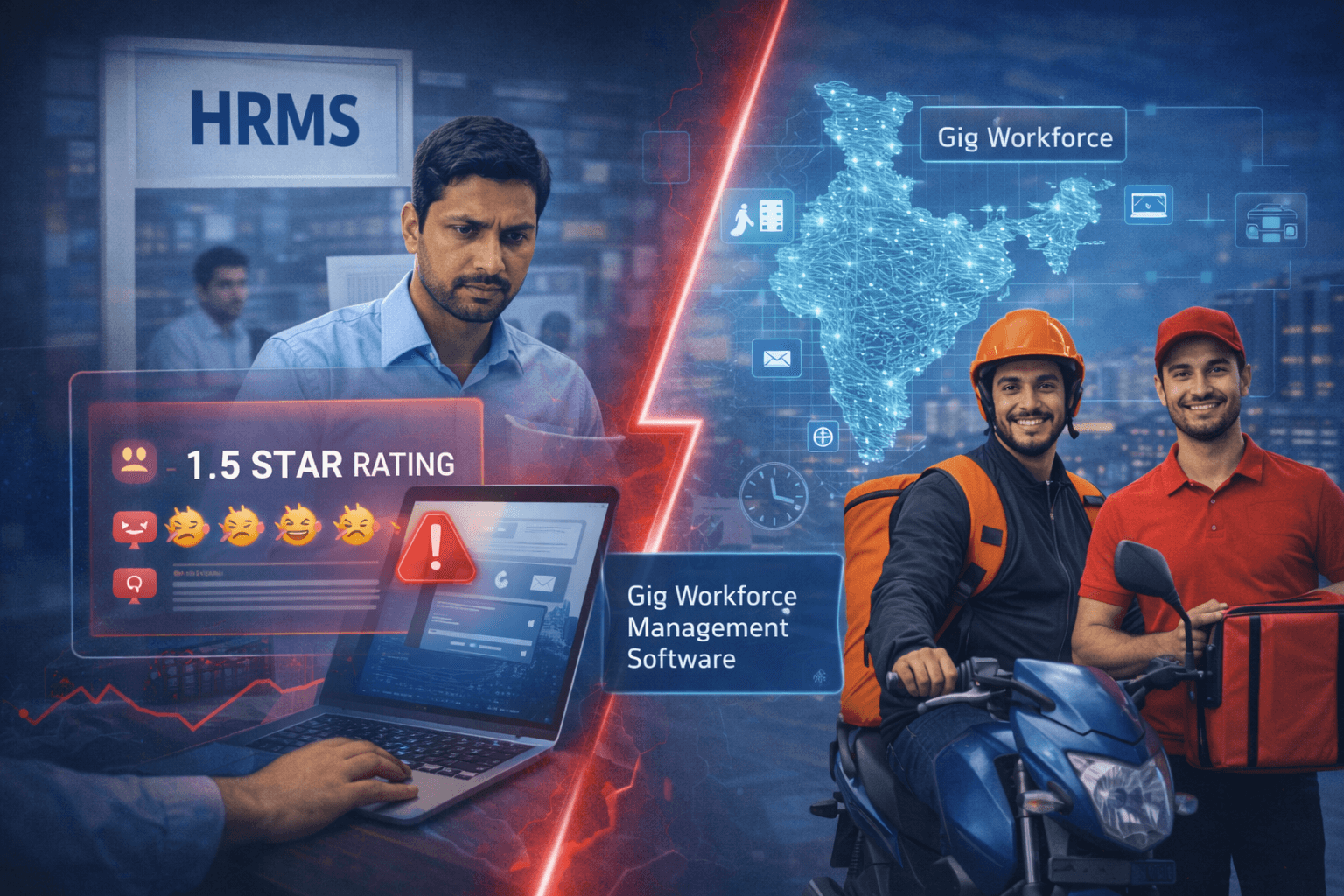
Gig workers need fast onboarding, variable pay, mobile-first execution, and governance under India’s Social Security Code 2026. This blog explains what gig workforce management software is, why traditional HRMS fails due to fixed shifts, rigid salary structures, and compliance gaps, and what a purpose-built platform must handle: work verification, dynamic payouts, UAN mapping, PF and ESI tracking, and audit-ready records at scale.
Introduction
Gig work is no longer a side conversation in workforce management.
It is becoming a core operating model for many industries.
Ecommerce companies use gig workers for delivery, sorting, picking, packing, and peak season operations. Logistics companies use flexible workers across hubs, routes, warehouses, and last-mile networks. Retail brands use temporary and part-time workers during seasonal demand. Facility management companies use distributed teams across client sites. Manufacturing and industrial businesses increasingly use flexible, vendor-supplied, apprentice, trainee, job-based, and task-based workers to support production and service continuity.
This shift is changing how enterprises think about workforce technology.
A traditional HRMS was built for stable employee populations.
It was designed around permanent employees, fixed roles, fixed salaries, standard leave policies, monthly payroll cycles, reporting managers, employee IDs, and long-term employment records.
Gig and flexible workforce models do not work that way.
A gig worker may work for a few hours, a few days, a campaign, a route, a shift, a task, a job, or a season. A worker may be onboarded through a vendor, paid through a variable model, marked present through mobile attendance, mapped to a location for only one day, and moved to another hub the next week.
This creates a very different workforce management challenge.
Enterprises need to know:
Who is available?
Who is verified?
Who is assigned to which job, shift, site, or route?
Who actually reported?
How many hours or tasks were completed?
What should be paid?
Which vendor supplied the worker?
Are statutory and compliance records available where applicable?
Is the worker eligible for payout?
Are there duplicate worker records?
Is the workforce cost aligned with output?
These questions cannot be answered properly through a traditional HRMS alone.
This is why gig workforce management software has become important.
A gig workforce software platform helps enterprises manage flexible workers, vendor workforce, task-based workers, temporary workers, and distributed frontline workers through a system designed for high-volume, high-variance workforce operations.
The issue is not that HRMS platforms are bad.
The issue is that gig workforce management is structurally different from employee HR management.
In 2026, enterprises need to understand this difference clearly.
How HRMS Has Evolved
HRMS platforms have evolved significantly over the last two decades.
Earlier HR systems were mainly used as digital employee databases. They helped HR teams store employee records, manage leave, run payroll, maintain attendance, and generate basic reports.
Over time, HRMS platforms became broader.
They expanded into recruitment, onboarding, performance management, learning, engagement, employee self-service, payroll, analytics, and mobile HR.
For permanent employees, this evolution has been valuable.
A modern HRMS can help enterprises manage:
Employee records
Recruitment workflows
Offer letters
Permanent employee onboarding
Leave and attendance
Monthly payroll
Performance reviews
Employee engagement
Learning and development
HR helpdesk
Employee documents
HR analytics
This works well when the workforce is structured and predictable.
A permanent employee usually has a defined role, fixed reporting manager, stable compensation structure, monthly payroll, standard benefits, leave eligibility, office or site mapping, and long-term employee lifecycle.
But the workforce has changed faster than many HRMS platforms.
Enterprises now manage multiple workforce models at the same time.
These include:
Permanent employees
Contract workers
Gig workers
Platform workers
Temporary workers
Daily wage workers
Piece-rate workers
Job-based workers
Apprentices
Trainees
Vendor-supplied workers
Seasonal workers
Field workers
Part-time workers
This mixed workforce does not behave like a traditional employee base.
A traditional HRMS may still manage permanent employees well, but it may not be designed for high-volume onboarding, rapid activation, flexible deployment, task-based pay, vendor mapping, real-time attendance, location-based controls, and payout readiness for non-standard workers.
This is where the limitation begins.
The future of HR technology is not one system that treats every worker like a permanent employee.
The future is a workforce architecture where different workforce types are managed with the right operating layer.
For permanent employees, HRMS remains important.
For gig, flexible, blue-collar, vendor, and external workers, enterprises need purpose-built workforce management software.
What Is Gig Workforce Management Software?
Gig workforce management software is a platform that helps enterprises manage flexible, temporary, task-based, vendor-supplied, and distributed workers across their lifecycle.
It is designed for workforces that do not follow a standard employee model.
A gig workforce software platform usually helps manage:
Worker registration
Worker onboarding
Identity verification
Document collection
Vendor mapping
Site, hub, route, or job allocation
Attendance management
Task or shift tracking
Productivity tracking
Payout readiness
Payroll management
Compliance management
Worker communication
Grievance handling
Offboarding
Workforce dashboards
Vendor and worker analytics
In simple terms, gig workforce management software helps answer one important question:
Can the enterprise manage flexible workers with the same level of visibility, control, and accuracy that it expects from its permanent workforce?
For many companies, the answer is no until they adopt specialized workforce management software.
Gig workforce software is built for high movement
Gig and flexible workforces have higher movement than permanent workforces.
Workers may join quickly, leave quickly, work intermittently, return after a gap, switch locations, work through different vendors, or participate only during demand peaks.
The system must handle this movement without breaking worker records, attendance, payout, or compliance visibility.
Gig workforce software is built for variable work
Gig workers may be paid based on:
Hours worked
Tasks completed
Deliveries completed
Orders processed
Distance covered
Shifts completed
Attendance days
Piece-rate output
Incentive rules
Campaign-based targets
Vendor-specific rate cards
Traditional HRMS platforms usually assume monthly payroll and fixed compensation structures.
Gig workforce software is built for variable compensation models.
Gig workforce software is built for distributed execution
Gig workers are often distributed across locations.
They may work at warehouses, hubs, stores, customer sites, routes, delivery zones, field locations, or temporary project sites.
The platform must support location-based attendance, geo-tagging, mobile access, supervisor validation, route or task mapping, and real-time visibility.
Gig workforce software is built for operational control
Gig workforce management is not only HR administration.
It directly affects operations.
If workers are not available, orders are delayed.
If attendance is wrong, payouts are wrong.
If task completion is not captured, productivity is unclear.
If worker identity is not verified, risk increases.
If vendor mapping is wrong, billing becomes disputed.
This is why gig workforce software must connect HR, operations, vendors, payroll, compliance, and finance.
Why Traditional HRMS Fails Gig Workforces?
Traditional HRMS fails gig workforces because it was designed around permanent employees, not flexible workforce operations.
Failure does not always happen immediately.
At first, enterprises may try to manage gig workers through HRMS fields, spreadsheets, vendor files, attendance exports, payroll uploads, and manual reconciliation.
This works for a small workforce.
It fails at scale.
Traditional HRMS assumes stable employment
A regular HRMS is designed for employees with long-term association.
It expects stable employee records, fixed roles, reporting managers, salary structures, leave policies, and monthly payroll cycles.
Gig workers are different.
They may work intermittently, accept tasks, work across multiple locations, exit quickly, return later, or operate through a vendor.
This makes standard employee lifecycle workflows insufficient.
Traditional HRMS struggles with high-volume onboarding
Gig workforce operations often require fast onboarding.
During festive seasons, campaign launches, logistics peaks, or retail demand spikes, enterprises may need to onboard hundreds or thousands of workers quickly.
Traditional HRMS onboarding flows are usually designed for permanent employees.
They may not support rapid worker activation, bulk onboarding, document validation, vendor-led onboarding, mobile-first onboarding, or day-zero readiness at scale.
Traditional HRMS does not handle flexible deployment well
Gig workers may be assigned to a job, shift, route, hub, store, facility, or task for a short period.
They may move across locations based on demand.
Traditional HRMS platforms often struggle with dynamic deployment because they are built around fixed location and department structures.
Gig workforce software needs to support:
Temporary allocation
Job-based assignment
Hub-level deployment
Route-level mapping
Vendor-wise assignment
Shift-wise planning
Real-time availability
Traditional HRMS is weak on variable pay
Gig compensation is rarely simple.
It may include:
Hourly pay
Daily pay
Per-task pay
Per-delivery pay
Piece-rate pay
Attendance bonus
Productivity incentive
Peak incentive
Referral bonus
Joining bonus
Shift allowance
Distance allowance
Vendor-specific rate card
Traditional HRMS payroll engines are usually built for monthly salary and fixed structures.
They may not manage dynamic pay rules without heavy customization.
Traditional HRMS may not connect work, attendance, and payout
For gig workers, payout depends on verified work.
The enterprise must know whether the worker actually worked, completed the task, met the attendance rule, and became eligible for payout.
If attendance, task completion, payroll, and vendor billing sit in different systems, payout accuracy suffers.
This creates disputes.
Traditional HRMS does not manage vendor workforce deeply
Many flexible workers are supplied through vendors, contractors, or staffing partners.
A traditional HRMS may store employee details, but it may not manage:
Vendor-worker mapping
Vendor onboarding
Work order mapping
Vendor rate cards
Contractor compliance
Vendor billing reconciliation
Worker-wise statutory proof
Vendor performance dashboards
This creates vendor governance gaps.
Traditional HRMS does not give real-time operational visibility
Gig workforce operations require real-time visibility.
Operations teams need to know:
How many workers are available today?
How many are reported at each hub?
Which routes are under-staffed?
Which workers are pending verification?
Which vendors are short on supply?
Which workers are payout-ready?
Which locations have attendance gaps?
Traditional HRMS reports are often HR-centric and periodic.
Gig workforce management needs operational dashboards.
Traditional HRMS creates manual reconciliation
When HRMS cannot manage gig workforce complexity, enterprises fall back to spreadsheets.
This leads to:
Manual onboarding files
Vendor-submitted worker lists
Attendance exports
Payroll correction sheets
Compliance follow-ups
Invoice reconciliation
Duplicate records
Delayed payouts
Disputes
The HRMS may remain the system of record for permanent employees, but the gig workforce continues to run outside controlled systems.
That is the real failure.
How Gig Workforce Software Differs from Traditional HRMS: Feature Comparison
Gig workforce software and traditional HRMS serve different purposes.
Both may manage people data, but the operating model is different.
A traditional HRMS is employee-centric.
Gig workforce software is work, worker, vendor, attendance, payout, and compliance-centric.
Capability Area | Traditional HRMS | Gig Workforce Management Software |
Core design | Built for permanent employees | Built for flexible, gig, vendor, blue-collar, and external workers |
Workforce model | Stable employment lifecycle | High-volume, high-movement, task-based or shift-based workforce |
Onboarding | Structured onboarding for employees | Fast, mobile-first, bulk, vendor-led, and high-volume worker onboarding |
Worker identity | Employee record and documents | Worker identity, duplicate checks, document capture, verification, vendor mapping |
Deployment | Fixed location, department, and role | Dynamic site, hub, route, task, shift, vendor, and work order allocation |
Attendance | Standard attendance and leave | Attendance by shift, location, route, task, geo-tag, device, mobile, or biometric |
Compensation | Fixed salary and monthly payroll | Variable pay, task pay, piece-rate, hourly pay, incentives, allowances, attendance-linked payouts |
Payroll | Monthly payroll processing | Payout readiness, payroll inputs, variable payout calculation, vendor payout support |
Vendor workforce | Limited or generic vendor fields | Vendor-worker mapping, contractor onboarding, work order mapping, vendor billing reconciliation |
Compliance | Employee compliance and statutory records | Worker-wise compliance, PF, ESI, document readiness, wage records, audit trails where applicable |
Communication | Employee announcements and HR notices | Targeted worker, vendor, supervisor, and location-wise communication |
Reporting | HR reports and employee analytics | Operational dashboards, worker availability, attendance gaps, payout readiness, vendor performance, compliance risk |
Best suited for | Permanent employee lifecycle management | Flexible workforce, gig workforce, vendor workforce, contract labour, frontline workers |
The difference is not cosmetic.
It is structural.
Traditional HRMS helps HR manage employees.
Gig workforce software helps enterprises manage work execution through flexible workers.
For companies that depend on gig and vendor workforces, this distinction is critical.
What Are the Best Practices for HR Digital Transformation in 2026?
HR digital transformation in 2026 should not mean digitizing old processes without rethinking the workforce operating model.
Enterprises must recognize that the workforce is no longer one uniform group.
A modern workforce includes permanent employees, contract workers, gig workers, platform workers, flexible workers, vendor workers, frontline workers, and distributed workers.
Each category needs different controls.
Segment the workforce before choosing software
Enterprises should begin by mapping workforce types.
This includes:
Permanent employees
Contract labour
Gig workers
Vendor workforce
Seasonal workers
Daily wage workers
Piece-rate workers
Trainees
Apprentices
Field workers
Frontline workers
This helps identify which workers should be managed through HRMS and which require specialized workforce management software.
Do not force every worker into the same HRMS workflow
One of the biggest HR transformation mistakes is trying to manage all workforce categories through one employee-centric HRMS.
This creates poor fit, customization pressure, manual workarounds, and reporting gaps.
A better approach is to define the right system for the right workforce layer.
Permanent employees may sit in HRMS.
Gig, flexible, contract, and vendor workforces may require specialized workforce management software.
Build a single workforce data layer
Even when systems differ, workforce visibility should be connected.
Enterprises should work toward a common data layer that can show:
Total workforce strength
Worker category
Location
Vendor
Attendance
Payroll readiness
Compliance status
Cost
Productivity
Workforce risk
This helps leadership see the full workforce, not only permanent employees.
Prioritize onboarding and identity control
In flexible workforce models, onboarding is the foundation.
Poor onboarding creates downstream problems in attendance, payroll, compliance, access, and billing.
Best practice is to digitize:
Worker registration
Document capture
Identity verification
Bank details
Vendor mapping
Site mapping
Statutory fields where applicable
Approval workflows
Duplicate checks
Day-zero readiness should become a key metric.
Connect attendance with payroll and payouts
Attendance should not sit separately from payroll.
For gig and vendor workforces, attendance is the base record for payout.
Best practice is to connect:
Shift attendance
Task completion
Location validation
Overtime
Supervisor approvals
Payroll rules
Vendor billing
Payout readiness
This improves accuracy and reduces disputes.
Design for compliance from the beginning
Compliance cannot be added at the end.
Enterprises should design workflows that capture compliance data during onboarding and operations.
This includes:
Worker documents
Statutory details
Wage records
Attendance records
Vendor records
Approval trails
Payout records
Audit reports
Compliance should be generated from daily workforce transactions, not reconstructed later.
Use dashboards for operational decisions
HR digital transformation should create visibility for multiple teams.
Dashboards should support:
HR
Operations
Payroll
Compliance
Finance
Vendors
Site teams
Leadership
Dashboards should show worker availability, attendance exceptions, payout readiness, compliance gaps, vendor performance, and workforce cost signals.
Build for flexibility, not only automation
Automation is useful only when the workflow fits the workforce.
Gig workforce management requires flexibility in onboarding, deployment, attendance, compensation, compliance, and payout models.
The best HR digital transformation programmes are not those that digitize everything into one rigid system.
They are the ones that create controlled flexibility.
The Cost of Getting Gig Workforce Management Wrong
Getting gig workforce management wrong creates hidden costs across operations, payroll, compliance, finance, vendors, and worker trust.
These costs may not appear immediately.
They build through repeated errors and manual corrections.
Delayed workforce activation
Gig workforce models often depend on speed.
If worker onboarding is slow, the business may not meet demand.
This affects:
Order fulfilment
Production support
Delivery capacity
Customer service
Seasonal operations
Peak demand readiness
A delay in onboarding can quickly become a revenue issue.
Attendance and payout disputes
When attendance is not captured correctly, payout disputes increase.
Workers may claim they worked.
Supervisors may have no proof.
Vendors may submit different records.
Payroll may receive incomplete inputs.
This creates distrust and correction cycles.
Variable pay errors
Gig workers often have dynamic pay rules.
If incentives, task payments, attendance bonuses, allowances, or deductions are calculated manually, errors increase.
This affects worker trust and vendor relationships.
Vendor billing leakage
When gig workers are supplied through vendors, billing must match verified work.
Without a structured system, enterprises may face:
Overbilling
Duplicate billing
Billing for inactive workers
Unapproved overtime claims
Wrong rate application
Task mismatch
Manual invoice disputes
This creates direct financial leakage.
Compliance exposure
Gig and flexible workforce compliance is evolving.
Enterprises need to maintain better records around worker identity, engagement, payout, working conditions, and statutory requirements where applicable.
If worker records are incomplete or fragmented, compliance confidence reduces.
Poor worker experience
Gig workers may not have long-term attachment to the enterprise.
If onboarding is confusing, attendance is disputed, payouts are delayed, or communication is poor, they may not return.
This increases replacement effort and workforce instability.
No visibility for leadership
Without gig workforce software, leadership may not know:
Real active workforce count
Worker availability
Cost per task
Attendance gaps
Vendor performance
Payout readiness
Compliance gaps
Workforce churn
Location-wise productivity
This weakens decision-making.
Operations depend on manual firefighting
When systems are weak, teams spend time firefighting.
HR chases documents.
Operations checks availability.
Supervisors resolve attendance.
Payroll handles corrections.
Finance checks invoices.
Compliance collects proof.
Vendors send revised files.
This is not scalable.
The cost of getting gig workforce management wrong is not only software inefficiency.
It is a business execution risk.
When Do You Actually Need Gig Workforce Software?
Not every business needs gig workforce software immediately.
A company with a small, stable employee base may manage with a traditional HRMS.
But once the workforce becomes flexible, distributed, high-volume, or vendor-linked, specialized software becomes important.
You need gig workforce management software when:
You onboard workers frequently
If your business regularly onboards temporary, gig, seasonal, daily wage, or vendor workers, HRMS onboarding may not be enough.
You need fast worker registration, document capture, identity checks, vendor mapping, and approval workflows.
Your workforce works across locations
If workers are deployed across hubs, routes, warehouses, stores, plants, client sites, or field locations, you need location-wise workforce visibility.
A static employee record will not show real deployment.
Attendance drives payout
If payout depends on attendance, tasks, shifts, jobs, hours, or output, you need a system that connects work capture to payout readiness.
This is especially important for gig, vendor, and blue-collar workers.
Compensation is variable
If workers are paid based on tasks, attendance, shifts, incentives, pieces, output, or vendor rate cards, a regular payroll model may not work.
You need flexible payout logic.
Vendors supply workers
If vendors supply your flexible workforce, you need vendor-worker mapping, vendor billing reconciliation, and vendor performance visibility.
Without this, vendor workforce management becomes spreadsheet-driven.
Compliance records matter
If you need to track worker documents, statutory details, wage records, payout proof, attendance history, or audit trails, a gig workforce platform becomes important.
Payroll corrections are frequent
Frequent payout corrections are a sign of upstream workforce data problems.
A specialized platform can reduce corrections by validating data before payroll.
You cannot see your active workforce in real time
If leadership cannot see how many workers are active, present, verified, payout-ready, or vendor-mapped, the enterprise needs better workforce software.
Worker communication is fragmented
If workers depend on contractors, supervisors, WhatsApp groups, or manual calls for updates, communication risk increases.
Gig workforce software should support structured worker and vendor communication.
Scale is increasing
The best time to implement gig workforce software is before complexity becomes unmanageable.
Once scale increases, manual processes become expensive.
How BlueTree Manages Flexible and Vendor Workforces at Scale
BlueTree BeeForce is built for enterprises that manage flexible, contract, gig, blue-collar, and vendor workforces at scale.
It is designed for workforce environments where traditional HRMS systems are not enough.
BeeForce helps enterprises manage the external workforce lifecycle across onboarding, attendance, payroll readiness, compliance, vendor governance, billing, communication, and reporting.
Worker onboarding at scale
BeeForce supports digital onboarding for large worker populations across vendors, sites, and workforce categories.
This helps enterprises onboard gig workers, contract workers, temporary workers, vendor workers, daily wage workers, apprentices, trainees, and frontline workers with structured records.
The platform helps capture worker documents, identity details, bank information, statutory fields where applicable, vendor mapping, site mapping, and approval status.
This improves day-zero readiness.
Vendor workforce visibility
Many flexible workers are supplied through vendors or contractors.
BeeForce helps enterprises map workers to vendors, contractors, work orders, locations, departments, and shifts.
This allows HR, operations, compliance, payroll, finance, and procurement teams to work from the same workforce data.
Attendance management
BeeForce helps manage attendance for distributed and shift-based workforces.
It supports location visibility, shift validation, overtime tracking, attendance exceptions, and attendance-linked payroll readiness.
For flexible workforces, attendance is the foundation of payout accuracy.
Payroll and payout readiness
BeeForce helps enterprises identify whether workers are ready for payroll or payout.
This includes checking attendance, approvals, worker data, bank details, statutory fields, vendor mapping, and payout rules.
This reduces manual corrections and improves first-time-right payroll.
Compliance management
BeeForce helps improve compliance visibility by connecting worker records, vendor records, attendance, wage data, statutory details, and audit trails.
For external workforce-heavy enterprises, compliance should not be managed only through month-end document collection.
It should be built into daily workforce operations.
Vendor billing reconciliation
BeeForce helps reconcile vendor billing with verified workforce data.
Vendor invoices can be validated against attendance, payable days, approved overtime, wage rules, worker mapping, and compliance proof.
This reduces overbilling, disputes, and finance reconciliation efforts.
Workforce communication
Flexible and distributed workforces need structured communication.
BeeForce helps enterprises communicate with workers, vendors, supervisors, and site teams through system-led alerts, workflows, and workforce updates.
This improves closure of attendance, onboarding, payroll, and compliance actions.
Dashboards and workforce analytics
BeeForce provides dashboards across worker strength, attendance, payroll readiness, compliance gaps, vendor performance, billing variance, and workforce risk.
This helps leadership see the full external workforce, not only permanent employees.
Built for enterprise complexity
BeeForce is especially relevant for industries such as:
Manufacturing
Logistics
Ecommerce
Retail
Facility management
Infrastructure
Industrial services
Large multi-site enterprises
Vendor-managed workforce operations
For such enterprises, BeeForce is not just gig workforce software.
It is an external workforce management platform.
It helps organizations manage flexible and vendor workforces with stronger visibility, control, compliance, and cost discipline.
Conclusion
Gig workforce management software exists because work has changed.
Enterprises no longer manage only permanent employees.
They manage flexible workers, gig workers, contract labour, vendor workforce, temporary workers, daily wage workers, field workers, and frontline teams across multiple locations and operating models.
Traditional HRMS platforms remain important for permanent employee management.
But they often fail when applied to gig workforce operations because gig work requires speed, flexibility, variable pay, worker-level visibility, vendor mapping, attendance-linked payout, and compliance readiness.
The failure is not about HRMS quality.
It is about fit.
A system built for stable employees cannot fully manage a workforce built around flexible deployment, high movement, variable work, and operational execution.
In 2026, enterprises need a more mature workforce technology architecture.
They need HRMS for permanent employees.
They need gig workforce management software for flexible, vendor, and external workforce operations.
BlueTree BeeForce helps enterprises build this operating model by connecting worker onboarding, attendance management, payroll management, compliance management, vendor workforce visibility, communication, billing reconciliation, and workforce analytics.
For enterprises managing flexible and vendor workforces at scale, BeeForce provides the control layer that traditional HRMS platforms were not designed to deliver.
That is how organizations can move from fragmented gig workforce management to connected, compliant, and scalable workforce operations.


Manage External Workforce with BlueTree - Govern contract, gig, and blue collar workers across vendors, sites, and shifts.
Frequenty Asked Questions
4-5 Minutes
|
All
category
Global Payroll Week 2026: Why Blue Collar Payroll Needs Better Governance
Read More >
7-8 Minutes
|
All
category
What Are the 4 Labour Codes in the New Labour Laws in India? A Complete Guide
Read More >
15 to 17 minutes
|
All
category
What Are the New External Workforce Trends in 2026?
Read More >