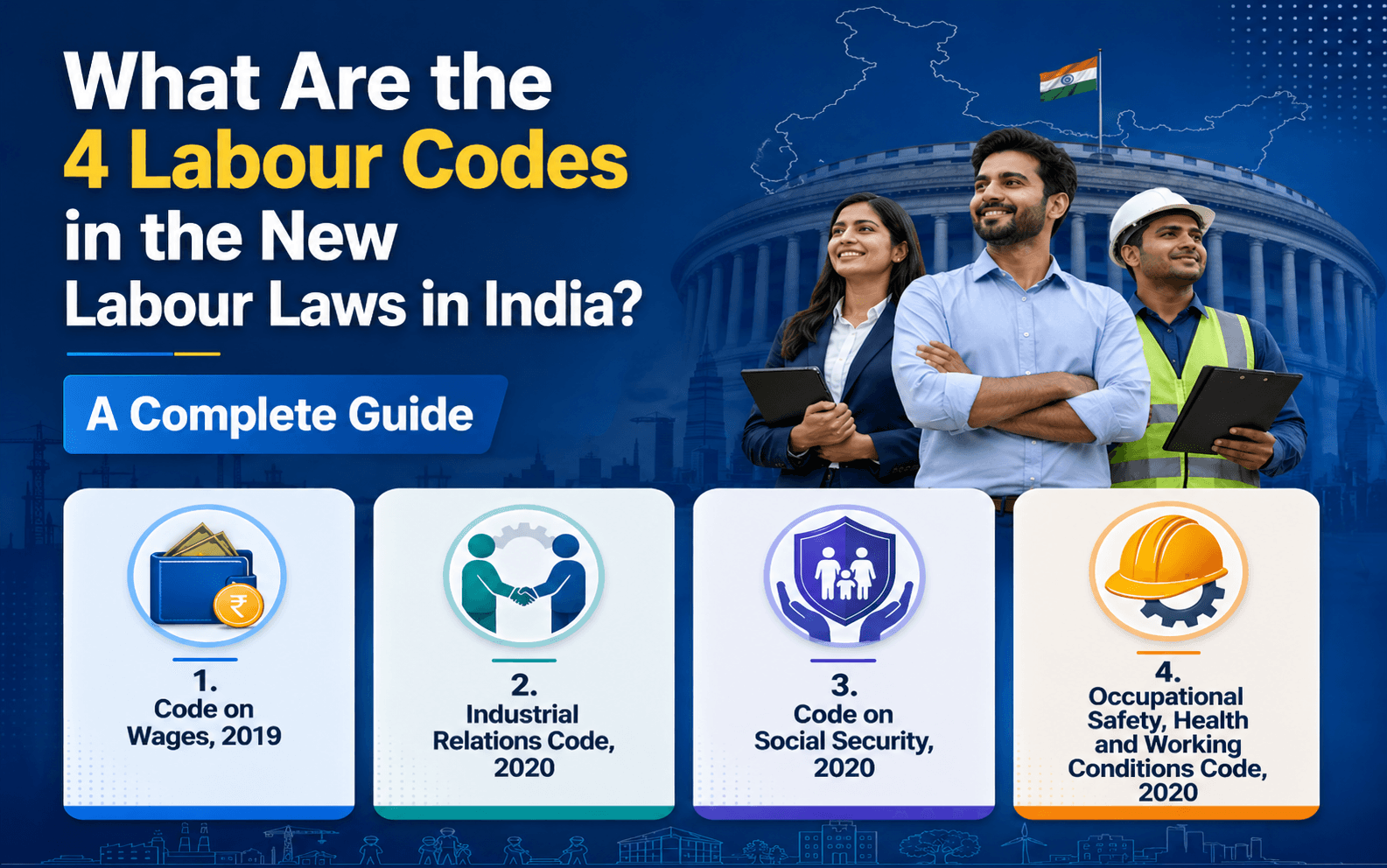
India’s labour law system has undergone significant reform with the introduction of the 4 Labour Codes, which consolidate 29 previous labour laws into four broader areas: wages, industrial relations, social security, and workplace safety. This reform aims to simplify compliance, modernize outdated provisions, and improve worker protection. The new codes require enterprises to adapt their HR, payroll, attendance, and contractor management practices to ensure legal compliance. This guide covers the major aspects of the 4 Labour Codes, highlighting how they impact salary structures, statutory contributions, wage calculations, contractor governance, and workplace safety. With the Labour Codes set to take effect from November 2025, enterprises must move from fragmented systems to a more connected, audit-ready workforce governance model.
Introduction
India’s labour law framework has gone through one of its most significant reforms in decades.
The earlier system had multiple central labour laws, different definitions, different registers, different returns, different wage concepts, and overlapping compliance requirements. For enterprises operating across states, sites, factories, warehouses, stores, branches, contractors, and worker categories, this created operational complexity.
The Four Labour Codes were introduced to simplify this landscape.
The four codes are:
Code on Wages, 2019
Industrial Relations Code, 2020
Code on Social Security, 2020
Occupational Safety, Health and Working Conditions Code, 2020
Together, these codes consolidate 29 central labour laws into a more unified framework.
For employers, the shift is not only legal. It is operational.
The new labour codes affect how enterprises manage wages, payroll, overtime, statutory benefits, appointment letters, worker records, contractor compliance, working hours, safety, welfare, grievance handling, social security, and audit readiness.
For HR teams, the impact is even more direct.
Labour laws in HR are no longer limited to policy documents and statutory filings. They now depend on whether workforce data is captured correctly, whether attendance is accurate, whether wage rules are updated, whether PF and ESI details are complete, whether workers receive wage slips, whether vendor records match actual deployment, and whether compliance records can be generated from approved daily transactions.
This is especially important for enterprises with large external workforces.
Manufacturing companies, logistics providers, ecommerce operations, retail chains, facility management businesses, construction sites, warehouses, and service organizations often manage a mix of permanent employees, contract workers, daily wage workers, piece-rate workers, gig workers, apprentices, trainees, and vendor-supplied labour.
For such organizations, labour code readiness is not just a legal checklist.
It is a workforce operating model question.
The real challenge is not only understanding the Four Labour Codes. The real challenge is converting them into controlled, traceable, and audit-ready workforce processes.
Why Were These New Labour Codes Brought In?
The new labour codes were brought in to simplify India’s complex labour law structure and make it more aligned with modern workforce realities.
Before the codes, employers had to deal with multiple laws that governed wages, social security, industrial relations, safety, working conditions, contract labour, factories, migrant workers, maternity benefits, gratuity, bonus, provident fund, ESI, and other areas.
Each law often had its own definitions, thresholds, registers, returns, formats, timelines, and enforcement requirements.
For enterprises, this created several challenges.
Too many laws with overlapping requirements
Different laws used different definitions for terms such as worker, employee, wages, contractor, establishment, and employer.
This created confusion in payroll design, statutory contribution calculation, wage structuring, contract labour management, and compliance reporting.
For example, a payroll team could not treat wage definition casually because the definition affected minimum wages, overtime, deductions, bonus, gratuity, PF, ESI, and wage slips.
When multiple laws applied at the same time, compliance became fragmented.
Manual and document-heavy compliance
Earlier compliance processes were heavily dependent on registers, physical documents, manual filings, contractor declarations, and periodic reconciliation.
For enterprises with large blue-collar and external workforces, this created recurring operational pressure.
Compliance teams often had to chase vendors for PF challans, ESI proof, wage sheets, attendance records, contractor registers, license copies, and worker details.
This meant compliance was often reconstructed after the event instead of being controlled during the workforce lifecycle.
Changing workforce models
India’s workforce has changed significantly.
Enterprises now depend on contract labour, gig workers, platform workers, fixed-term employees, daily wage workers, piece-rate workers, trainees, apprentices, and vendor-managed workforces.
The earlier labour law structure was not designed for this level of workforce variety.
The new codes attempt to create a broader framework for modern workforce models, including social security considerations for gig and platform workers.
Need for easier compliance
Employers needed a simplified framework that could reduce duplication and improve ease of compliance.
The labour codes aim to consolidate laws, reduce overlapping obligations, introduce unified registers and returns, and create a more structured compliance framework.
However, simplification at the law level does not automatically simplify operations.
Enterprises still need systems, workflows, data controls, and accountable ownership to operationalize the codes.
Need for stronger worker protection
The codes were also introduced to improve worker welfare, wage protection, social security, safety, and formalization.
Key areas such as minimum wages, timely wage payment, wage slips, appointment letters, social security coverage, safety, health, welfare, and grievance mechanisms have become more important.
For workers, the objective is better protection and formal visibility.
For employers, the objective is clearer obligations and more structured compliance.
How Many Labour Laws in India Were There Before the New Codes?
Before the Four Labour Codes, India’s central labour law framework consisted of 29 separate central labour laws.
These laws covered different areas of employment and workforce regulation.
Some laws focused on wages.
Some focused on industrial relations.
Some focused on provident fund, ESI, gratuity, and maternity benefits.
Some focused on factories, mines, contract labour, migrant workers, and working conditions.
This created a fragmented compliance structure.
For employers, the issue was not only the number of laws. The issue was how those laws interacted with daily workforce operations.
For example:
Wage laws affected salary structure, minimum wages, deductions, wage slips, overtime, and payment timelines.
Social security laws affected PF, ESI, gratuity, maternity benefits, and contribution records.
Industrial relations laws affected grievance handling, standing orders, worker communication, retrenchment, and dispute resolution.
Safety and working condition laws affected working hours, safety training, medical records, welfare facilities, accident reporting, and contractor records.
When these requirements were managed separately, enterprises often ended up with disconnected processes.
HR maintained worker records.
Payroll calculated wages.
Compliance maintained registers.
Vendors submitted challans.
Site teams managed attendance.
Safety teams maintained training and incident records.
Finance reconciled invoices.
The same worker could appear differently across different records.
This is where risk increases.
A worker could be onboarded by a vendor, marked present at a site, paid through contractor payroll, billed to the principal employer, and reflected in statutory records. If these records did not match, the enterprise faced compliance and audit exposure.
The Four Labour Codes attempt to simplify this by consolidating 29 central laws into four broader codes.
But enterprises should not mistake consolidation for automatic compliance.
The number of laws may reduce, but the need for accurate workforce data increases.
The future of compliance is not only about knowing which law applies.
It is about ensuring that daily workforce transactions generate reliable compliance records.
The 4 Labour Codes - Everything You Need to Know
The Four Labour Codes bring India’s labour law framework into four major categories.
Each code covers a different dimension of workforce governance.
Together, they affect the entire worker lifecycle, from onboarding to payroll, statutory benefits, working conditions, safety, grievance handling, contractor management, and exit.
Code on Wages, 2019
The Code on Wages consolidates laws related to wages, minimum wages, payment of wages, bonus, and equal remuneration.
For enterprises, this code is highly important because wage compliance is one of the most sensitive areas of workforce management.
It impacts:
Wage definition
Minimum wage compliance
Floor wage
Wage payment timelines
Deductions
Overtime
Bonus
Equal remuneration
Wage slips
Wage registers
Payroll records
For HR and payroll teams, the Code on Wages requires tighter control over wage structures, wage masters, overtime rules, payment cycles, deductions, and worker classification.
In external workforce environments, this also affects contractor payroll and vendor billing.
If vendor-submitted wages do not match applicable wage rules, the enterprise may face risk.
Industrial Relations Code, 2020
The Industrial Relations Code consolidates laws related to trade unions, industrial disputes, standing orders, grievance redressal, layoffs, retrenchment, and closure.
For enterprises, this code is important because industrial relations risk is not limited to formal disputes.
It can arise from daily workforce issues such as wage disputes, attendance corrections, shift changes, contractor escalations, worker communication gaps, grievance delays, and unclear employment terms.
This code impacts:
Standing orders
Grievance redressal mechanisms
Worker communication
Appointment letters
Notice of change
Works committees
Layoff and retrenchment procedures
Dispute resolution records
For HR teams, this means communication and grievance records must become more traceable.
Informal issue resolution is no longer enough.
Enterprises need proof of communication, acknowledgement, ownership, escalation, and closure.
Code on Social Security, 2020
The Code on Social Security consolidates laws related to provident fund, ESI, gratuity, maternity benefit, employee compensation, and social security for different categories of workers.
This code is critical for enterprises managing large permanent and external workforces.
It impacts:
PF coverage
ESI coverage
Gratuity
Maternity benefits
Employee compensation
Contractor worker records
Gig and platform worker social security
Contribution readiness
Benefit eligibility
Statutory proof
Worker identity
For external workforce operations, the most important control is the connection between worker identity, wage data, attendance, contractor records, and statutory contribution proof.
Social security compliance fails when these records are separated.
For example, if a contractor submits PF or ESI proof after billing, the enterprise may not know whether statutory contributions match the actual worker deployment and wage data.
Occupational Safety, Health and Working Conditions Code, 2020
The OSHWC Code consolidates laws related to safety, health, welfare, working hours, working conditions, contract labour, inter-state migrant workers, factories, mines, docks, building and construction workers, and other workplace requirements.
This code is highly operational.
It impacts:
Working hours
Weekly rest
Overtime limits
Safety training
Welfare facilities
Medical fitness
Accident reporting
Worker registers
Contractor records
Site-level compliance
Hazardous process controls
Safety committee records
Women working conditions and night shift safety where applicable
For enterprises with factories, warehouses, logistics hubs, retail networks, client sites, and contractor-heavy operations, OSHWC compliance depends on accurate site-level workforce visibility.
Safety cannot be separated from workforce data.
The enterprise must know who is deployed, where they are deployed, whether they are trained, whether they are medically fit where required, whether their shift is compliant, and whether incident records are linked to worker identity.
Key Changes and Impact of the Four Labour Codes
The Four Labour Codes create several important changes for employers and workers.
Some changes simplify compliance. Some increase the need for stronger workforce data. Some make payroll and HR processes more structured. Some improve worker protection.
For enterprises, the biggest impact is that compliance becomes more connected to daily workforce operations.
Consolidation of laws
The most visible change is the consolidation of 29 central labour laws into four codes.
This reduces fragmentation at the legal framework level.
However, operational compliance still remains complex because enterprises must implement these rules across multiple locations, vendors, worker categories, wage models, and employment structures.
Broader wage governance
The Code on Wages brings greater focus on wage definition, minimum wages, wage payment, overtime, deductions, wage slips, and wage records.
This directly affects payroll design.
Employers need to ensure that wage structures, deductions, payment timelines, wage slips, and overtime calculations are controlled properly.
Minimum wage and floor wage focus
The new framework increases attention on minimum wage compliance and wage protection.
For enterprises operating across multiple states, wage categories, skill levels, and contractors, wage masters must be kept updated.
Manual tracking of wage notifications and wage rates can create serious payroll risk.
Appointment letters and worker records
The new labour codes increase the importance of formal worker records and appointment letters.
This is particularly relevant for blue-collar and external workforces where worker documentation is often vendor-dependent.
Enterprises need a consistent way to issue, store, track, and retrieve worker records.
Social security expansion
The Code on Social Security strengthens the need for worker-wise statutory visibility.
Enterprises need to track PF, ESI, gratuity, maternity benefit, compensation, and other applicable benefits more systematically.
Gig and platform worker recognition also signals that social security will continue expanding beyond traditional employment.
Contractor and principal employer accountability
For enterprises using contractor-supplied workers, compliance cannot stop at vendor onboarding.
The principal employer needs visibility into worker deployment, contractor records, statutory contributions, wage payments, safety readiness, and vendor proof.
Vendor declarations alone are not enough.
Greater focus on safety and working conditions
The OSHWC Code increases the need to connect workforce deployment with safety, health, welfare, working hours, rest days, medical records, incident reporting, and site-level compliance.
This is especially important in manufacturing, logistics, construction, facility management, and hazardous operations.
More importance of digital records
The codes and related compliance direction support a move toward electronic records, unified registers, and digital compliance.
For enterprises, this creates an opportunity to move from manual registers to system-generated records.
But digital records must be reliable.
A digital register generated from inaccurate attendance or incomplete worker data does not reduce risk.
What Has Changed Practically for Workers and Employers?
The practical impact of the Four Labour Codes depends on how enterprises implement them.
For workers, the codes aim to improve wage protection, social security, safety, transparency, and formalization.
For employers, the codes create a more consolidated framework, but also require better operating control.
Practical changes for workers
Workers may see greater emphasis on:
Formal appointment letters
Timely wage payment
Wage slips
Minimum wage protection
Equal remuneration principles
Overtime payment rules
Social security coverage where applicable
Safer working conditions
Health and welfare provisions
Grievance redressal
Records of employment and wages
Better visibility into statutory benefits
For blue-collar workers, this is especially important.
Many workers depend on vendors, contractors, supervisors, or site HR teams for payroll and compliance communication. If the enterprise implements the codes properly, workers should have clearer records, more transparent wage information, and stronger statutory visibility.
Practical changes for employers
Employers need to move from periodic compliance to continuous compliance.
This means employers must strengthen:
Worker onboarding
Contractor master validation
Worker identity records
Wage structure design
Attendance accuracy
Overtime approvals
Minimum wage validation
PF and ESI readiness
Wage slip generation
Statutory registers
Grievance records
Safety and medical records
Vendor compliance proof
Audit trails
The practical challenge is that these obligations do not sit in one department.
HR may own employee records.
Payroll may own wage calculation.
Compliance may own statutory registers.
Finance may own vendor payment.
Procurement may own contractor agreements.
Operations may own attendance and deployment.
Safety may have its own training and incidents.
The new labour code environment requires these teams to work from one connected source of workforce truth.
Practical changes for external workforce-heavy enterprises
Enterprises that depend heavily on contract labour need to pay special attention.
They must be able to answer:
Which workers are deployed today?
Which vendor supplied them?
Are they onboarded correctly?
Are their statutory details complete?
Are they mapped to the right site and work order?
Is their attendance accurate?
Are wages aligned with applicable rules?
Is overtime approved?
Are PF and ESI contributions traceable?
Are wage slips issued?
Does the vendor invoice match verified work?
Can statutory records be produced quickly?
This is where the new labour codes become an operating model shift.
Compliance is no longer only about maintaining documents. It is about controlling the daily workforce transactions that produce those documents.
Labour Laws in HR - How the New Codes Change HR & Payroll Compliance
Labour laws in HR have traditionally been managed through policies, registers, returns, wage sheets, statutory filings, and compliance calendars.
The new labour codes require HR and payroll teams to take a more integrated approach.
HR compliance, payroll compliance, workforce compliance, and vendor compliance must work together.
HR master data becomes compliance data
Worker master data is no longer just an HR record.
It affects payroll, statutory contributions, wage slips, registers, safety, vendor billing, and audits.
Incorrect worker data can create downstream compliance risk.
For example:
Wrong date of joining affects tenure and benefits
Wrong worker category affects wage and statutory eligibility
Wrong vendor mapping affects contractor compliance
Missing bank details affects payout
Missing UAN or ESI details affects contribution readiness
Wrong site mapping affects safety and statutory records
HR data must therefore be complete, accurate, and continuously updated.
Payroll becomes a compliance control point
Payroll is one of the most important compliance control points under the new codes.
Payroll teams must ensure:
Wage structures are compliant
Minimum wages are validated
Overtime is calculated correctly
Deductions are authorized
Wage slips are generated
Payment timelines are met
Statutory contributions are supported by records
Registers can be generated from approved payroll data
Payroll errors can become legal, financial, and worker trust issues.
Attendance becomes a wage compliance input
Attendance is not just an operational record.
It affects payable days, overtime, weekly rest, leave, deductions, wage calculation, statutory records, and vendor billing.
If attendance is corrected manually without approvals, wage compliance becomes weak.
Enterprises need controlled attendance workflows with approval trails.
Overtime must be governed more carefully
Overtime affects cost, worker welfare, working hours, compliance, and payroll.
HR and payroll teams must ensure that overtime is:
Captured accurately
Approved before payroll
Calculated correctly
Paid according to applicable rules
Reflected in wage records
Monitored for working hour limits
Linked to vendor billing where applicable
Uncontrolled overtime creates both cost leakage and compliance risk.
Vendor compliance becomes HR and payroll responsibility
For contract workers, vendors may process payroll and statutory contributions, but enterprises still need visibility.
HR and payroll teams should verify:
Vendor worker records
Attendance
Wage payments
PF and ESI proof
Contractor registers
Wage slips
Statutory challans
Vendor invoices
Worker exits
Compliance exceptions
Vendor compliance cannot be handled only through periodic document collection.
It must be linked to worker-level records.
Registers must be generated from transactions
A key shift is that registers should not be prepared manually at month-end or during audits.
The strongest compliance model is one where registers are generated from approved daily workforce transactions.
This means onboarding, attendance, wage calculation, overtime, deductions, statutory data, and vendor records must be connected.
Key Benefits of the 4 Labour Codes for Employers and Employees
The Four Labour Codes create benefits for both employers and employees when implemented properly.
The benefits come not only from legal consolidation, but from better workforce discipline, clearer records, stronger compliance, and improved transparency.
Benefits for employers
Simplified legal framework
Consolidating 29 central labour laws into four codes makes the legal framework easier to understand and organize.
This helps employers structure compliance responsibilities more clearly.
Improved ease of compliance
Unified registers, digital records, and consolidated compliance expectations can reduce duplication.
However, this benefit is achieved only when enterprises move from manual compliance to system-led compliance.
Better payroll governance
The codes push enterprises to improve wage structure, minimum wage validation, overtime calculation, deductions, wage slips, and payment timelines.
This improves payroll accuracy and reduces disputes.
Stronger vendor accountability
For enterprises using contract labour, the codes increase the need to track worker-level compliance.
This helps enterprises move beyond vendor declarations toward verified compliance proof.
Improved audit readiness
System-led compliance makes it easier to generate records, registers, wage slips, statutory proof, and reports quickly.
This reduces last-minute audit pressure.
Better workforce cost visibility
When attendance, wages, overtime, statutory contributions, and vendor billing are connected, enterprises get better visibility into labour cost.
This supports CFO and operations decision-making.
Benefits for employees and workers
Better wage protection
The Code on Wages strengthens focus on minimum wages, timely payment, wage slips, deductions, overtime, and wage transparency.
This helps workers understand and trust their payouts.
Greater formalization
Appointment letters, worker records, statutory data, and digital registers improve worker formalization.
This is especially relevant for contract and external workers.
Improved social security visibility
The Code on Social Security strengthens the need to track PF, ESI, gratuity, maternity benefits, compensation, and other benefit-related records.
This improves worker-level statutory visibility.
Safer working conditions
The OSHWC Code increases focus on workplace safety, health, welfare, working hours, rest, accident reporting, and site-level records.
This improves worker protection in operational environments.
Better grievance and communication records
The Industrial Relations Code strengthens the need for structured grievance and communication processes.
This can help workers raise issues through more formal and traceable channels.
The true benefit of the codes will depend on execution.
If enterprises implement them only as legal documentation, the impact will be limited.
If enterprises implement them as connected workforce controls, the impact can be significant.
Implementation Roadmap of Four Labour Codes
Enterprises should approach labour code readiness as a structured implementation programme.
The objective should be to convert legal requirements into operational controls.
A practical roadmap can be built in six phases.
Phase 1: Compliance gap assessment
Enterprises should begin by assessing current readiness.
This includes reviewing:
Worker master data
Contractor records
Wage structures
Minimum wage mapping
Attendance systems
Overtime process
Payroll rules
PF and ESI records
Wage slips
Statutory registers
Grievance records
Safety records
Vendor compliance documents
Audit trail availability
The goal is to identify where compliance depends on manual effort, vendor declarations, or disconnected systems.
Phase 2: Workforce classification
Enterprises should classify all workforce categories clearly.
This includes:
Permanent employees
Contract workers
Daily wage workers
Piece-rate workers
Gig workers
Platform workers
Apprentices
Trainees
Fixed-term employees
Inter-state migrant workers
Vendor-managed workers
Classification matters because different obligations may apply differently across categories.
Incorrect classification can create wage, benefit, payroll, and statutory risk.
Phase 3: Wage and payroll readiness
Enterprises should review wage structures, wage masters, overtime logic, deductions, payment timelines, and wage slips.
This phase should include:
Wage definition review
Minimum wage mapping
State-wise wage updates
Skill category mapping
Overtime rule configuration
Deduction controls
Payroll input validation
Wage slip standardization
Final settlement process review
Payroll readiness is one of the most important labour code readiness areas.
Phase 4: Social security and statutory data readiness
Enterprises should ensure that statutory data is complete and traceable.
This includes:
UAN details
ESI details
PF applicability
ESI applicability
Bank details
Nominee details
Contractor statutory proof
Contribution records
Worker-wise challan reconciliation
Benefit eligibility tracking
For contractor-supplied workers, this phase must include vendor-wise verification.
Phase 5: Safety, working conditions, and site readiness
Enterprises should review site-level compliance.
This includes:
Working hours
Weekly rest
Overtime limits
Shift patterns
Medical fitness where applicable
Safety training
Hazardous process eligibility
Incident reporting
Welfare facilities
Women worker safety provisions where applicable
Contractor deployment records
Site registers
This is especially important for manufacturing, logistics, construction, facilities, and industrial operations.
Phase 6: System-led compliance implementation
The final phase is to move from manual compliance to system-led compliance.
This means creating workflows for:
Capture
Validation
Approval
Payroll
Vendor billing
Reconciliation
Reporting
Audit readiness
A system-led approach ensures that compliance records are generated from approved transactions, not reconstructed after the fact.
This is the difference between being document-ready and being truly compliance-ready.
Have the 4 Labour Codes Been Implemented in India?
Yes. The Four Labour Codes have been made effective in India from 21 November 2025.
The Government of India announced that the four codes were made effective to modernize labour regulations, enhance worker welfare, simplify compliance, and align India’s labour ecosystem with the evolving world of work.
This means employers should not treat labour code readiness as a future project.
It is now an active compliance and operating requirement.
However, enterprises should also recognize that implementation in India involves central and state-level rules, notifications, enforcement practices, and operational interpretation.
This means labour code readiness should be continuously reviewed.
For employers, the practical approach should be:
Track central notifications
Track state-specific rules and updates
Review wage structures
Review statutory contribution logic
Update HR policies
Review appointment letter formats
Review standing orders and grievance processes
Update payroll and overtime logic
Validate contractor compliance processes
Review safety and working condition records
Move toward digital records and system-led registers
The implementation question is no longer:
“Have the labour codes come?”
The better question is:
“Is our workforce operating model ready for the labour codes?”
For many enterprises, the answer will depend on the maturity of their workforce systems.
If worker data, attendance, wages, compliance, safety, and vendor records are disconnected, the organization may face difficulty even if policies have been updated.
If these records are connected, validated, and traceable, implementation becomes more manageable.
BlueTree Perspective: Labour Code Readiness Is an Operating Model Question
At BlueTree, we believe labour code readiness is not only a legal or compliance exercise.
It is an operating model question.
The Four Labour Codes require enterprises to connect workforce data, wage rules, attendance, overtime, statutory proof, safety records, grievance workflows, vendor accountability, payroll, billing, and audit outputs.
This is especially important for external workforce-heavy enterprises.
In many organizations, external workforce compliance still depends on fragmented processes.
Vendors onboard workers.
Site teams mark attendance.
Supervisors approve overtime.
Payroll teams calculate wages.
Compliance teams collect statutory proof.
Finance teams process vendor invoices.
Safety teams maintain training records.
HR teams handle grievances.
If these processes are disconnected, compliance gaps accumulate silently.
The organization may appear compliant on paper, but risk may exist inside daily transactions.
For example:
A worker may be active at site but missing from statutory records
A vendor may bill for workers not verified in attendance
Overtime may be paid without proper approval
Wage rates may not reflect the latest minimum wage
PF or ESI proof may be collected after vendor payment
Safety training may not be linked to worker deployment
Grievances may be closed informally without records
Registers may be prepared manually during audits
This is not a documentation problem.
It is a control problem.
BlueTree BeeForce helps enterprises build this operating control layer for external workforce management.
BeeForce connects:
Worker onboarding
Vendor management
Worker identity
Site and department mapping
Attendance and shifts
Overtime approvals
Wage and payroll readiness
PF and ESI visibility
Compliance records
Vendor billing reconciliation
Grievance workflows
Safety and workforce records
Dashboards and audit trails
This helps enterprises move from reactive compliance to system-led compliance.
The strongest labour code readiness model is not one where records are prepared at the end of the month.
It is one where every worker transaction is captured, validated, approved, paid, reconciled, and reported through a controlled system.
That is the shift the Four Labour Codes demand.
Conclusion
The Four Labour Codes represent a major shift in India’s labour law framework.
They simplify the structure by consolidating 29 central labour laws into four codes, but they also raise the bar for operational compliance.
For employers, the impact is significant.
Wage structures, minimum wages, overtime, deductions, wage slips, PF, ESI, contractor records, appointment letters, grievance workflows, safety records, working hours, vendor compliance, and statutory registers all need stronger control.
For workers, the codes aim to improve wage protection, social security visibility, formalization, safety, welfare, and transparency.
But the success of the labour codes will depend on execution.
Policies alone will not create readiness.
Manual registers alone will not create confidence.
Vendor declarations alone will not reduce principal employer risk.
Month-end reconciliation alone will not prevent compliance gaps.
Enterprises need connected workforce systems that can generate compliance from daily operations.
For CHROs, CFOs, compliance leaders, HR Operations teams, payroll teams, plant HR, and business leaders, the question is clear:
Can your organization prove compliance from the way work actually happens every day?
That is the future of labour code readiness.
BlueTree BeeForce helps enterprises prepare for this future by connecting workforce lifecycle management, payroll readiness, compliance controls, vendor accountability, and audit-ready records into one external workforce management platform.
The organizations that act early will not only reduce compliance risk.
They will build a more transparent, reliable, and controlled workforce operating model for the next decade.


Manage External Workforce with BlueTree - Govern contract, gig, and blue collar workers across vendors, sites, and shifts.
Frequenty Asked Questions
4-5 Minutes
|
All
category
Global Payroll Week 2026: Why Blue Collar Payroll Needs Better Governance
Read More >
7-8 Minutes
|
All
category
What Are the 4 Labour Codes in the New Labour Laws in India? A Complete Guide
Read More >

15 to 17 minutes
|
All
category
What Are the New External Workforce Trends in 2026?
Read More >