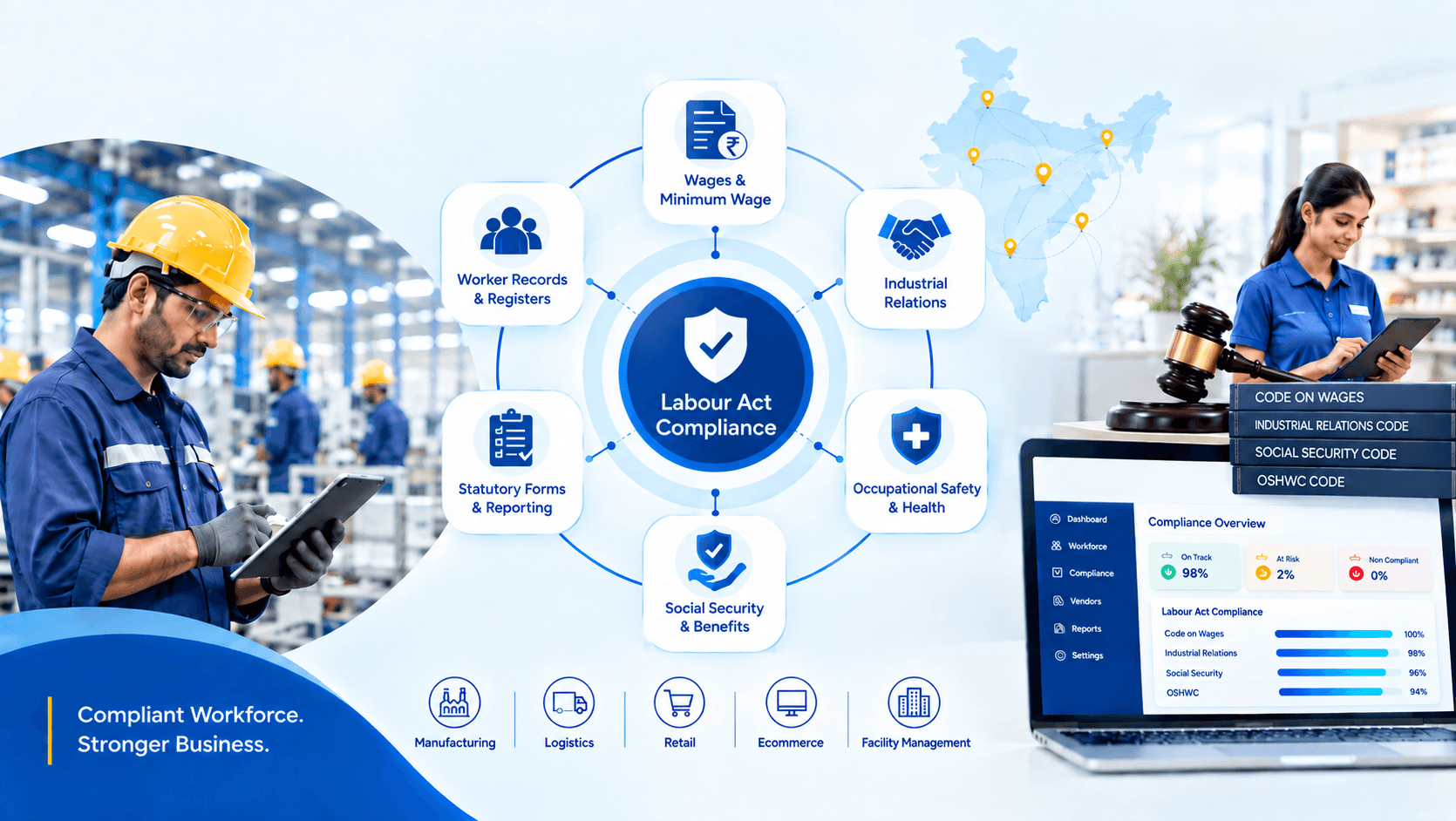
This blog explains labour act management and its importance for enterprises managing diverse workforces across multiple locations. It covers the key features of a labour act management system, statewise compliance considerations, common challenges, and how technology can help organisations improve compliance visibility, manage workforce and contractor records, track requirements, and maintain better control over labour-related processes.
What Is Labour Act Management?
Labour act management is the process of identifying, implementing, monitoring, and maintaining the labour laws, rules, statutory requirements, and employment-related obligations applicable to an organisation.
For enterprises, labour act management goes beyond maintaining legal documents. It involves ensuring that workforce records, contractor documentation, statutory registers, licences, wage-related requirements, working conditions, filings, and other compliance activities are managed consistently across locations.
This becomes particularly important for organisations operating across multiple states or managing large contract and external workforces. Labour requirements may differ based on the state, establishment, industry, workforce category, and nature of operations, making manual compliance tracking difficult.
An effective labour act management process helps organisations:
Identify labour laws and statutory requirements applicable to each establishment.
Maintain required workforce and contractor records.
Track registrations, licences, renewals, and statutory due dates.
Monitor contractor and vendor compliance.
Maintain statutory registers, forms, and supporting records.
Track wage, working-hour, overtime, and other applicable requirements.
Identify missing documents, expired records, and compliance gaps.
Maintain an audit trail for compliance activities and corrective actions.
Provide HR, payroll, compliance, and operations teams with consistent compliance visibility.
For a large enterprise, the objective is to create a centralised and structured approach to labour compliance, rather than managing requirements through disconnected spreadsheets, emails, and physical records.
A labour act management system can further support this process by bringing compliance information, workforce records, contractor data, alerts, documentation, and reporting into a single technology-enabled environment.
Understanding the Labour Management Act
The term Labour Management Act is often used broadly to describe the laws, rules, and statutory requirements that govern the relationship between organisations, workers, contractors, and other workforce stakeholders. In India, labour compliance is not governed by a single law called the Labour Management Act. It involves multiple central and state-level labour laws, rules, notifications, registrations, and statutory obligations.
The requirements applicable to an organisation can depend on several factors, including:
Type of establishment: Factory, commercial establishment, shop, warehouse, office, or other workplace.
Workforce category: Permanent, contract, temporary, gig, fixed-term, or other workforce arrangements.
Industry and nature of work: Different sectors and activities may have specific compliance requirements.
State of operation: State-specific rules, registrations, notifications, and implementation requirements can apply.
Workforce size: Certain obligations may become applicable based on the size of the establishment or number of workers.
Contractor engagement: Enterprises engaging contract workforce may have additional requirements relating to contractors and deployed workers.
Working conditions: Requirements relating to wages, working hours, overtime, leave, welfare, health, safety, and other employment conditions may need to be monitored.
For enterprises operating across multiple locations, the challenge is not simply understanding labour laws. HR and compliance teams also need to determine which requirements apply to which establishment, workforce, contractor, and location, and ensure that the relevant records and actions are maintained.
This is where a structured technology approach can make labour act management more manageable. BlueTree helps enterprises bring workforce, contractor, compliance, and operational information into a more structured environment, enabling teams to improve visibility across locations and workforce categories.
A labour act management system can support this process by helping organisations organise compliance requirements, workforce documentation, contractor information, statutory records, alerts, and reporting. Instead of relying entirely on spreadsheets, emails, and disconnected records, enterprise teams can work with a centralised view of compliance-related information.
For organisations managing large and distributed workforces, effective labour act management ultimately means creating a consistent, traceable, and auditable process that supports HR, compliance, payroll, and operations teams across locations.
Key Features of a Labour Act Management System
A labour act management system should do more than store compliance documents. For large enterprises, it needs to connect workforce information, contractor operations, attendance, payouts, compliance activities, and workforce lifecycle processes so that teams can manage labour requirements with better visibility and control.
Key features to look for include:
Digital Workforce Onboarding: Capture workforce information, documents, contractor details, and required compliance information during onboarding. BlueTree offers digital onboarding capabilities designed for contract workforce and multi-site operations.
Labour Compliance Management: Track applicable labour compliance requirements, statutory information, and compliance records across establishments and workforce categories. BlueTree offers a dedicated compliance module to support this process.
Time & Attendance Management: Maintain reliable attendance and working-hour records that can support wage calculations, overtime monitoring, workforce visibility, and compliance processes. BlueTree provides real-time attendance capabilities with location and geo-tracking options.
Shift & Overtime Management: Manage shift schedules, monitor workforce deployment, and track overtime-related information. This is particularly relevant for enterprises managing large workforces across multiple sites.
Payouts & Billing: Connect attendance and approved workforce inputs with payout and billing processes. BlueTree offers Payouts & Billing capabilities that help create structured, compliance-ready payout records.
Contractor & Vendor Management: Maintain visibility into contractors, vendors, deployed workforce, and site-level operations. This becomes important when enterprises work with multiple staffing partners across locations.
Workforce Engagement & Communication: Provide channels for workforce communication, announcements, and engagement throughout the workforce lifecycle. BlueTree includes a Workforce Engagement module as part of its platform.
Workforce Grievance Management: Provide a structured mechanism to record, track, and resolve workforce grievances. A dedicated grievance module can improve visibility and accountability around workforce concerns.
Compliant Offboarding: Ensure workforce exits are documented and completed through a defined process, including relevant records and closure activities. BlueTree offers an Offboarding module to support the final stage of the workforce lifecycle.
Centralised Workforce Records: Maintain workforce documents, compliance records, and operational information in one structured environment, making information easier to retrieve during reviews and audits.
For enterprises managing contract, gig, and piece-rate workforce across multiple locations, these capabilities work best when they are connected rather than managed through separate systems. BlueTree offers BeeForce, an external workforce management platform that brings onboarding, attendance, payouts, compliance, engagement, grievance management, and offboarding together in one platform.
Statewise Labour Act Management System: An Overview
A statewise labour act management system helps enterprises manage labour compliance requirements that may differ across states, establishments, industries, and workforce categories. This is particularly important for organisations operating multiple factories, warehouses, stores, offices, or project sites across India.
While labour regulation includes central-level requirements, their implementation can involve state-specific rules, registrations, licences, forms, registers, returns, notifications, and procedural requirements. As a result, a compliance process that works for one location may not be sufficient for another.
Statewise Labour Act Management in India
Enterprises may need to manage requirements across states such as:
Andhra Pradesh: Track applicable establishment, workforce, wage, contractor, and statutory requirements based on the nature of operations.
Assam: Manage state-specific registrations, records, workforce documentation, and applicable labour compliance activities.
Bihar: Monitor establishment-level requirements, workforce records, contractor obligations, and statutory activities.
Chhattisgarh: Maintain location-specific labour compliance information and documentation for industrial and commercial operations.
Delhi: Manage applicable requirements for establishments, contractors, workforce records, and statutory documentation.
Gujarat: Track labour compliance requirements across manufacturing, logistics, retail, and other large workforce operations.
Haryana: Monitor establishment registrations, contractor-related requirements, workforce records, and applicable statutory obligations.
Himachal Pradesh: Maintain state-specific compliance records, licences, registers, and workforce documentation.
Jharkhand: Track applicable labour requirements across industrial establishments and contractor-managed workforce.
Karnataka: Manage state-specific establishment and workforce compliance requirements across technology, manufacturing, retail, logistics, and other sectors.
Kerala: Maintain applicable labour records, registrations, contractor information, and statutory documentation.
Madhya Pradesh: Track establishment-level requirements, workforce records, contractor compliance, and applicable statutory activities.
Maharashtra: Manage labour compliance across large and diverse operations including manufacturing, retail, logistics, and commercial establishments.
Odisha: Monitor applicable establishment, workforce, contractor, and statutory compliance requirements.
Punjab: Maintain relevant registrations, workforce records, contractor documentation, and statutory records.
Rajasthan: Track state-specific labour requirements across establishments and workforce categories.
Tamil Nadu: Manage applicable labour registrations, records, contractor information, and workforce-related compliance activities.
Telangana: Monitor establishment and workforce requirements across sectors and locations.
Uttar Pradesh: Track applicable establishment, workforce, contractor, wage-related, and statutory requirements across locations.
Uttarakhand: Maintain applicable labour compliance records, registrations, and workforce documentation.
West Bengal: Monitor establishment-level requirements, workforce records, contractor obligations, and statutory documentation.
For enterprises operating across several states, maintaining this information manually can create gaps in visibility. A statewise approach helps compliance teams understand what applies, where it applies, what has been completed, and what requires action.
How Technology Supports Statewise Labour Compliance
A labour act management system can organise compliance information by state, establishment, contractor, workforce category, and requirement. This allows HR and compliance teams to maintain a more consistent process while accounting for location-specific requirements.
BlueTree offers compliance capabilities as part of its workforce management platform, helping enterprises connect workforce and contractor information with compliance processes across their operations. This is particularly useful for organisations managing large distributed workforces where compliance visibility needs to extend beyond a single establishment or state.
Common Challenges in Labour Act Management
Managing labour compliance becomes increasingly complex as enterprises expand across multiple locations, workforce categories, and contractor networks. Without a structured process, HR and compliance teams may spend significant time collecting information, following up with stakeholders, and checking whether requirements have been completed.
Common challenges include:
Managing Multiple Labour Requirements: Enterprises need to track several labour laws, rules, registrations, licences, statutory records, and filing requirements, making manual monitoring difficult.
State-wise Compliance Variations: Labour requirements and procedures can differ across states and establishments. Maintaining separate compliance information for every location increases administrative complexity.
Fragmented Workforce & Contractor Data: Worker information, contractor records, attendance, documents, and compliance data may sit across spreadsheets, emails, and different systems, making it difficult to establish a consistent view.
Missing or Expired Documentation: Identifying missing worker documents, expired licences, certificates, registrations, or contractor records can become difficult when information is maintained manually.
Limited Compliance Visibility: HR and compliance teams may not have a real-time view of completed, pending, or overdue compliance activities across sites.
Manual Tracking & Follow-ups: Teams often rely on spreadsheets, calendars, emails, and individual reminders to track compliance due dates, renewals, submissions, and corrective actions.
Contractor Compliance Management: Enterprises working with multiple contractors need visibility into contractor documentation and workforce compliance. Inconsistent submissions or delayed updates can make monitoring more difficult.
Audit Readiness: During internal reviews, customer audits, or statutory inspections, teams may need to collect records from multiple locations and stakeholders, increasing the effort required to demonstrate compliance.
Inconsistent Processes Across Locations: Different sites may follow different approaches for onboarding, documentation, attendance records, approvals, and compliance tracking, making enterprise-wide standardisation difficult.
Lack of Integrated Workforce Data: When compliance information is disconnected from onboarding, attendance, payouts, and contractor management, teams may need to reconcile data manually before taking action.
A technology-enabled approach can help address these challenges by connecting workforce and contractor information with compliance processes. BlueTree offers workforce management and compliance capabilities that help enterprises centralise relevant information, monitor activities, and improve visibility across distributed workforce operations.
Why BlueTree Is the Best Labour Act Management Software
For enterprises, choosing labour act management software is not only about tracking compliance. The platform also needs to connect compliance with the wider workforce lifecycle, contractor operations, attendance, payouts, and workforce records.
BeeForce by BlueTree is built for enterprise labour workforce operations, with capabilities covering contract labour, gig, and piece-rate workforce management. The platform brings workforce management and labour compliance into a connected environment, helping organisations manage distributed workforce operations across multiple sites.
Key capabilities that make BlueTree relevant for labour act management include:
Centralised Workforce Records: BeeForce provides a digital workforce record system where worker documents, compliance records, and audit trails can be maintained with role-based access.
Dedicated Compliance Management: The platform includes a dedicated Compliance module to support adherence to applicable labour requirements and provide greater visibility into compliance activities.
Contractor & Vendor Management: Enterprises can manage contractor and vendor information across locations, helping create better visibility into the external workforce ecosystem.
Day Zero Onboarding: BeeForce supports bulk and self-onboarding for contractors and sites, helping organisations capture workforce information and required documentation at the beginning of the workforce lifecycle.
Time & Attendance: Real-time attendance dashboards, geo-tracking, and location rules help organisations maintain reliable workforce attendance information that can support operational and compliance processes.
Shift & Overtime Management: Shift scheduling and overtime tracking provide enterprises with greater visibility into working hours and overtime-related costs and compliance requirements.
Payouts & Billing: BeeForce connects attendance with payout records, supporting more structured and audit-ready payout processes.
Multi-State Operations: The platform supports multi-state employer payout configuration, making it relevant for enterprises managing workforce operations across different locations.
End-to-End Workforce Lifecycle: Along with onboarding, attendance, compliance, and payouts, BeeForce includes Workforce Engagement, Workforce Grievance, and Offboarding capabilities, allowing enterprises to manage more of the workforce lifecycle within one platform.
For enterprises managing a large contract and external workforce, this connected approach can reduce dependence on fragmented spreadsheets and disconnected processes. Instead, HR, compliance, payroll, procurement, and operations teams can work with a more structured view of workforce and labour management information.
With BeeForce by BlueTree, labour act management becomes part of a broader workforce management framework, connecting compliance with the operational information enterprises need to manage their external workforce at scale.
Conclusion
Effective labour act management is essential for enterprises managing large and distributed workforces. With multiple locations, contractors, workforce categories, and state-specific requirements, relying on manual records and disconnected processes can make compliance difficult to monitor consistently.
A structured labour act management system helps organisations centralise workforce and compliance information, track statutory requirements, manage documentation, monitor contractors, and maintain better audit readiness.
With BeeForce by BlueTree, enterprises can connect labour compliance with workforce onboarding, contractor management, attendance, payouts, engagement, and offboarding through a unified workforce management platform. This helps HR, compliance, payroll, and operations teams gain greater visibility and control across their workforce operations.


Manage External Workforce with BlueTree - Govern contract, gig, and blue collar workers across vendors, sites, and shifts.
Frequenty Asked Questions
4-5 Minutes
|
All
category
Global Payroll Week 2026: Why Blue Collar Payroll Needs Better Governance
Read More >

7-8 Minutes
|
All
category
What Are the 4 Labour Codes in the New Labour Laws in India? A Complete Guide
Read More >

15 to 17 minutes
|
All
category
What Are the New External Workforce Trends in 2026?
Read More >