
This blog explains what a Contract Labour Management Platform is and why it has become essential for enterprises managing large blue-collar workforces. It covers how contract labour operates across vendors and locations, the different engagement models used at scale, and the operational risks that arise without a unified system. The article highlights how a structured platform brings visibility, control, and governance across onboarding, attendance, shifts, payouts, and compliance, enabling enterprises to manage contract labour with operational clarity and confidence.
Contract Labour in Today’s Enterprise Operating Model
For large enterprises, blue-collar contract labour is no longer a support layer but the engine that keeps operations running across factories, warehouses, project sites, and retail networks. This workforce drives scale, speed, and cost efficiency, but managing thousands of workers deployed through multiple vendors, locations, and engagement models introduces significant operational and regulatory complexity. As volumes grow, enterprises struggle with fragmented onboarding, inconsistent attendance capture, payout leakages, and limited compliance visibility when relying on manual or vendor-driven processes. A Contract Labour Management Platform built for blue-collar realities brings structure to this complexity by unifying onboarding, identity verification, attendance, shift and overtime tracking, payouts, and statutory readiness into a single operational system. BlueTree enables enterprises to manage high-volume, distributed blue-collar workforces with real-time visibility, standardized controls, and audit-ready data, ensuring operational continuity without disrupting existing vendor ecosystems or site-level execution.
What Is Contract Labour?
Contract labour refers to workers who are not employed directly on an organization’s permanent payroll but are engaged through contractors or service providers to perform operational roles. These workers operate under contractual arrangements governed by work orders, service agreements, and statutory obligations rather than standard employment contracts.
Effective contract labour management ensures these workers are integrated into operations without compromising visibility, compliance, or accountability. BlueTree enables enterprises to manage this integration through structured workflows and centralized records.
What Role Does Contract Labour Play in Enterprise Operations?
Contract labour plays a critical role in enabling enterprises across manufacturing, logistics, retail, and eCommerce to run high-volume, blue-collar operations with speed and flexibility. It supports core activities that directly influence productivity, service levels, and business continuity.
Production and operations: Contract labour runs shop-floor activities and production lines that impact output, quality, and uptime.
Warehousing and movement: Contract workers support warehousing, order fulfillment, dispatch, and distribution across supply chains.
Store and frontline execution: Contract labour enables daily store operations, merchandising, and customer-facing activities at scale.
Site-based and variable demand work: Enterprises rely on contract labour to manage project-based work and respond quickly to seasonal and peak-demand cycles.
Scalable workforce execution: Contract labour provides agility, but without system-level controls across onboarding, attendance, shifts, payouts, and exits, scale can introduce operational risk.
To manage this complexity, enterprises need structured control across the contract labour lifecycle, including onboarding, attendance tracking, shift and scheduling management, compliance oversight, billing and payouts, and offboarding. When these processes operate in a unified system, enterprises gain visibility, consistency, and governance across vendors, locations, and workforce volumes.
Types of Contract Labour Models
Enterprises across manufacturing, logistics, retail, and eCommerce engage contract labour through multiple operational models to balance scale, cost, and flexibility. Common models include:
Time-based contract labour: Workers engaged through vendors and paid based on attendance, shifts, and overtime, widely used in factories, warehouses, and retail operations.
Piece-rate and output-based labour: Workers compensated based on productivity or units produced, common in manufacturing lines, packaging, sorting, and last-mile activities.
Site-based and project labour: Contract workers deployed for specific locations or projects such as infrastructure work, plant expansions, or facility management, often with changing workforce volumes.
Flexi and demand-driven labour: Workers scheduled dynamically based on daily or seasonal operational requirements, especially during sales peaks, festivals, or high-demand cycles.
These models are typical of high-volume blue-collar environments where workforce scale and variability are constant. BlueTree supports these diverse contract labour models through a unified platform that aligns onboarding, attendance, shift scheduling, compliance, billing and payouts, and offboarding, enabling enterprises to maintain consistent governance and visibility across all engagement types.
What Is a Contract Labour Management Platform?
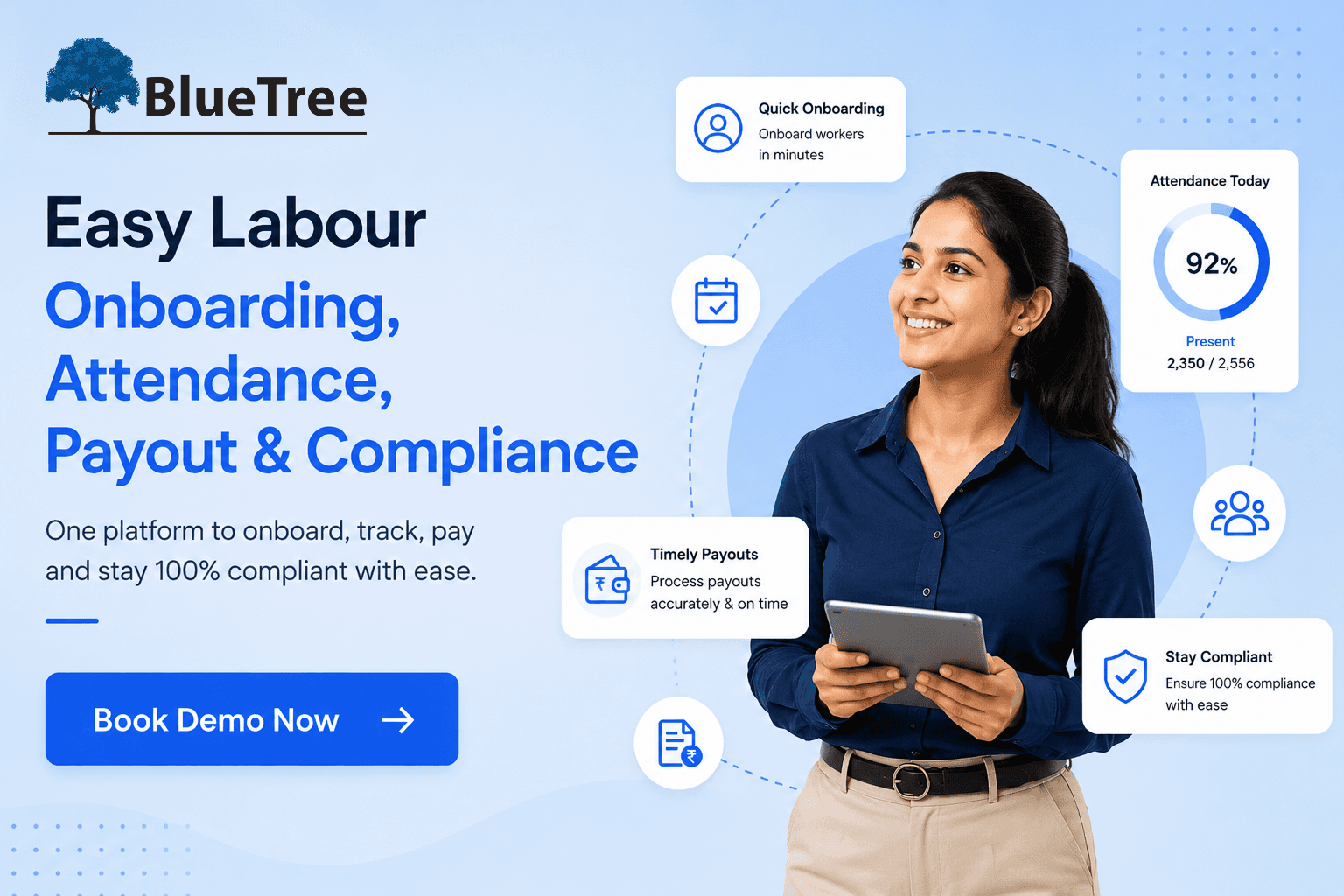
A Contract Labour Management Platform is an enterprise system designed to govern the complete lifecycle of contract and blue-collar workers, from vendor onboarding to worker exit, within a single, controlled framework. It brings together critical workforce functions such as onboarding and identity verification, attendance capture, shift and scheduling management, billing and payouts, compliance oversight, and offboarding, ensuring these processes operate as one connected system rather than disconnected tools.
By linking verified onboarding with real-time attendance, payout-ready billing, continuous statutory tracking, and documented exits, the platform eliminates operational silos and manual dependencies. BlueTree enables this lifecycle-driven approach through a centralized platform purpose-built for enterprise-scale contract labour operations, helping organizations maintain visibility, consistency, and governance across vendors, locations, and workforce volumes.
For enterprises comparing solutions, contract labour management system software should connect everyday workforce activity with clear oversight rather than create another isolated database. Contract labour management software can help teams coordinate vendor records, attendance, documentation, and payout checks through a shared workflow. When evaluating contract labour management software india options, organizations should consider multi-location reporting, user access, and how easily the platform fits existing operations. A contract labour management system india search should lead decision-makers to assess practical workflow coverage, support, and implementation needs. The right contract worker management approach also depends on clear responsibilities across vendors, site teams, HR, finance, and compliance.
Why Contract Labour Management Platform Is Critical for Enterprises
For enterprises operating at scale across manufacturing, logistics, retail, and eCommerce, contract labour forms the backbone of daily execution. As workforce volumes, vendor dependencies, and operational complexity increase, managing contract labour through fragmented processes exposes organizations to cost, compliance, and continuity risks. A structured platform provides the system-level control required to govern this workforce reliably.
For HR, operations, and business leaders, such a platform delivers clear, measurable advantages:
Controlled workforce scaling: Enables rapid workforce expansion across plants, warehouses, stores, and delivery networks without increasing permanent headcount.
Reduced cost leakages: Validates attendance, shifts, and overtime before they flow into billing and payouts, minimizing errors and disputes.
Consistent operations across vendors and locations: Standardizes onboarding, attendance, shift and scheduling, and offboarding processes across sites and service providers.
Improved audit readiness and regulatory confidence: Embeds compliance tracking and documentation into daily operations, reducing last-minute audit risk.
Reliable workforce data for decisions: Provides accurate, real-time workforce data to support planning, productivity analysis, and cost control.
BlueTree helps enterprises achieve these outcomes by unifying onboarding, attendance, shift and scheduling, compliance, billing and payouts, and offboarding into a single operational system, improving visibility and governance across contract labour operations at scale.
A well-defined contract labour management system gives teams a consistent way to review worker information and resolve exceptions before they affect operations. It can also make contract labour management more transparent by linking attendance and deployment records with the processes that depend on them. For growing organizations, contract worker management becomes easier to coordinate when each party knows what information to provide and who must approve it. A contract labour management system software solution should support these controls without adding unnecessary steps. When comparing contract labour management software india providers, enterprises should look for practical reporting, reliable records, and workflows that reflect their actual workforce model
Key Challenges Without a Contract Labour Management Platform
Enterprises across manufacturing, logistics, retail, and eCommerce that manage contract labour without a unified platform face growing operational and governance challenges as workforce scale increases. Common issues include:
Limited workforce visibility: Lack of real-time insight into worker deployment, attendance, and utilization across sites and vendors.
Inconsistent onboarding and verification: Varying onboarding practices across vendors leading to identity, documentation, and eligibility gaps.
Statutory and documentation gaps: Missing or fragmented registers, licenses, and compliance records that increase audit and regulatory risk.
Payout discrepancies and delays: Attendance and shift mismatches resulting in billing errors, disputes, and delayed payouts.
Manual dependency at scale: Heavy reliance on spreadsheets, emails, and follow-ups, making coordination slow and error-prone.
As contract labour volumes grow, these challenges compound and directly impact cost control, compliance confidence, and operational continuity. BlueTree addresses these risks by acting as a single source of truth for contract labour data and processes, bringing structure, visibility, and governance to enterprise-scale operations.
Without connected workflows, contract labour management can become difficult to oversee as worker volumes and vendor networks expand. A contract labour management system india solution may help bring records and processes together, but teams should first define their data requirements and approval responsibilities. Effective contract worker management also depends on timely updates from vendors and clear escalation paths for missing or inconsistent information. A contract labour management system should make exceptions visible so teams can resolve them before they lead to avoidable delays. Enterprises assessing contract labour management software india should therefore review how each option supports day-to-day coordination, not just the list of features.
Which Industries Benefit From a Contract Labour Management System?
A contract labour management system can be useful wherever enterprises depend on a large, distributed workforce and need consistent oversight across contractors, sites, and shifts. The operational needs vary by industry, but the common requirement is clear: organizations need reliable workforce information, traceable processes, and a practical way to coordinate vendors and internal teams.
Manufacturing: Supports worker onboarding, attendance, shift allocation, overtime tracking, and workforce records across plants and production lines.
Warehousing and logistics: Helps coordinate deployment across hubs, warehouses, dispatch operations, and distribution networks where demand can change quickly.
Retail and eCommerce: Supports workforce planning across stores, fulfilment centres, and other customer-facing or high-volume locations.
Construction and project sites: Helps teams manage site-based workers, changing headcounts, document status, and project-related workforce records.
Facility management: Supports visibility into workers deployed across client locations, including attendance, vendor details, and relevant compliance records.
The value of a contract labour management system is not limited to one sector. It is most relevant when multiple vendors and locations make it difficult to maintain consistent records and accountability. A contract labour management system can help standardize the way teams track workforce activity while allowing each site to follow its operational requirements.
Across industries, contract labour management system software can help teams maintain consistent workforce information even when deployment patterns differ by site. A contract labour management software platform is especially useful when operations need to coordinate many vendors, shifts, or locations. A contract labour management system india solution should also be assessed against the organization’s local operating and compliance requirements. With clear workflows, contract worker management can become more predictable for both site supervisors and central teams. These capabilities help contract labour management remain organized as workforce needs change.
What Are the Best Practices for Effective Contract Labour Management?
Effective contract labour management starts with clearly defined responsibilities and repeatable processes. Rather than relying on individual follow-ups or disconnected spreadsheets, enterprises can establish practical controls that make workforce activity easier to monitor and review.
Standardize worker onboarding: Use consistent information requirements and verification steps across vendors, while allowing for applicable site-specific requirements.
Maintain accurate attendance records: Capture attendance and working hours consistently so the information can be checked before billing and payouts.
Track applicable compliance obligations: Keep relevant registrations, licences, records, and renewal dates organized, and confirm requirements for each location and workforce category.
Connect operational data: Align onboarding, attendance, shift schedules, billing, payouts, and offboarding so teams are not repeatedly reconciling disconnected records.
Define ownership and escalation paths: Make it clear who reviews missing documents, resolves discrepancies, and approves changes.
Review performance regularly: Use workforce reports to identify recurring delays, attendance mismatches, and process gaps across vendors and locations.
These practices make contract labour management more consistent and easier to govern. A contract labour management system can support the practices by giving authorized teams shared visibility into workforce records and pending actions, but the organization still needs clear ownership and regular review.
How Does a Contract Labour Management System Work?
A contract labour management system typically connects the main stages of the contract workforce lifecycle. The exact workflow depends on the organization’s operating model, but a common process includes:
Vendor and requirement setup: Record vendor details, work orders, site requirements, and the workforce needed for each assignment.
Worker onboarding and verification: Collect worker details and relevant documents, then complete the applicable identity and eligibility checks.
Deployment and attendance: Assign workers to locations or shifts and record attendance and working hours.
Shift, overtime, and billing validation: Review attendance and approved working hours before using them for billing, payout calculations, or dispute resolution.
Compliance tracking: Maintain relevant documentation and monitor applicable obligations, deadlines, and records.
Offboarding and record closure: Record exits, update deployment information, and retain the required workforce records.
By connecting these stages, a contract labour management system can reduce the need to reconcile information across separate tools. It also gives HR, operations, finance, and compliance teams a clearer view of the workforce lifecycle. The platform works best when processes are defined, information is updated consistently, and access is assigned according to each user’s responsibilities.
A contract labour management system software workflow should make it straightforward to follow a worker’s journey from onboarding through deployment and exit. Contract labour management software can connect the relevant records, while contract worker management practices define who updates and reviews them. When comparing contract labour management software india solutions, check whether teams can trace changes and review pending actions across locations. A contract labour management system india platform should fit the organization’s vendor model and existing operating processes. Ultimately, contract labour management works best when technology supports clear procedures and accountable teams.
When selecting a platform, enterprises should compare how a contract labour management system india solution handles their locations, workforce model, and operational requirements. They should also assess whether the contract labour management system software provides clear reporting and role-based access, and whether the contract labour management software india option supports their vendor workflows and implementation needs.
Conclusion
Contract labour is central to how modern enterprises run large-scale, blue-collar operations, but managing this workforce through disconnected tools and vendor-driven processes creates operational risk, cost leakage, and compliance exposure. This platform brings structure, visibility, and governance to this complexity by unifying vendor management, onboarding, attendance, shift and scheduling, billing and payouts, compliance, and offboarding into a single operational system.
BlueTree supports enterprises in managing high-volume contract labour at scale through standardized workflows, audit-ready records, and centralized oversight. For HR and operations leaders, this reduces manual dependency and improves day-to-day control. For business leaders, it enables predictable, scalable growth built on reliable and governed workforce execution.


Manage External Workforce with BlueTree - Govern contract, gig, and blue collar workers across vendors, sites, and shifts.
Frequenty Asked Questions
4-5 Minutes
|
All
category
Global Payroll Week 2026: Why Blue Collar Payroll Needs Better Governance
Read More >

7-8 Minutes
|
All
category
What Are the 4 Labour Codes in the New Labour Laws in India? A Complete Guide
Read More >

15 to 17 minutes
|
All
category
What Are the New External Workforce Trends in 2026?
Read More >