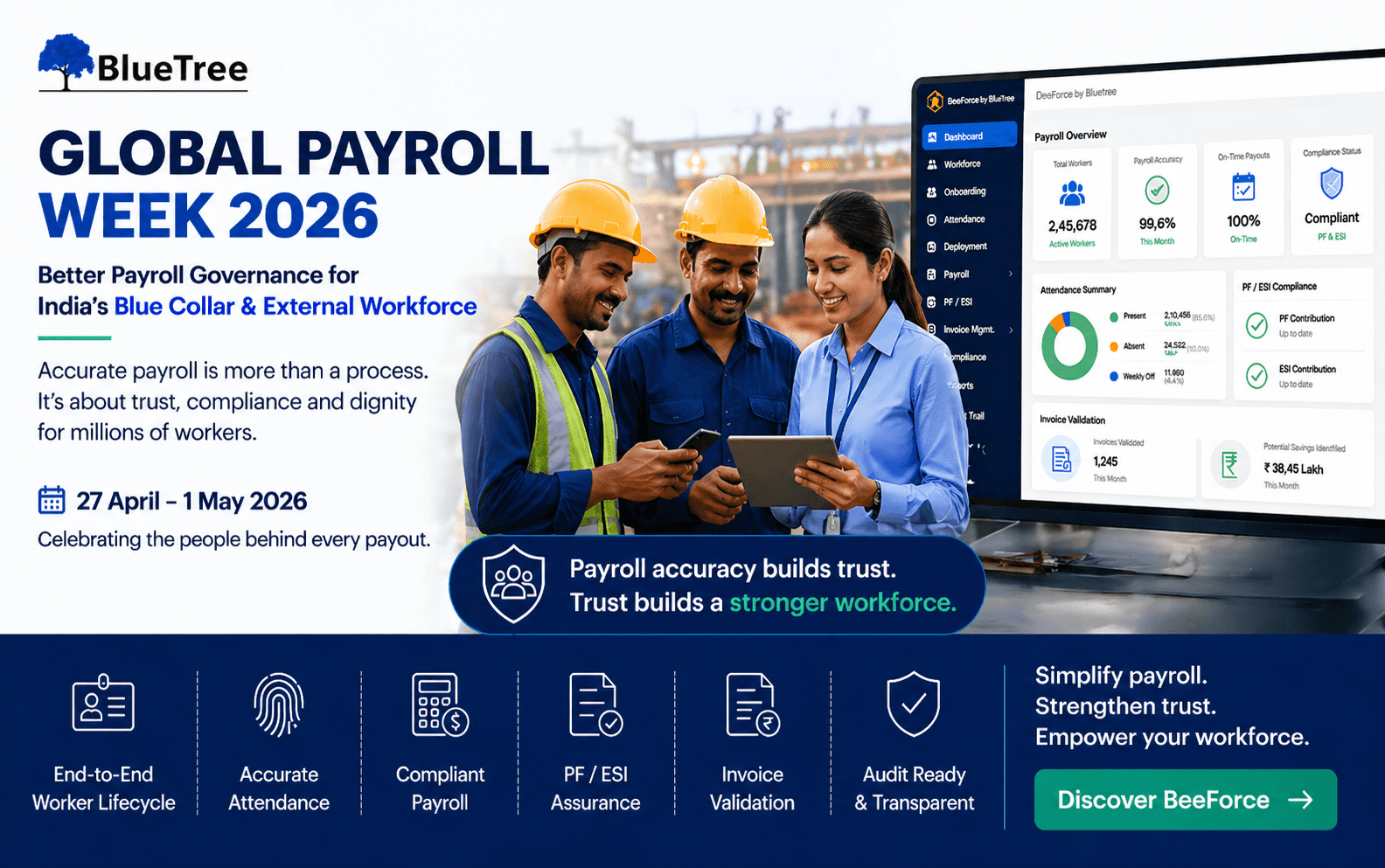
Global Payroll Week 2026 is a reminder that payroll is more than a back office function. For India’s blue collar and external workforce, payroll directly impacts trust, dignity, compliance, and livelihood.
This blog explains why blue collar payroll is structurally different from traditional employee payroll, especially when workers are managed across contractors, vendors, sites, supervisors, and business units.
It also highlights how connected workforce systems like BeeForce by BlueTree can help enterprises improve payroll accuracy by linking onboarding, attendance, deployment, PF/ESI, compliance, invoice validation, and audit trails into one governed operating layer.
Introduction
Global Payroll Week 2026 is a reminder that payroll is no longer a back-office transaction.
It is a trust system.
It is a compliance system.
It is a workforce experience system.
It is a finance control system.
It is an operating discipline.
Payroll Organisations positioned Global Payroll Week 2026 around education, global payroll capability, AI, automation, compliance, and human accountability, with the 2026 event running from 27 April to 1 May 2026. The theme is relevant because payroll teams are no longer only expected to process wages. They are expected to protect accuracy, compliance, transparency, and trust at scale.
This is especially important for enterprises that manage large blue-collar, contract, gig, field, off-roll, daily wage, piece-rate, and vendor-managed workforces.
In these workforce environments, payroll does not begin with salary calculation.
It begins much earlier.
Payroll depends on whether the worker was onboarded correctly, whether identity was verified, whether attendance was captured accurately, whether shifts were mapped correctly, whether overtime was approved, whether wage rules were updated, whether PF and ESI data was available, whether vendor records were aligned, and whether payroll inputs were validated before closure.
For permanent employees, payroll may be relatively structured. Employee records are stable. Salary structures are defined. Locations are fixed. Attendance exceptions are fewer. Payroll cycles follow a predictable pattern.
For blue-collar and external workforces, payroll is structurally different.
Workers move across vendors, sites, shifts, departments, wage categories, contracts, and worker types. Their payouts may depend on daily attendance, approved overtime, piece-rate output, shift allowances, incentives, deductions, minimum wage applicability, statutory contributions, and contractor billing rules.
This creates a payroll environment where errors are not isolated mistakes.
A missed attendance punch can become an underpayment issue.
An unapproved overtime entry can become a compliance exposure.
A wrong wage master can create minimum wage risk.
A duplicate worker record can create payroll leakage.
A vendor-submitted attendance mismatch can create invoice disputes.
A missing statutory field can delay PF or ESI readiness.
A delayed correction can damage worker trust.
This is why Global Payroll Week 2026 is not only relevant to payroll professionals. It is relevant to CHROs, CFOs, HR Operations leaders, compliance heads, plant HR teams, operations leaders, finance teams, procurement teams, and business leaders.
The enterprises that build stronger payroll governance today will be better prepared for the future of workforce operations.
The future of payroll will belong to organizations that can connect workforce data, attendance, compliance, payroll, vendor billing, approvals, and intelligence into one governed operating model.
Why Payroll for Blue-Collar Workers Matters More?
Payroll matters for every worker, but for blue-collar workers, payroll accuracy has a more immediate and visible impact.
For many frontline workers, wages support monthly household expenses, food, rent, transport, school fees, medical costs, loan repayments, and family commitments.
A payroll error is not just a system issue. It can become a real financial stress.
Even small errors can create dissatisfaction.
If one day of attendance is missed, the worker may lose wages.
If overtime is not approved, the worker may feel underpaid.
If deductions are unclear, trust reduces.
If wage slips are not available, the worker may not understand the payout.
If salary is delayed, the worker may leave or raise a grievance.
For enterprises, this makes blue-collar payroll a direct driver of workforce trust.
Payroll accuracy affects:
Worker retention
Attendance discipline
Grievance volume
Supervisor credibility
Vendor accountability
Compliance readiness
Finance control
Site productivity
Industrial relations stability
Employer brand among frontline workers
In blue-collar environments, payroll also has a strong operational link.
A worker who is repeatedly underpaid may stop accepting overtime. A group of workers facing payout disputes may slow down operations. Vendors facing delayed invoice approvals may delay replacement labour. Supervisors may spend hours resolving attendance and payout queries instead of managing production, service delivery, or site operations.
Payroll errors can also increase attrition.
If a worker joins a site and faces payout confusion in the first payroll cycle, the worker may exit quickly. For enterprises already facing high frontline attrition, payroll accuracy becomes a retention lever.
This is why blue-collar payroll must be treated differently from standard payroll.
It is not only about calculating wages.
It is about ensuring that the worker’s entire operating record is accurate before payout:
Worker identity
Vendor mapping
Site allocation
Attendance
Shift
Overtime
Leave or absence
Wage rate
Allowance
Deduction
Statutory information
Bank details
Payroll eligibility
Vendor billing status
For HR leaders, accurate payroll improves trust.
For CFOs, it improves labour cost control.
For compliance teams, it improves statutory readiness.
For operations teams, it improves site stability.
For workers, it creates predictability and fairness.
That is why payroll for blue-collar workers matters more than most enterprises realize.
HRMS Usage Issues: External Workforce Payroll Systems are Structurally Different
Most HRMS platforms were designed for permanent employee management.
They are useful for maintaining employee records, leave, salary structures, payslips, performance workflows, and standard payroll inputs.
But external workforce payroll is structurally different.
External workforce payroll must manage workers who are often not part of a stable employee hierarchy. These workers may be:
Contract workers
Gig workers
Daily wage workers
Piece-rate workers
Apprentices
Trainees
Vendor-supplied workers
Seasonal workers
Shift-based workers
Site-based workers
Field workers
Project-based workers
A standard HRMS may store worker data, but it may not manage the operational complexity that creates payroll accuracy.
External workforce payroll depends on several upstream processes that usually sit outside a general HRMS.
These include:
Vendor onboarding
Contractor master validation
Work order mapping
Worker onboarding
Identity verification
Site allocation
Skill or category mapping
Attendance capture
Shift assignment
Overtime approval
Minimum wage validation
Statutory data capture
Bank validation
Payroll input readiness
Vendor billing reconciliation
Compliance record generation
If these processes are not connected, payroll teams depend on spreadsheets, attendance exports, vendor submissions, emails, manual corrections, and finance follow-ups.
That is where payroll risk begins.
Standard HRMS systems may not manage vendor-worker relationships deeply
External workers are often linked to vendors, contractors, work orders, cost centres, sites, departments, and contract terms.
A payroll error may occur simply because a worker is mapped to the wrong vendor or wrong site.
This creates problems for:
Payroll allocation
Vendor billing
Cost centre reporting
Compliance ownership
Attendance validation
Exit tracking
A general HRMS may not provide the depth required for vendor-wise workforce governance.
Attendance complexity is higher for external workers
Blue-collar attendance is not a simple present or absent record.
It may involve:
Multiple shifts
Night shifts
Rotational shifts
Split shifts
Weekly offs
Holiday work
Overtime
Late arrivals
Early exits
Missing punches
Regularization
Site transfer
Biometric failures
Mobile attendance
Geo-tagged attendance
Supervisor approval
If attendance exceptions are not closed before payroll, errors move directly into payout.
External workforce pay models are more variable
Permanent employee payroll is usually based on fixed salary structures.
External workforce payroll may include:
Daily wages
Piece-rate pay
Monthly wages
Attendance incentives
Shift allowances
Productivity incentives
Overtime
Statutory deductions
Advances
Recoveries
Contractor service charges
Vendor billing rules
A generic HRMS may not handle this variation without manual workarounds.
Payroll and vendor invoicing are connected
For contract workers, payroll and vendor billing are linked.
If payroll is calculated using verified attendance, but the vendor invoice is submitted using headcount summaries or contractor attendance sheets, mismatches occur.
These mismatches create repeated disputes between HR, finance, procurement, site teams, and vendors.
Compliance cannot be handled after payroll
External workforce payroll must be compliance-ready before closure.
This includes:
Minimum wage validation
PF and ESI readiness
Overtime compliance
Wage slip accuracy
Contractor records
Statutory registers
Deductions
Payment proof
Vendor statutory proof
Audit trails
If compliance checks happen after payroll, the enterprise is already late.
This is why external workforce payroll systems need to be designed around workforce execution, not only payroll calculation.
“First Time Right” Payroll Starts Before Payroll Day
Payroll accuracy is often measured on payroll day.
But the first time right payroll does not start on payroll day.
It starts at onboarding.
If the worker master is wrong, payroll will be wrong.
If vendor mapping is wrong, billing will be wrong.
If attendance is wrong, payable days will be wrong.
If shift data is wrong, overtime may be wrong.
If wage rates are wrong, payout will be wrong.
If statutory details are missing, compliance will be wrong.
If exceptions are pending, payroll will require corrections.
Payroll day is only the final output of many daily workforce transactions.
For blue-collar and external workforces, first-time-right payroll requires control across the full workforce lifecycle.
Clean worker master data
Every worker should have one verified profile.
This profile should include:
Name and identity details
Photo
Mobile number
Vendor
Site
Department
Role
Worker category
Wage category
Bank details
UAN where applicable
ESI details where applicable
Joining date
Status
Exit information where applicable
Duplicate worker records, missing bank details, wrong vendor mapping, or incorrect worker category can create payroll errors before attendance is even processed.
Validated attendance capture
Attendance should be captured through reliable systems.
Depending on the operating model, this may include biometric, mobile, geo-tagged, kiosk, QR, device-based, or approved site attendance systems.
For payroll, attendance must answer:
Who worked?
Where did the worker work?
Which shift was assigned?
Was the worker present for the full shift?
Was overtime worked?
Was the exception approved?
Was attendance corrected manually?
Was the correction authorized?
Without validated attendance, payroll teams cannot produce accurate payouts.
Timely exception closure
Payroll errors often come from unresolved exceptions.
Common exceptions include:
Missing punches
Late arrivals
Early exits
Wrong shift mapping
Unapproved overtime
Holiday work
Weekly off work
Leave mismatch
Site transfer
Duplicate attendance
Inactive worker attendance
These exceptions must be closed before payroll processing.
If they are handled after payroll, the enterprise enters correction mode.
Wage rule validation
Wage rules should be validated before payroll closure.
This includes:
Minimum wage applicability
State and zone
Skill category
Scheduled employment
Worker category
Wage period
Allowance eligibility
Overtime rules
Deduction rules
Effective date of wage revision
If wage masters are outdated, even accurate attendance will produce incorrect payroll.
Statutory readiness
External workforce payroll must be linked to statutory readiness.
Before payroll closure, enterprises should check:
PF details
ESI details
Bank validation
Professional tax where applicable
Labour welfare fund where applicable
Wage slip readiness
Statutory contribution records
Contractor proof
Minimum wage compliance
Overtime compliance
Statutory gaps discovered after payroll create rework, audit exposure, and vendor follow-up.
Vendor billing alignment
For contractor-supplied workers, first-time-right payroll must also support first-time-right vendor invoicing.
Vendor bills should be validated against:
Worker identity
Vendor mapping
Attendance
Approved overtime
Wage rules
Work order
Contract terms
Payable days
Statutory proof
Service charges
Deductions
The goal is not only to pay workers correctly.
The goal is to ensure that payroll, billing, compliance, and workforce records all match.
That is what first-time-right payroll means in an external workforce environment.
When Do Payroll Errors Become Enterprise Risk?
A payroll error may start as a small correction.
But in enterprise environments, payroll errors become risk when they repeat, scale, or affect compliance, cost, trust, or operations.
For blue-collar and external workforces, payroll errors can quickly move beyond payroll teams.
They can affect HR, finance, compliance, operations, vendors, supervisors, and leadership.
When workers lose trust
For blue-collar workers, payroll is immediate.
A wage error is not an abstract issue. It affects household planning, expenses, and confidence in the employer.
When errors repeat, workers may stop trusting supervisors, vendors, HR, and payroll teams.
This can lead to:
Grievances
Attrition
Absenteeism
Informal disputes
Lower willingness to work overtime
Resistance to shift changes
Worker dissatisfaction at site
Payroll trust is workforce trust.
When errors repeat across locations
One payroll error can be corrected manually.
But if the same issue repeats across multiple sites, vendors, or worker categories, it indicates a system problem.
Examples include:
Repeated missing punches
Wrong wage rates across sites
Unapproved overtime appearing in payroll
Vendor attendance mismatch
Wage slip errors
Bank detail failures
PF or ESI data gaps
Duplicate worker records
At scale, small errors become enterprise-wide control issues.
When compliance records become unreliable
Payroll data feeds statutory records.
If payroll data is wrong, then wage registers, wage slips, PF, ESI, deductions, overtime records, and contractor records may also become wrong.
This creates compliance exposure.
The issue may not appear immediately. It may surface during audits, inspections, worker disputes, customer audits, or internal reviews.
When vendor billing is affected
Payroll errors often create vendor billing disputes.
For example:
Vendor bills for 1,000 payable days, but enterprise-approved attendance shows 940
Vendor claims overtime, but approvals are missing
Vendor submits worker wages, but PF or ESI proof is incomplete
Vendor invoice includes inactive workers
Vendor billing rate does not match contract terms
These disputes delay invoice approval and create friction between procurement, finance, HR, and vendors.
When finance loses workforce cost control
Payroll is one of the largest recurring cost lines in workforce-heavy industries.
Errors affect labour cost visibility.
Overtime leakage, duplicate workers, wrong payable days, wrong rates, and manual corrections distort the true cost of labour.
For CFOs, this becomes a financial control issue.
When corrections become routine
If every payroll cycle requires large correction files, manual approvals, late inputs, backdated changes, and repeated reconciliation, the enterprise is not running payroll efficiently.
It is managing payroll recovery.
This is when payroll becomes enterprise risk.
A mature payroll function should reduce corrections over time. If correction volumes remain high, the problem is not payroll effort. The problem is upstream workforce governance.
What Are the Biggest Global Payroll Challenges Enterprises Face Today?
Global payroll challenges are becoming more complex because enterprises are managing more distributed, varied, and compliance-sensitive workforces.
Even when enterprises operate mainly in one country, the same structural issues appear across states, business units, vendors, locations, employment models, and worker categories.
The biggest challenge is no longer payroll calculation alone.
It is payroll governance.
Fragmented workforce data
Payroll teams often depend on data from multiple systems.
This may include:
HRMS
Attendance systems
Vendor files
Biometric devices
Payroll software
Finance systems
Compliance trackers
ERP systems
Spreadsheets
Emails
Site reports
When data is fragmented, payroll becomes reconciliation-heavy.
Teams spend more time validating inputs than improving payroll quality.
Multiple worker categories
Enterprises now manage many workforce types together.
These may include permanent employees, contract workers, gig workers, daily wage workers, piece-rate workers, trainees, apprentices, field workers, and vendor-managed staff.
Each category may have different payroll logic.
A single payroll process cannot handle these categories effectively unless the system supports workforce-level configuration.
Regulatory complexity
Payroll must comply with wage rules, working hours, overtime, statutory deductions, tax requirements, social security, labour welfare contributions, and reporting obligations.
For enterprises operating across states or countries, this complexity increases.
A wage rule change in one location can affect payroll accuracy across hundreds or thousands of workers.
Payroll accuracy pressure
Workers expect accurate and timely payouts.
Leadership expects cost visibility.
Compliance teams expect audit-ready records.
Finance expects reconciliation control.
Payroll teams are expected to deliver all of this within strict timelines.
This creates pressure when source data is incomplete or delayed.
Lack of real-time visibility
Many payroll problems are discovered too late.
By the time payroll teams receive final inputs, attendance errors, overtime gaps, wage rate mismatches, or statutory data issues may already be embedded in the payroll file.
Real-time visibility is essential because payroll errors should be identified before payroll closure, not after wage disbursement.
Manual correction effort
Payroll teams often spend significant time correcting errors caused by upstream processes.
These corrections may include attendance changes, wage changes, bank corrections, statutory data updates, and overtime approvals.
Manual correction effort increases payroll cycle time and weakens audit trails.
Poor integration between payroll and finance
Payroll affects finance directly.
For external workforces, payroll also connects with vendor invoices, cost centres, work orders, overtime exposure, and labour spend reporting.
If payroll and finance are disconnected, the organization cannot confidently answer:
What was the actual labour cost?
Which vendor drove the highest variance?
How much overtime was avoidable?
Where did payroll leakage occur?
Which sites had repeated corrections?
Which invoices are not supported by verified work?
AI without reliable data governance
AI can help payroll teams identify anomalies, predict risks, and improve decision-making.
But AI needs clean data.
If underlying workforce data is fragmented, incomplete, or inconsistent, AI will only accelerate poor decisions.
AI-enabled payroll requires a governed data foundation.
What Makes Global Payroll So Difficult to Manage in 2026?
Payroll in 2026 is difficult because the workforce, compliance environment, technology landscape, and leadership expectations are all changing at the same time.
Payroll teams are expected to manage accuracy, compliance, transparency, data security, employee experience, cost control, and automation together.
This is a structural shift.
Workforce models are more complex
The workforce is no longer limited to permanent employees.
Enterprises increasingly depend on external workers, contract labour, gig workers, daily wage workers, field workers, and vendor-managed teams.
Payroll systems must support these varied models without creating manual workarounds.
Pay structures are more variable
Payouts may include:
Fixed salary
Daily wages
Piece-rate earnings
Incentives
Overtime
Shift allowances
Attendance bonuses
Deductions
Advances
Reimbursements
Statutory contributions
Vendor-linked billing components
Each component needs rules, approvals, validation, and reporting.
Compliance expectations are higher
Enterprises need stronger proof that payroll was processed correctly.
This means they must maintain:
Worker records
Attendance records
Wage records
Overtime approvals
Wage slips
Statutory contribution proof
Deduction records
Vendor billing records
Exception logs
Audit trails
Compliance is no longer only about having records.
It is about proving that records were generated from reliable transactions.
Workers expect transparency
Workers increasingly expect visibility into attendance, wages, deductions, overtime, and payslips.
For blue-collar workers, transparency is especially important because they may depend on supervisors or vendors for payroll explanations.
A digital payroll governance system reduces this dependency.
Payroll teams need better data infrastructure
Many payroll problems are actually workforce data problems.
Wrong master data, missing attendance, outdated wage masters, incorrect site mapping, pending approvals, and vendor mismatches create payroll errors before payroll teams begin processing.
Payroll teams cannot fix poor data at the last stage.
They need better upstream control.
AI is entering payroll governance
AI-enabled payroll can help detect anomalies, identify recurring risks, prioritize exceptions, forecast cost exposure, and support leadership dashboards.
But AI must operate within a governed environment.
AI should not become a black box for payroll decisions.
It must be supported by:
Clear rules
Human review
Audit trails
Data security
Explainable outputs
Exception workflows
Policy-based controls
The challenge in 2026 is not whether payroll can be automated.
The real challenge is whether payroll can be governed intelligently.
Payroll Is Becoming a C-Suite Priority
Payroll is becoming a C-suite priority because it directly affects workforce trust, compliance exposure, finance control, business continuity, and enterprise reputation.
For years, payroll was viewed as an operational function.
That view is changing.
When payroll works well, it is invisible. When payroll fails, it becomes a leadership issue.
For CHROs, payroll affects trust and retention
Payroll accuracy is one of the strongest signals of employer reliability.
If workers are paid correctly and on time, trust improves.
If payroll errors repeat, engagement suffers.
For blue-collar and external workforces, payroll errors can increase attrition, absenteeism, grievances, and worker dissatisfaction.
This makes payroll a core part of workforce experience.
For CFOs, payroll affects cost control
Payroll is a major cost line.
For external workforces, payroll also affects vendor billing, overtime, productivity, and labour utilization.
CFOs need visibility into whether workforce cost is accurate, approved, and aligned with actual work performed.
Payroll leakage is not only a payroll issue. It is a financial control issue.
For compliance leaders, payroll affects statutory risk
Payroll data supports wage registers, PF, ESI, overtime records, deductions, wage slips, and statutory filings.
If payroll data is wrong, compliance records become unreliable.
This is why compliance leaders need payroll inputs to be validated before closure.
For operations leaders, payroll affects continuity
Payroll disputes affect operations.
Workers may avoid overtime, supervisors may spend time resolving wage issues, vendors may delay replacements, and site productivity may suffer.
In workforce-heavy operations, payroll stability supports operational stability.
For procurement leaders, payroll affects vendor governance
Contract workforce payroll is deeply connected to vendor performance.
If vendors submit inaccurate attendance, delayed statutory proof, or inconsistent worker records, payroll and billing become dispute-heavy.
Procurement teams need vendor scorecards that include payroll accuracy, compliance readiness, and billing variance.
For CEOs, payroll affects enterprise credibility
An enterprise that cannot pay its workforce accurately creates trust issues across workers, vendors, regulators, customers, and investors.
Payroll governance therefore belongs on the leadership agenda.
It is not just about paying people.
It is about proving that the enterprise has control over its workforce operating model.
The Future with AI-Enabled Payroll Governance
AI-enabled payroll governance will not replace payroll responsibility.
It will strengthen payroll control when used correctly.
The future of payroll is not only faster calculation. It is better validation, better exception management, better anomaly detection, better compliance visibility, and better decision support.
AI can help payroll teams identify risks before they become payout errors.
But AI will only work if the workforce data foundation is reliable.
Payroll anomaly detection
AI can help identify unusual payroll patterns.
Examples include:
Sudden overtime spikes
Duplicate worker records
Unusual deductions
Missing attendance
Wage rate mismatches
Vendor billing variance
Repeated manual corrections
Payroll amounts outside normal patterns
Inactive workers appearing in payout files
Workers with attendance but missing statutory data
These signals help payroll teams focus on high-risk exceptions.
Predictive payroll risk
AI can help identify sites, vendors, shifts, worker categories, or processes that are likely to create payroll errors.
For example:
A site that repeatedly submits attendance late
A vendor with high correction rates
A shift with abnormal overtime
A role category with frequent wage mismatches
A location with repeated statutory data gaps
These patterns can be identified before payroll closure.
Faster exception prioritization
Not all payroll exceptions carry the same risk.
AI can help prioritize exceptions based on impact.
A missing punch for one worker may be low risk.
A minimum wage shortfall affecting hundreds of workers is high risk.
A vendor invoice variance across multiple sites is high risk.
A recurring overtime breach may become compliance exposure.
AI can help payroll teams focus on the right issues first.
Compliance rule monitoring
AI-enabled payroll systems can help monitor whether wage rules, overtime rules, deductions, statutory inputs, and approval workflows are being applied consistently.
This improves compliance visibility.
However, final responsibility must remain with enterprise policy owners and human reviewers.
Payroll intelligence for leadership
AI can turn payroll data into leadership intelligence.
It can help answer:
Which sites are causing payroll corrections?
Which vendors create the most billing variance?
Which worker categories have the highest payroll disputes?
Where is overtime cost increasing?
Where is wage leakage likely?
Which compliance gaps are recurring?
Which payroll controls are improving?
This moves payroll from a processing function to an intelligence function.
Human accountability remains essential
Payroll involves worker income, statutory obligations, financial reporting, and enterprise trust.
AI should assist payroll governance, not replace accountability.
AI-enabled payroll must include:
Defined rules
Human review
Approval workflows
Audit trails
Role-based access
Data security
Explainable outputs
Exception ownership
Governance dashboards
The future is not autonomous payroll without control.
The future is governed by payroll with better intelligence.
How BeeForce by Bluetree Solves This Problem
BeeForce by BlueTree helps enterprises manage payroll readiness and governance for large blue-collar and external workforces.
It is designed for workforce environments where payroll accuracy depends on onboarding, worker identity, attendance, shifts, overtime, compliance, vendor data, payroll inputs, and billing reconciliation.
BeeForce does not treat payroll as an isolated month-end activity.
It connects the workforce lifecycle before payroll day.
Worker identity and master data control
BeeForce helps enterprises maintain structured worker records across vendors, sites, departments, roles, wage categories, and employment types.
This reduces duplicate records, wrong mapping, inactive worker errors, and payroll input gaps.
A clean worker master becomes the foundation for payroll accuracy.
Digital onboarding and payout readiness
BeeForce supports high-volume onboarding across sites and vendors, with worker profiles, document capture, identity checks, bank validation, statutory readiness, and approval workflows.
This ensures that workers become payout-ready before they enter payroll cycles.
A worker who is not payout-ready should not become a payroll exception later.
Attendance and shift visibility
BeeForce helps capture and manage attendance across blue-collar and external workforce environments.
Attendance can be connected with shifts, approvals, exceptions, overtime, and payroll readiness.
This improves first-time-right payroll because payroll teams receive validated inputs instead of raw attendance data.
Exception management before payroll closure
BeeForce helps teams identify and resolve issues before payroll is processed.
These include:
Missing punches
Shift deviations
Unapproved overtime
Inactive workers
Worker category mismatches
Pending approvals
Bank validation failures
Statutory data gaps
Vendor mapping errors
This reduces correction cycles and improves payroll confidence.
Compliance-linked payroll readiness
BeeForce supports better payroll readiness by connecting worker records, attendance, wage-related inputs, statutory data, approvals, and compliance requirements.
This helps enterprises reduce gaps in:
PF
ESI
Minimum wages
Overtime
Deductions
Wage slips
Statutory records
Contractor proof
Audit trails
Payroll becomes compliance-ready before closure.
Vendor billing reconciliation
For contract and vendor-managed workers, BeeForce helps align payroll-ready data with vendor invoices.
Vendor bills can be validated against:
Verified attendance
Worker deployment
Approved overtime
Wage rules
Contract terms
Work order mapping
Compliance inputs
Payable days
Service charges
Exceptions
This reduces billing disputes and improves finance control.
Dashboards for HR, payroll, finance, and leadership
BeeForce provides visibility into workforce data, attendance status, payroll readiness, pending exceptions, compliance gaps, vendor-level issues, and billing variances.
This helps leadership move from reactive payroll correction to proactive payroll governance.
Workforce intelligence layer
BeeForce helps enterprises understand recurring payroll risks.
Teams can identify which sites, vendors, shifts, worker categories, or processes are causing payroll delays, disputes, corrections, or compliance gaps.
This creates a stronger foundation for AI-enabled payroll governance.
Built for external workforce complexity
General payroll or HRMS systems may not fully address external workforce realities.
BeeForce is built for contract labour, gig workers, blue-collar workforce, vendor-managed labour, attendance-linked payroll, compliance readiness, and workforce lifecycle governance.
This is where it helps enterprises create a stronger payroll operating model.
Conclusion
Global Payroll Week 2026 is a reminder that payroll is one of the most important trust systems inside an enterprise.
For blue-collar and external workforces, payroll accuracy is even more critical because it directly affects worker income, retention, compliance, vendor relationships, finance control, and operational continuity.
Payroll errors do not begin on payroll day.
They begin earlier, when worker identity is incomplete, attendance is inaccurate, overtime is unapproved, wage rules are outdated, statutory inputs are missing, vendor data is disconnected, or exceptions are not closed in time.
That is why enterprises need to think of payroll as a governance process, not only a calculation process.
The future of payroll will be shaped by better data, stronger workflows, AI-enabled risk detection, real-time dashboards, and human accountability.
But technology will only work if the underlying workforce data is accurate and connected.
BlueTree BeeForce helps enterprises build this connected payroll governance model for blue-collar and external workforces by linking onboarding, attendance, shifts, overtime, compliance, payroll readiness, vendor billing, approvals, and workforce intelligence.
The outcome is stronger payroll accuracy, better worker trust, improved compliance readiness, reduced vendor disputes, and greater leadership visibility.
In 2026, payroll is no longer only about getting people paid.
It is about getting people paid accurately, compliantly, transparently, and on time, at enterprise scale.


Manage External Workforce with BlueTree - Govern contract, gig, and blue collar workers across vendors, sites, and shifts.
Frequenty Asked Questions
4-5 Minutes
|
All
category
Global Payroll Week 2026: Why Blue Collar Payroll Needs Better Governance
Read More >
7-8 Minutes
|
All
category
What Are the 4 Labour Codes in the New Labour Laws in India? A Complete Guide
Read More >
15 to 17 minutes
|
All
category
What Are the New External Workforce Trends in 2026?
Read More >