External workforce trends in 2026 show a major shift from manual contractor coordination to structured enterprise workforce governance. The blog explains how external workforce management is becoming more strategic as enterprises manage contract, gig, task-based, vendor-managed, fixed-term, and other off-roll workforce categories across multiple sites and industries. It highlights key trends such as day-zero readiness, worker verification, compliance visibility, attendance-to-payout integrity, vendor accountability, multi-model workforce planning, and location-wise visibility. The blog also explains the external workforce ecosystem and why HR leaders must build connected systems across onboarding, attendance, payouts, billing, and compliance to scale safely and reduce operational risk.
Introduction
External workforce trends in 2026 show a clear shift in how enterprises plan, manage, and govern non-payroll workforce categories. The external workforce is no longer a secondary category in enterprise manpower planning. In many industries, it now represents a large and operationally critical share of the total workforce.
Manufacturing plants rely on contract labour for production continuity. Logistics and warehousing networks depend on flexible workforce models during peak demand periods. Retail, e-commerce, facility management, and services businesses need workforce elasticity across locations, vendors, and demand cycles.
At the same time, HR, finance, operations, and compliance teams are under pressure to bring more structure to a workforce segment that has historically been managed through fragmented vendor practices, spreadsheets, emails, and reactive follow-up.
That is why external workforce trends in 2026 are not about volume alone. They are about visibility, governance, workforce readiness, compliance traceability, payout accuracy, and vendor accountability.
Enterprises are moving away from seeing external workforce management as a contractor coordination issue. They now see it as a system problem involving worker identity, onboarding readiness, attendance integrity, statutory visibility, payout control, billing accuracy, and vendor-level governance.
That shift is defining the external workforce agenda in 2026.
The State of the External Workforce in 2026
The external workforce in 2026 is broader, more visible, and more strategic than before.
Large enterprises are no longer dealing with one workforce model. They are managing a multi-model workforce environment where permanent, fixed-term, contract, gig, task-based, and vendor-managed categories often coexist.
This matters because each workforce type comes with a different legal position, cost structure, operating dependency, and risk profile.
Contract workforce may be deployed through vendors, but the enterprise still carries serious oversight responsibility. Gig models may offer flexibility, but regulatory interpretation continues to evolve. Fixed-term employment may reduce vendor dependency, but it increases direct compliance ownership.
The enterprise challenge is not choosing one workforce model. It is managing multiple workforce models with clarity.
In 2026, mature enterprises are asking a new set of questions:
Do we know exactly who is working at each site, under which vendor, and under what engagement model?
Can we verify whether workers are onboarding-ready, site-ready, and payout-ready before deployment?
Do attendance, overtime, billing, and statutory records align?
Can we identify weak vendors before they become audit, payout, or operational problems?
Do we have one operating view of the external workforce ecosystem, or only disconnected process fragments?
These questions define the state of the market.
The organizations that manage this well will not treat external workforce management as an isolated HR activity. They will treat it as an enterprise operating system across HR, operations, finance, compliance, vendors, and sites.
Top External Workforce Trends Shaping 2026
External workforce management is moving from operational administration to enterprise governance
This is one of the most important external workforce trends in 2026.
Earlier, many organizations treated the external workforce as a field-level execution problem. In 2026, it is increasingly being managed as an enterprise control layer.
The reason is simple: when workforce scale rises, process gaps become business risk.
A delayed onboarding is not just an HR issue. It affects shift readiness and production start.
A missed attendance correction is not just an admin issue. It affects wages, vendor billing, and worker trust.
A contractor default is not only a vendor problem. It can create statutory exposure and principal employer risk.
This is why enterprises are shifting from manual coordination to system-led governance.
For enterprise HR teams, the goal is not only to digitize workforce records. It is to improve workforce readiness, reduce compliance exposure, prevent payout disputes, improve vendor accountability, and create a single source of truth across sites.
External workforce governance also helps leadership move from reactive problem-solving to proactive control. Instead of discovering issues during audits, wage escalations, or vendor disputes, enterprises can track exceptions earlier and act before they become business risks.
Day-zero readiness is becoming a serious operating expectation
Enterprises no longer want workers to arrive first and complete documentation later. They want workers to be deployment-ready before they report to site.
Day-zero readiness means a worker is:
Site-eligible
Compliance-eligible
Payout-eligible
Verified for identity and documents
Mapped to the right contractor, location, department, and role
Ready for induction, access, attendance, and wage processing
This trend is especially important in manufacturing, logistics, warehousing, and other site-led operations where a worker who is physically present but not system-ready can still create downtime.
In 2026, onboarding is no longer only about collecting documents. It is about ensuring that every required condition is completed before deployment.
That includes identity validation, document completion, bank verification, statutory creation or validation, induction readiness, and contractor master approval.
For enterprises, day-zero readiness reduces avoidable delays, strengthens worker data quality, and improves control before the worker enters the operating environment.
Worker identity and verification controls are becoming foundational
One of the biggest shifts in 2026 is the rise of verification-led workforce control.
Enterprises are putting more emphasis on:
Worker identity accuracy
Duplicate prevention
Aadhaar or alternate ID validation based on policy
Face match checks
Bank validation
Traceable onboarding approvals
Rehire and blacklist checks where applicable
This is not only about fraud prevention. It is about improving data quality across the full external workforce lifecycle.
If worker identity is weak at the point of onboarding, every downstream process becomes weaker.
Attendance disputes become harder to resolve. Payroll and payout errors increase. Re-joining history cannot be tracked properly. Vendor quality becomes harder to assess. Audit support becomes slower.
That is why verification is becoming a foundational external workforce trend, not just an onboarding feature.
In high-volume blue-collar and off-roll workforce environments, even a small percentage of inaccurate worker data can create major downstream impact. Identity errors can affect attendance mapping, statutory records, bank payments, vendor billing, and exit processing.
For enterprises, verified worker data is becoming the starting point of workforce control.
Compliance visibility is shifting from document storage to live monitoring
In many organizations, compliance was historically managed as file collection. In 2026, that is not enough.
Enterprises want active visibility into:
PF and ESIC remittances
Non-remittance flags
Minimum wage adherence
License and registration coverage
Statutory register readiness
Vendor-wise compliance performance
Site-wise compliance gaps
Audit-ready records
The trend here is important: compliance is no longer only about whether records exist. It is about whether exceptions are visible early enough to act.
For large enterprises, this shift is visible in the growing demand for real-time PF and ESIC validation, minimum wage adherence reporting, vendor-wise dashboards, and audit-ready workforce records.
Modern external workforce platforms are increasingly expected to support worker verification, contractor governance, statutory tracking, and location-wise visibility in one connected workflow.
For CHROs and compliance leaders, this changes the role of compliance from a month-end or audit-time activity to a continuous operating discipline.
Attendance-to-payout integrity is becoming a key control trend
Another major external workforce trend in 2026 is tighter linkage between attendance, overtime, shifts, approvals, payout preparation, and vendor billing.
Enterprises are realizing that the external workforce cannot be managed properly when these processes sit in separate tools or manual loops.
Attendance mismatches create payout delays. Overtime errors create wage disputes. Billing disagreements create vendor friction. If HR, operations, finance, and vendor teams all work from different versions of data, control is lost.
That is why organizations are prioritizing connected workflows instead of isolated modules.
A strong attendance-to-payout control model should answer:
Was the worker eligible to work?
Was the worker mapped to the correct site, shift, and contractor?
Was attendance captured accurately?
Was overtime approved correctly?
Was the payout calculated using approved attendance and wage rules?
Was vendor billing aligned to the same source of truth?
In 2026, attendance is not just an operational record. It is the foundation for payout accuracy, billing control, worker trust, and compliance readiness.
For enterprises managing large external workforces, this linkage is critical. When attendance, payouts, billing, and compliance records do not align, the result is not only administrative delay. It can lead to worker dissatisfaction, vendor disputes, financial leakage, and audit risk.
Vendor governance is becoming as important as worker governance
In 2026, enterprises are paying much more attention to the vendor layer within the external workforce ecosystem.
This includes:
Contractor master validation
Work order or PO gating
License and statutory document tracking
Vendor correction SLAs
Remittance performance
Contractor-level dashboards
Escalation ownership
Vendor-wise exception trends
This is a critical shift. Mature external workforce programs are not built only around worker records. They are built around worker-plus-vendor governance.
If the vendor master is weak, onboarding can begin under the wrong structure. If work orders are not mapped, workforce deployment can exceed approved limits. If remittance performance is not tracked, compliance issues may surface only during audit or escalation.
For enterprises, vendor governance is no longer a procurement-only topic. It is a workforce risk and operating control topic.
A good vendor governance model should help enterprises understand which vendors are performing well, which vendors repeatedly delay corrections, which vendors create compliance exceptions, and which vendors need stronger oversight. In 2026, vendor workforce management will become a core part of enterprise workforce governance, especially for organizations operating across multiple sites, contractors, and workforce categories. Vendor accountability will increasingly become a measurable operating metric.
Multi-model workforce strategy is replacing one-model thinking
Many enterprises previously framed workforce decisions too simply: permanent versus contract.
That is no longer enough.
The external workforce ecosystem in 2026 includes contract, gig, task-based, vendor-managed, piece-rate, flexi, and fixed-term categories. Each model is suited to different business needs.
For example:
Manufacturing may need contract labour for production support and plant operations.
Warehousing may need flexible workers for peak movement.
Retail may need seasonal or location-based support.
Field services may need task-based or distributed workforce models.
Facility management may depend heavily on vendor-managed manpower.
Enterprises should not treat all workforce models as interchangeable. Each model should be aligned to the nature of work, required control, compliance responsibility, cost structure, and flexibility needs.
This makes multi-model planning one of the defining external workforce trends of 2026.
For HR leaders, the key challenge is to build governance that can support workforce flexibility without losing visibility, accountability, or compliance discipline.
Visibility across sites is becoming a competitive advantage
In a single-site environment, manual oversight may work for longer. In a multi-site enterprise, it breaks faster.
This is why enterprises are increasingly investing in location-level dashboards, contractor-level views, and workforce status visibility across sites.
In 2026, HR and operations leaders need visibility into:
Who is active at each site
Which vendor deployed each worker
Which workers are onboarding-ready
Which workers are blocked due to verification or statutory gaps
Which sites have attendance exceptions
Which vendors have repeated payout or compliance issues
Which locations are exposed to workforce readiness risk
The ability to see workforce readiness, compliance status, vendor performance, and operational exceptions across locations is becoming a differentiator.
For enterprise HR leaders, visibility is no longer reporting. It is controlled.
When leaders have only consolidated month-end reports, they are often looking at problems after they have already occurred. When they have live location-wise visibility, they can intervene earlier and manage risk more effectively.
Understanding the External Workforce Ecosystem
The external workforce ecosystem is the full operating environment around non-payroll or non-core workforce deployment.
In simple terms, it is not just the workers. It includes every process, party, and control needed to source, onboard, verify, deploy, track, pay, bill, and govern that workforce at scale.
A typical external workforce ecosystem includes:
Enterprise HR and HR operations teams
Compliance and payroll stakeholders
Site and security teams
Finance and billing reviewers
Contractors, staffing vendors, and aggregators
Workers across contract, gig, piece-rate, and task-based models
Identity, bank, and statutory verification processes
Attendance, overtime, shift, and leave tracking
Payout and invoice reconciliation
Audit records, statutory registers, and vendor scorecards
For an enterprise, the external workforce ecosystem is a control network. If one part is weak, the whole system becomes unstable.
For example:
If vendor master validation is weak, onboarding can begin under the wrong structure.
If onboarding is incomplete, day-zero readiness is affected.
If attendance capture is weak, wages and invoices become disputed.
If remittance checks are delayed, vendor issues surface only during audit or escalation.
If visibility is fragmented, leadership gets reports after damage has already been done.
That is the real meaning of the external workforce ecosystem in 2026.
The external workforce ecosystem must be designed as a connected operating model. Worker onboarding, contractor governance, attendance, payouts, billing, compliance, and reporting cannot function as separate islands if the enterprise wants reliable control.
Strategic Implications: What HR Leaders Must Do Now
For CHROs, HR operations leaders, and compliance heads, 2026 requires a more structured external workforce strategy.
Treat external workforce as a governed workforce category
Do not treat it as an unstructured extension of procurement or vendor management. The workforce may be external, but the business dependency is internal and immediate.
External workforce decisions affect production continuity, site readiness, worker trust, statutory exposure, vendor accountability, and cost control.
The starting point is to recognize external workforce management as an enterprise governance priority, not only a manpower administration activity.
Standardize onboarding before scaling
If each vendor follows a different onboarding method, the organization loses control before the worker even joins.
Enterprises need one standard operating model with approval gates, verification rules, exception routing, document checks, statutory readiness, and deployment criteria.
Standardization also reduces dependency on individual coordinators and manual follow-up. It helps every vendor, site, and internal stakeholder work with the same process expectations.
Build one view across onboarding, attendance, payouts, and compliance
Fragmented systems create fragmented control.
The more external workforce volume you have, the more dangerous disconnected workflows become.
A connected view helps HR, finance, compliance, operations, site teams, and vendors work from the same operating truth.
This is especially important when enterprises manage multiple sites, contractors, workforce categories, and wage structures.
Measure risk operationally, not only legally
External workforce risk should not be measured only during audits.
Enterprises should track operational indicators such as:
Day-zero readiness
Duplicate workers blocked
Statutory aging
Attendance mismatch rates
Payout exceptions
Vendor correction time
Compliance deviations
Repeated location-wise exceptions
These are leading indicators of control maturity.
When these indicators are measured regularly, enterprises can identify process weaknesses before they become major business or compliance problems.
Design for vendor accountability
External workforce quality depends heavily on vendor performance.
Enterprises should increasingly track vendor readiness, correction SLAs, remittance quality, document discipline, and repeat exception patterns, not just worker counts.
A vendor who supplies manpower but repeatedly creates data, attendance, payout, or compliance gaps should be visible to HR and leadership.
Vendor accountability should move from relationship-based follow-up to data-backed governance.
Build for multi-model workforce reality
The future will not be permanent employees alone, contract labour alone, or gig alone.
Enterprises need governance models that support mixed workforce structures without losing visibility, payout accuracy, or compliance control.
This requires systems, processes, and dashboards that can handle different engagement models while still maintaining one consistent control framework.
External Workforce Trends by Industry
Manufacturing
Manufacturing continues to depend heavily on contract workforce for plant operations, line support, material movement, maintenance support, and facility activities.
The key 2026 trends in manufacturing workforce management are:
Day-zero deployment readiness
Attendance discipline
Shift and overtime control
Work order-linked onboarding
Contractor compliance visibility
Site-wise workforce dashboards
In this sector, external workforce issues quickly affect output, safety, audits, and production continuity.
For manufacturing enterprises, the external workforce is directly linked to shopfloor reliability. If onboarding is delayed, shifts are affected. If attendance is inaccurate, payouts and billing become disputed. If contractor compliance is weak, audits become harder to manage.
Logistics and warehousing
Logistics and warehousing operations require flexibility, fast scale-up, and workforce movement across shifts, hubs, and locations.
The main trends here are:
Mobile-first onboarding
Attendance integrity
Shift and overtime control
Payout readiness for large distributed populations
Vendor-level visibility
Peak-season workforce planning
Peak-season workforce volatility makes system-led coordination especially important.
For logistics and warehousing enterprises, the ability to quickly onboard, verify, deploy, and track workers across locations can directly influence service levels and operational continuity.
E-commerce and retail
E-commerce and retail businesses continue to depend on external workforce models across stores, dark stores, warehouses, hubs, delivery-linked operations, and seasonal demand cycles.
Key trends include:
Fast onboarding
Identity accuracy
Contractor consistency
Real-time workforce visibility across operating points
Attendance and payout accuracy
Location-wise worker deployment tracking
For these sectors, the challenge is not only workforce availability. It is consistent control across fast-moving locations.
When workforce data is fragmented across vendors and sites, HR leaders lose visibility into who is working, where they are deployed, and whether they are ready from an operational and compliance perspective.
Facility management and security
Facility management and security operations often run on vendor-managed manpower models, which makes vendor governance especially important.
The 2026 trend here is stronger emphasis on:
Contractor compliance scoring
Document discipline
Worker verification
Site-level workforce readiness
License and statutory tracking
Attendance and shift visibility
In these functions, gaps in worker records, site deployment, or vendor compliance can quickly become operational and audit risks.
For enterprises, facility and security workforce governance must be handled with the same seriousness as other critical workforce categories because these workers are often deployed across sensitive sites, offices, plants, and customer-facing locations.
Services and field operations
Field teams, service support teams, and distributed task-based roles are pushing organizations toward more flexible workforce models.
As a result, enterprises are paying more attention to:
Engagement model clarity
Output traceability
Worker classification
Attendance and task visibility
Misclassification risk
Location-wise deployment control
The future of field workforce management will depend on balancing flexibility with traceability.
As field operations scale, enterprises need to know not only whether work was completed, but also who completed it, under what engagement model, with what approval, and with what level of workforce visibility.
The Future of the External Workforce
The future of the external workforce is not just larger. It is more structured, more digital, and more accountable.
Over the next few years, enterprises will likely move toward:
Stronger classification of workforce models by use case
Deeper verification at the point of entry
Tighter connection between attendance, payouts, and billing
More active vendor governance
Greater audit traceability
Centralized workforce visibility across sites and contractors
Platform-led management instead of email-and-spreadsheet coordination
The enterprises that perform better will not necessarily be the ones with the smallest external workforce. They will be the ones with the clearest system of control.
That is the real lesson behind external workforce trends in 2026.
The market is moving from labour dependency to workforce governance maturity. For HR leaders, the question is no longer whether the external workforce is strategic. It already is.
The real question is whether the organization is managing that workforce with enough visibility, discipline, and design to scale safely.
Conclusion
External workforce trends in 2026 show a clear shift in enterprise thinking. The external workforce is no longer being managed as a peripheral labour pool. It is being managed as a critical operating system involving people, vendors, controls, compliance, payouts, billing, and business continuity.
For enterprise HR leaders, this means three things.
First, workforce flexibility must now be matched with stronger governance.
Second, workforce scale without visibility will create risk faster than before.
Third, the external workforce ecosystem must be treated as an integrated system, not a collection of disconnected activities.
That is where the next phase of enterprise workforce maturity will be built.


Manage External Workforce with BlueTree - Govern contract, gig, and blue collar workers across vendors, sites, and shifts.
Frequenty Asked Questions
4-5 Minutes
|
All
category
Global Payroll Week 2026: Why Blue Collar Payroll Needs Better Governance
Read More >
7-8 Minutes
|
All
category
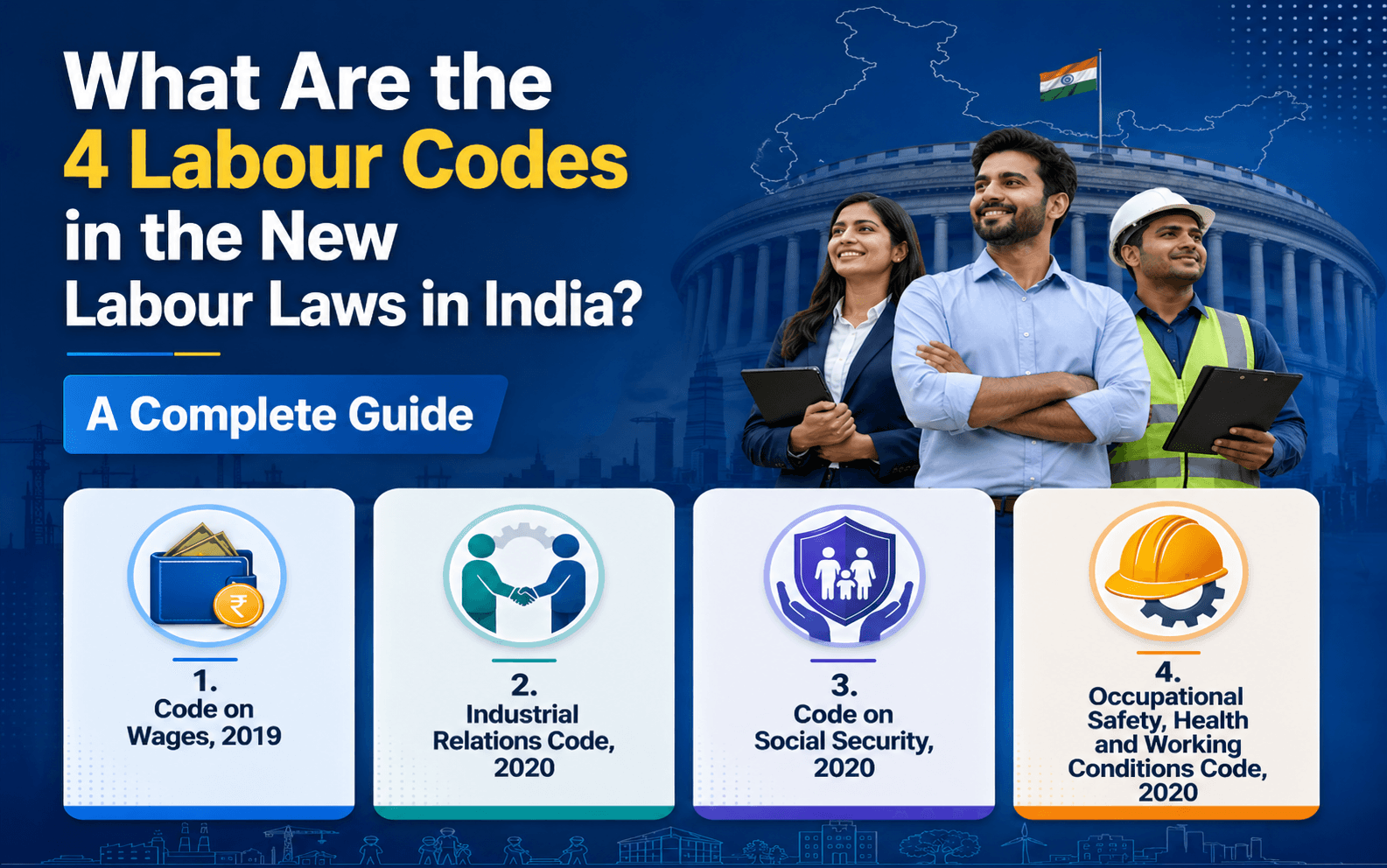
What Are the 4 Labour Codes in the New Labour Laws in India? A Complete Guide
Read More >
15 to 17 minutes
|
All
category
What Are the New External Workforce Trends in 2026?
Read More >