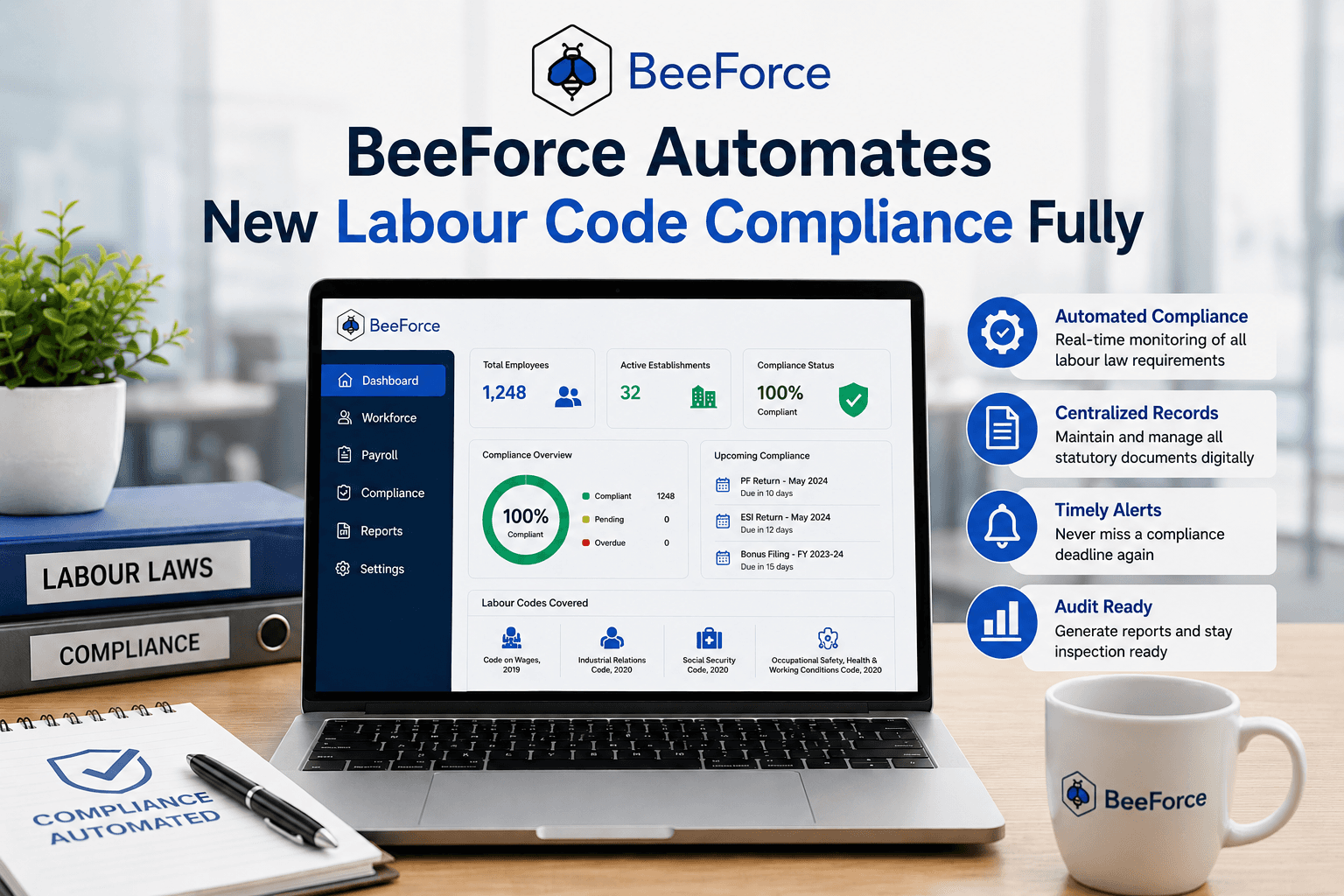
The new Labour Codes require enterprises to move beyond manual compliance tracking and build connected, system-led workforce governance. This blog explains how organizations can automate compliance workflows across onboarding, attendance, wages, PF, ESI, contractor records, safety, billing, and audit readiness using BeeForce by BlueTree for large external workforce operations.
Introduction
The new Labour Codes have changed the way enterprises need to think about workforce compliance.
For years, many HR and compliance teams managed labour law requirements through registers, spreadsheets, vendor documents, emails, payroll exports, and periodic audits. That model may have worked when the workforce scale was smaller and compliance checks were largely reactive.
But under the new labour law framework, compliance needs to become more connected, traceable, and system-led.
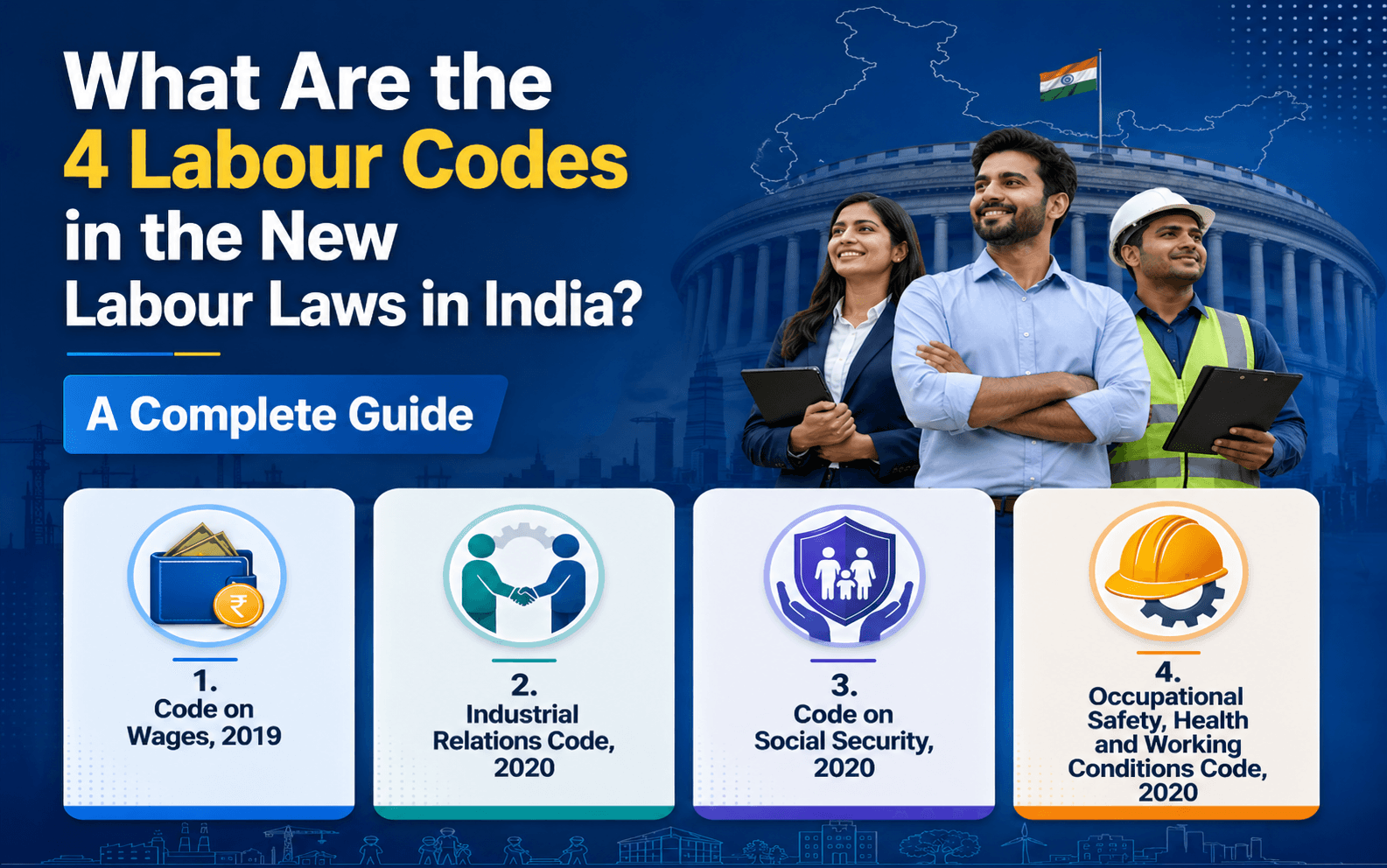
Official Government of India communication states that the four Labour Codes were made effective from 21 November 2025 and rationalised 29 existing central labour laws. The four codes are the Code on Wages, 2019, the Industrial Relations Code, 2020, the Code on Social Security, 2020, and the Occupational Safety, Health and Working Conditions Code, 2020.
For enterprises managing large external workforces, this is not only a legal change. It is an operating model change.
Contract workers, gig workers, piece-rate workers, trainees, vendor-deployed workers, and blue-collar employees now need stronger data governance across onboarding, attendance, wages, overtime, statutory benefits, safety, contractor records, billing, and exits.
This is where BeeForce by BlueTree helps enterprises move from manual compliance tracking to automated compliance workflows.
Why New Labour Code Compliance Is Hard to Manage Manually
Manual compliance breaks because labour compliance is no longer a single department activity.
It depends on data from multiple teams:
HR captures worker details.
Vendors submit worker and statutory records.
Site teams approve attendance and overtime.
Payroll calculates wages and deductions.
Finance processes vendor bills.
Compliance teams collect PF, ESI, register, and proof documents.
Safety teams manage incidents, medical fitness, and workplace records.
When this data sits in different systems, compliance becomes difficult to prove.
Manual compliance creates five common risks
Worker records do not match vendor records
A worker may exist in the vendor file but not in the enterprise system. Another worker may be deployed at site without complete identity, bank, PF, or ESI details.
This creates risk during payroll, billing, inspection, and audit.
Attendance and wages do not reconcile
Labour code compliance depends heavily on wage accuracy.
If attendance is captured in one system, overtime is approved manually, payroll is prepared separately, and vendor billing is reconciled later, errors are difficult to catch before wage closure.
PF and ESI checks happen too late
In many enterprises, statutory readiness is checked after payroll or vendor invoice submission.
By then, missing UAN, missing ESIC details, wrong wage base, or pending contribution proof can become a compliance exposure.
Registers are prepared only during audit
Manual statutory registers are often prepared after the event from multiple data sources.
This creates a high risk of mismatch between worker master, attendance, wage slip, payroll, PF, ESI, contractor records, and vendor bills.
No one sees risk before closure
The biggest weakness of manual compliance is timing.
Risks are often discovered after payroll is closed, vendor payment is processed, worker disputes are raised, or audit requests arrive.
For external workforce-heavy enterprises, this is too late.
What Changes Under the New Labour Codes
The new Labour Codes consolidate several earlier labour laws into four broader codes covering wages, industrial relations, social security, and occupational safety, health, and working conditions. The reform is intended to simplify compliance, streamline enforcement, modernize labour regulation, and create a more efficient framework for both workers and employers.
For enterprises, the practical impact is clear: compliance must be connected across the employee lifecycle.
Wage compliance becomes more structured
The Code on Wages focuses on wages, minimum wages, payment of wages, deductions, bonus, and wage definitions. For enterprises, this means salary structures, minimum wage mapping, overtime, deductions, wage slips, wage registers, and wage payment timelines need stronger system control.
For contract labour and blue-collar workforce, this is especially important because wages may vary by:
State
Zone
Skill category
Worker type
Contractor
Location
Shift
Overtime
Attendance
Piece-rate output
Manual wage compliance becomes risky when wage rules are not connected to actual workforce transactions.
Social security visibility becomes more important
The Code on Social Security consolidates laws relating to social security and covers areas such as provident fund, ESI, gratuity, maternity benefit, and employee compensation. India Code describes the purpose of the Code as extending social security to employees and workers across organised, unorganised, and other sectors.
For enterprises, this means worker-level statutory visibility becomes critical.
HR and compliance teams need to know:
Does the worker have UAN?
Is ESIC data available where applicable?
Is the wage base correct?
Has the contractor submitted statutory proof?
Are contribution records traceable?
Are benefit-related records connected to the worker profile?
OSHWC compliance becomes operational
The Occupational Safety, Health and Working Conditions Code covers occupational safety, health, welfare, hours of work, working conditions, and related employer duties. India Code lists chapters covering registration, duties of employer and employees, occupational safety and health, welfare provisions, and hours of work and annual leave with wages.
For factories, warehouses, logistics hubs, retail operations, and project sites, this means safety compliance cannot sit separately from workforce management.
Worker identity, contractor mapping, site deployment, medical fitness, safety training, shift records, working hours, incident records, and inspection readiness need to be connected.
Contractor governance becomes central
The Labour Codes increase the need for stronger contractor workforce visibility.
Principal employers need better control over:
Worker deployment
Contractor records
Wage payments
PF and ESI proof
Licenses and registrations
Attendance and overtime
Vendor billing
Statutory registers
Audit-ready records
This is why labour code compliance cannot be treated as only an HR compliance checklist. It must be embedded into daily workforce operations.
How BeeForce Automates Compliance Workflows
BeeForce automates labour code compliance by connecting workforce data across onboarding, attendance, wages, statutory readiness, vendor governance, billing, safety, and audit records.
This matters because compliance is only reliable when it is generated from approved transactions.
Worker onboarding and statutory readiness
BeeForce supports high-volume digital onboarding across sites and vendors, including identity checks, bank validation, and statutory readiness through UAN and ESI creation or validation. The BeeForce onboarding guide also positions day-zero readiness as site-eligible, compliance-eligible, and payout-eligible before reporting.
This helps enterprises reduce downstream compliance gaps.
If worker data is incomplete at onboarding, payroll, statutory records, billing, and audit outputs will also be incomplete.
BeeForce helps convert onboarding into a controlled compliance gate.
Attendance-linked wage compliance
Wage compliance depends on trusted attendance.
BeeForce connects attendance, leave, overtime, shifts, payable days, and wage rules so that payroll and billing are based on approved workforce data.
This helps enterprises reduce:
Wrong payable days
Missed overtime
Excess overtime
Unapproved deductions
Attendance and billing mismatch
Wage register mismatch
For labour code compliance, this is important because wages, working hours, overtime, deductions, and statutory records need to reconcile.
Minimum wage and wage rule checks
BeeForce can support wage compliance by helping enterprises maintain wage rules by location, category, contractor, effective date, and worker type.
This allows HR and compliance teams to identify wage gaps before payroll or vendor billing closure.
Instead of checking minimum wage compliance after an audit query, teams can monitor wage readiness during the payroll process.
PF and ESI validation workflows
BeeForce helps enterprises track PF and ESI readiness at the worker and vendor level.
This includes statutory identifiers, contribution readiness, missing data, vendor proof, and billing risk.
BlueTree project material positions BeeForce around PF and ESIC remittance validation, non-remittance monitoring, minimum wage adherence reports, and vendor-wise compliance dashboards.
This is especially useful for enterprises where vendors submit statutory proof after invoice generation or where PF and ESI records are checked manually.
Contractor and vendor compliance dashboards
Manual contractor governance depends heavily on vendor declarations.
BeeForce helps create a more system-led model by connecting vendor-wise worker records, attendance, wages, statutory proof, and billing readiness.
This helps HR, finance, compliance, and site teams see which vendors are compliant, which records are pending, and where risk exists before payment approval.
Register and audit-ready outputs
Under the new labour law environment, enterprises need faster access to reliable records.
BeeForce helps generate compliance-ready outputs from actual approved data rather than compiling records manually at the time of audit.
This can include worker records, wage details, attendance, overtime, deductions, PF and ESI details, contractor records, billing records, and approval trails.
Exception alerts and workflow ownership
Compliance automation is not only about digitizing forms.
It is about identifying gaps early and assigning ownership.
BeeForce can help teams track:
Missing worker documents
Missing statutory IDs
Wage gaps
Overtime breaches
Pending vendor proof
Billing mismatches
Expired contractor records
Pending approvals
Audit exceptions
This changes compliance from a reactive activity to a controlled workflow.
How BlueTree Can Help With Labour Code Compliance
BlueTree helps enterprises manage labour code compliance through BeeForce, its external workforce management platform built for contract, gig, piece-rate, and blue-collar workforce operations.
BeeForce is designed for enterprises where workforce operations are spread across multiple contractors, sites, plants, warehouses, stores, and business units.
The platform supports external workforce lifecycle management across onboarding, attendance, payouts, billing, compliance, workforce engagement, grievance, and offboarding. BlueTree’s website positions BeeForce as an external workforce management software for contract, gig, and piece-rate workforces, with capabilities across onboarding, time and attendance, payouts and billing, and compliance.
From BlueTree’s perspective, labour code readiness needs one connected layer
Enterprises should not manage labour code compliance through separate files for each function.
They need a connected operating layer where:
Worker onboarding is verified.
Contractor records are complete.
Attendance is trusted.
Overtime is approved.
Wage rules are configured.
PF and ESI readiness is visible.
Vendor billing is reconciled.
Safety and incident records are linked.
Exits are traceable.
Registers are generated from system data.
Audit trails are available.
BeeForce helps enterprises move toward this model.
What BeeForce helps enterprises achieve
For HR teams: Better visibility into worker readiness, attendance, wages, and compliance status.
For compliance teams: Stronger traceability across PF, ESI, wage registers, contractor records, and statutory proof.
For finance teams: Better control over vendor bills, wage-linked payouts, and statutory proof before payment.
For site teams: Clearer view of deployment, attendance, shifts, overtime, safety, and worker status.
For leadership: Enterprise-wide visibility into workforce risk across locations and vendors.
This is what makes BeeForce relevant as labour law software for external workforce-heavy enterprises.
It does not only store compliance documents. It connects the operating transactions that create compliance evidence.
Conclusion
Labour code compliance cannot be managed fully through spreadsheets, vendor files, and audit-time register preparation.
The new Labour Codes require enterprises to build a more connected workforce governance model across wages, social security, contractor management, safety, working hours, payroll, billing, and audit records.
For enterprises managing large external workforces, the biggest risk is not lack of awareness. The bigger risk is disconnected execution.
BeeForce by BlueTree helps address this by automating compliance workflows across onboarding, attendance, wage calculation, statutory readiness, vendor proof, billing, registers, and audit trails.
The outcome is a more controlled, traceable, and enterprise-ready compliance operating model.


Manage External Workforce with BlueTree - Govern contract, gig, and blue collar workers across vendors, sites, and shifts.
Frequenty Asked Questions
4-5 Minutes
|
All
category
Global Payroll Week 2026: Why Blue Collar Payroll Needs Better Governance
Read More >
7-8 Minutes
|
All
category
What Are the 4 Labour Codes in the New Labour Laws in India? A Complete Guide
Read More >

15 to 17 minutes
|
All
category
What Are the New External Workforce Trends in 2026?
Read More >