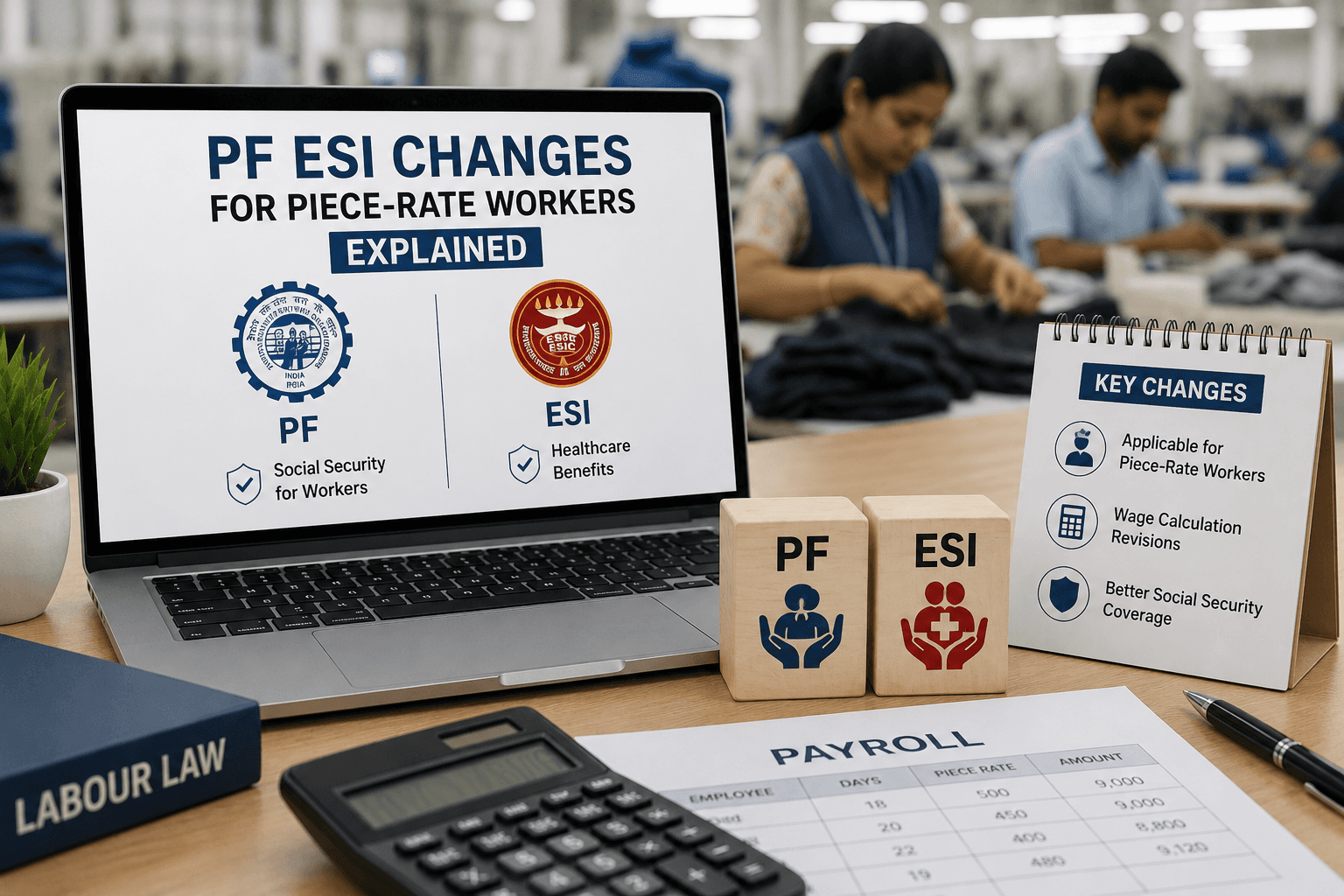
PF and ESI compliance for piece-rate workers requires more than payroll processing. This blog explains how enterprises should manage wage-period records, minimum wage checks, contractor governance, and statutory applicability for output-based workers. It also covers how connected workforce data, attendance, and vendor billing help improve compliance visibility and reduce PF and ESI risk across sites and contractors.
Introduction
Piece-rate work is common in labour-intensive industries.
Manufacturing units, warehouses, logistics operations, packaging lines, facility services, retail support operations, and seasonal production environments often engage workers whose earnings depend on output, units completed, tasks handled, or quantity processed.
This model gives enterprises flexibility. But it also creates a serious compliance question:
How should PF and ESI be handled when wages are not fixed monthly salaries?
This question has become more important because wage compliance is no longer limited to monthly payroll. Enterprises now need stronger visibility into worker identity, wage basis, attendance, payable output, statutory coverage, contractor records, and contribution proof.
Under the Code on Wages, minimum wages can be fixed for both time work and piece work. For piece-rate employees, the law also recognises the need to secure a minimum rate of wages on a time-work basis. This means enterprises cannot treat piece-rate pay as outside wage governance.
For CHROs, HR operations teams, compliance leaders, finance teams, and plant HR teams, the risk is simple.
If piece-rate worker data is not connected to wage calculation, PF, ESI, contractor billing, and statutory records, the enterprise may face wage compliance gaps even when workers are paid regularly.
Why PF and ESI Matter for Piece-Rate Workers
PF and ESI matter because piece-rate workers are still workers.
Their wage model may be different, but their statutory coverage depends on legal applicability, wage thresholds, employment relationship, establishment coverage, and contribution rules.
The Employees’ Provident Funds and Miscellaneous Provisions Act defines employee broadly to include a person employed for wages in connection with the work of an establishment, including persons employed by or through a contractor.
For ESI, the law also treats contribution as a wage-period obligation. The principal employer is required to pay contributions in the first instance for every employee, whether directly employed or employed through an immediate employer, subject to applicability.
This is important for enterprises using vendors or contractors for piece-rate operations.
A worker may be paid per unit, per piece, per carton, per delivery activity, per production output, or per task. But if the worker is covered under PF or ESI rules, the enterprise and contractor ecosystem must still ensure correct registration, wage basis, contribution calculation, proof tracking, and audit records.
Why this matters in real operations
Piece-rate compliance becomes difficult because the wage amount may change every day or every cycle.
A worker may earn ₹600 on one day, ₹900 on another day, and nothing on a day when work is not assigned. Output may be approved by a supervisor, captured in a production system, or submitted by the vendor.
If this data is handled manually, PF and ESI gaps can occur quickly.
Common gaps include:
Worker not mapped to UAN or ESIC number
Output earnings not converted into wage records properly
Wage period not clearly defined
PF wage base calculated incorrectly
ESI eligibility missed because wages fluctuate
Contractor invoice not matching worker-level wage data
Statutory proof collected after billing instead of before billing
Minimum wage comparison not done for piece-rate earnings
For enterprise HR and compliance teams, the challenge is not only to know the rule.
The challenge is to prove that the rule was applied correctly across every worker, vendor, site, and wage period.
What Changes Affect PF and ESI Applicability
PF ESI changes for piece-rate workers should be understood in the larger context of wage compliance, social security coverage, and contractor governance.
The core principle is this:
Piece-rate pay does not automatically remove PF or ESI responsibility.
Applicability depends on the law, establishment coverage, wage limits, wage definition, worker category, and contribution rules.
1. PF applicability needs worker and wage-base clarity
PF contributions are linked to wages. EPFO guidance explains that both employee and employer contribute 12% of basic wages plus dearness allowance, with mandatory contributions for salaries up to ₹15,000 and voluntary contribution options for higher wages.
For piece-rate workers, this creates an operational question:
How is the PF wage base determined when the worker is not paid a fixed monthly wage?
Enterprises need a clear rule for converting piece-rate earnings into wage-period records. This should be consistent, documented, and aligned with applicable legal advice.
2. ESI applicability depends on wage eligibility and contribution records
ESI coverage is linked to wage eligibility, establishment applicability, and the worker’s wage-period earnings.
For piece-rate workers, this creates a practical challenge because earnings may vary from one wage period to another. A worker’s eligibility cannot be assumed only from the rate card or vendor declaration. It must be reviewed against actual earnings, approved output, and applicable ESI rules.
This means enterprises need worker-wise wage records, contribution status, and proof of statutory coverage wherever ESI is applicable.
For piece-rate workers, wage eligibility cannot be guessed. It must be calculated from actual wage-period earnings.
3. Minimum wage comparison becomes important
Piece-rate workers should not fall below applicable minimum wage protection.
The Code on Wages recognises minimum wage fixation for piece work and also provides that for piece-work employees, minimum wages should secure a minimum rate on a time-work basis.
This means enterprises should compare piece-rate earnings against applicable minimum wage requirements by state, skill, category, zone, and wage period.
4. Contractor involvement does not remove enterprise risk
Many piece-rate workers are deployed through contractors.
The legal employer may be the contractor. But for principal employers, the risk remains if worker records, wage data, statutory contribution proof, and contractor registers are not maintained properly.
This is why piece-rate worker compliance must be treated as part of contractor governance, not only payroll processing.
How Piece-Rate Pay Impacts Compliance
Piece-rate pay creates compliance complexity because it separates effort from time.
In a fixed monthly wage model, payroll teams usually know the salary structure, wage period, deductions, and statutory base. In a piece-rate model, the payable wage depends on output.
This makes every upstream data point important.
1. Output must be approved before wage calculation
Piece-rate wages should not be calculated only from vendor declarations.
Output data must be validated by the enterprise, site supervisor, production system, or approved operational record.
Without approval, a wrong output count can create wrong wages, wrong PF or ESI contribution, and wrong vendor billing.
2. Wage period must be clearly defined
PF and ESI calculations need wage-period clarity.
If a worker is paid daily, weekly, fortnightly, or monthly based on output, the system should still define how earnings are grouped for statutory calculation and reporting.
3. Minimum wage protection must be checked
Piece-rate earnings may vary. Some workers may earn more than minimum wage. Others may fall below the minimum threshold due to low output, machine downtime, rejected units, or limited work allocation.
Enterprises should track whether piece-rate earnings meet the applicable minimum wage requirement for the relevant period.
4. Attendance still matters
Even when pay is linked to output, attendance matters for compliance.
Attendance helps prove deployment, workdays, shift presence, overtime exposure, site access, and worker activity. It also supports wage registers, contractor records, and audit responses.
5. ESI eligibility can fluctuate
Piece-rate workers may have variable earnings. This can make ESI eligibility and contribution tracking more sensitive.
Enterprises should avoid manual assumptions and maintain worker-wise wage data, contribution status, and statutory proof.
6. Vendor billing must match worker-level wage data
A vendor invoice may show total quantity completed and total payout payable. But compliance requires worker-level traceability.
The enterprise should be able to answer:
Which worker performed the work?
What was the approved output?
What was the rate applied?
What was the payable wage?
Was minimum wage protected?
Was PF applicable?
Was ESI applicable?
Was statutory proof submitted?
Was the vendor bill reconciled with worker payout?
If these questions cannot be answered from one connected data layer, piece-rate compliance becomes risky.
How BlueTree Can Help Manage Piece-Rate Compliance
BlueTree helps enterprises manage piece-rate compliance through BeeForce, its external workforce management platform built for contract, gig, and piece-rate workforce operations.
BeeForce is designed for enterprises where workforce data is spread across contractors, sites, HR teams, finance teams, compliance teams, and operational systems.
For piece-rate workers, this matters because compliance does not begin at payroll.
It begins when the worker is onboarded, mapped to the right vendor, assigned to the right site, linked to the right wage rule, and validated for PF, ESI, and payout readiness.
BlueTree project source material positions BeeForce around end-to-end external workforce lifecycle management, including attendance, leave, overtime, shift scheduling, statutory reporting, piece-rate wage calculation, vendor invoices, PF and ESIC validation, minimum wage reporting, and vendor-wise compliance dashboards.
BeeForce onboarding controls also support statutory readiness through UAN and ESI creation or validation, worker identity checks, bank validation, centralized worker profiles, dashboards, and exception workflows across sites and vendors.
BeeForce can support piece-rate compliance through:
Worker onboarding with statutory identity capture
UAN and ESIC validation where applicable
Vendor and contractor mapping
Piece-rate wage rule configuration
Output-based wage calculation
Attendance and deployment linkage
Minimum wage comparison
PF and ESI readiness checks
Wage-period records
Vendor billing based on approved worker-level data
Statutory proof tracking before bill approval
Audit-ready worker, wage, and contribution records
From a BlueTree perspective, the objective is not only to automate payout calculation.
The objective is to make piece-rate compliance traceable before payroll closure, vendor settlement, or audit pressure begins.
What this means for enterprises
For CHROs and HR operations teams, it improves workforce visibility.
For compliance teams, it reduces dependency on contractor declarations.
For finance teams, it connects vendor billing with approved wage data.
For site teams, it creates control over deployment, attendance, and output validation.
For workers, it improves wage transparency and social security readiness.
This is where piece-rate workforce management moves from manual payout processing to system-led wage compliance.
Conclusion
PF and ESI compliance for piece-rate workers cannot be managed through monthly summaries alone.
Piece-rate pay may be variable, but compliance expectations remain structured. Enterprises need worker-level visibility into identity, deployment, output, wages, PF, ESI, minimum wage protection, vendor billing, and statutory proof.
The main risk is not that piece-rate work is non-compliant.
The risk is that piece-rate work is often managed through disconnected systems, vendor files, manual approvals, and delayed statutory checks.
Enterprises that connect piece-rate output with wage rules, attendance, social security, and vendor billing will be better prepared to reduce disputes, protect workers, and maintain audit-ready compliance.


Manage External Workforce with BlueTree - Govern contract, gig, and blue collar workers across vendors, sites, and shifts.
Frequenty Asked Questions
4-5 Minutes
|
All
category
Global Payroll Week 2026: Why Blue Collar Payroll Needs Better Governance
Read More >
7-8 Minutes
|
All
category
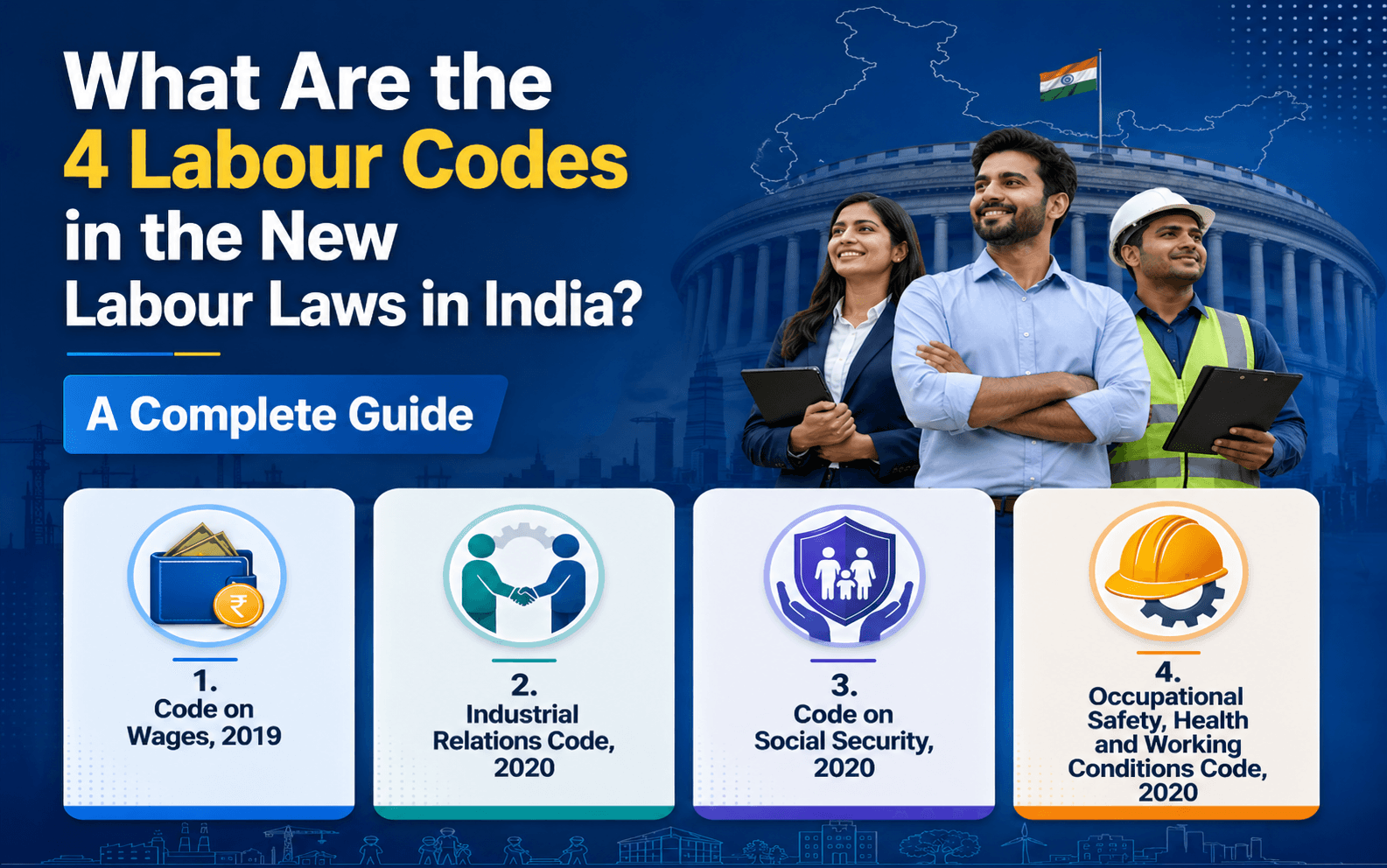
What Are the 4 Labour Codes in the New Labour Laws in India? A Complete Guide
Read More >

15 to 17 minutes
|
All
category
What Are the New External Workforce Trends in 2026?
Read More >