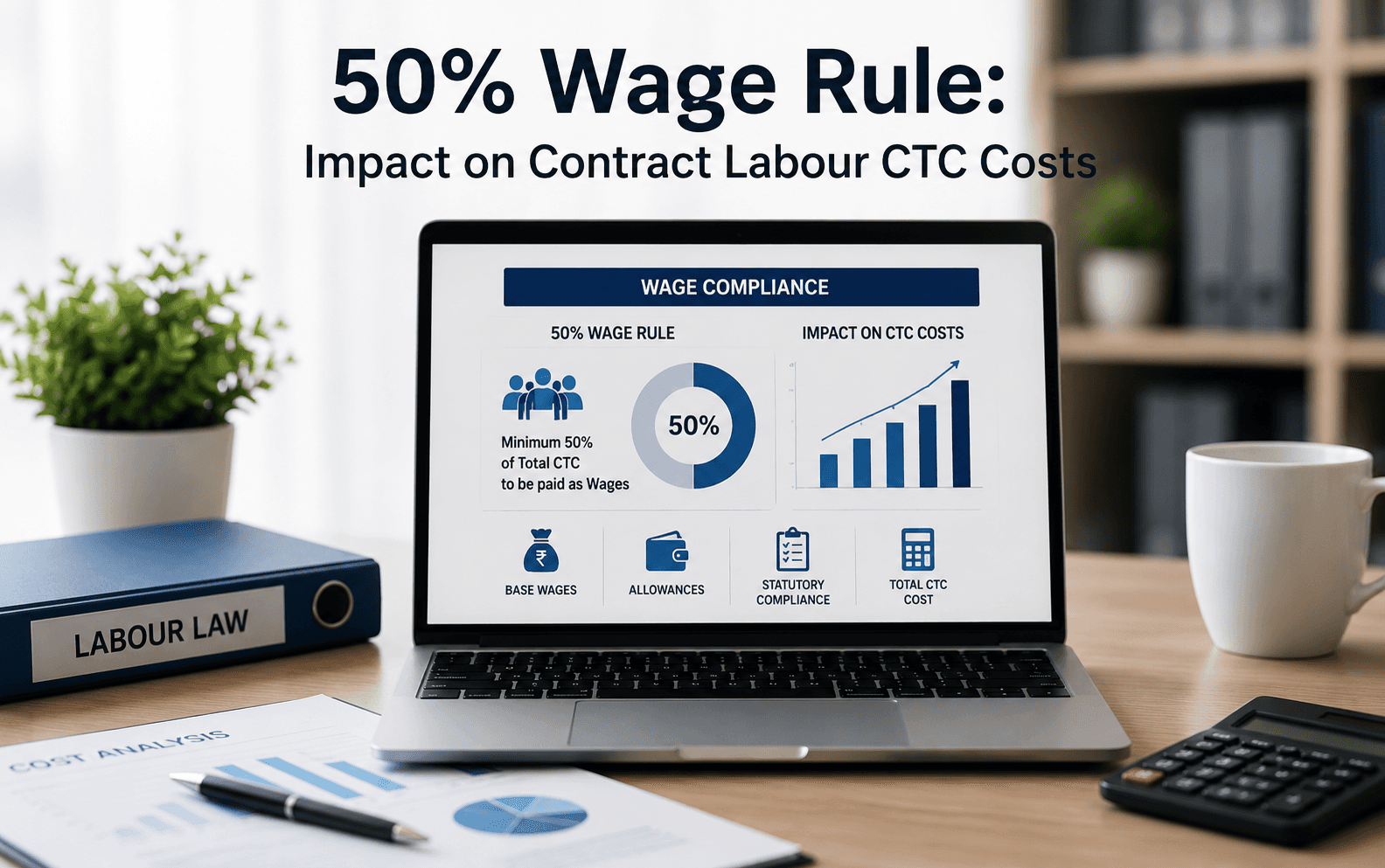
The 50 percent wage rule is reshaping how enterprises structure contract labour CTC in India. This blog explains the impact of the revised wage definition on PF, gratuity, take-home pay, vendor billing, and payroll cost. It also covers how enterprises can redesign salary structures, align vendor workflows, and build system-led wage compliance across attendance, payroll, and billing operations.
Introduction
The 50 percent wage rule is one of the most important payroll and compliance changes for enterprises managing contract labour in India.
For many companies, contract labour CTC has traditionally been structured with a lower basic wage and a higher share of allowances. This helped manage statutory cost, vendor billing, and take-home pay expectations. Under the new wage definition, this model needs closer review.
The Code on Wages, 2019 defines wages to include basic pay, dearness allowance, and retaining allowance, while excluding certain components. However, if the excluded components cross the prescribed 50 percent threshold, the excess may be added back for wage computation. This is why the rule is often referred to as the 50 percent wage rule.
For CHROs, HR operations teams, compliance leaders, finance teams, and plant HR teams, the impact is not limited to salary structure. It affects PF, gratuity provisioning, payroll cost, contractor billing, vendor rate cards, wage compliance, and worker take-home pay.
For contract workforce-heavy enterprises, the real question is not only whether the salary structure is compliant.
The real question is whether wage compliance is connected to onboarding, attendance, overtime, payout calculation, vendor billing, and statutory records.
How the Rule Changes Contract Labour CTC
The 50 percent wage rule changes how enterprises need to look at contract labour CTC.
Earlier, many contractor salary structures were designed with a lower wage component and multiple allowances. For example, basic and DA may have been kept lower, while other allowances made up a large part of the total CTC.
Under the wage rule in India, this structure may need to be reviewed because wages should not fall below the required proportion of total remuneration for statutory computation.
What changes in practice?
For contract labour, the rule can affect:
Basic wage and DA structure
Allowance design
PF wage base
Gratuity provisioning
Minimum wage alignment
Vendor payout calculations
Contractor billing
Worker take-home pay
Payroll cost for the principal employer or contractor
Example
Assume a contract worker has a monthly CTC of ₹18,000.
If the wage component is only ₹7,200 and the rest is structured as allowances, the structure may need review. Under the 50 percent wage rule, the wage component may need to be closer to ₹9,000 for statutory wage computation, depending on the final salary components and applicable interpretation.
This may increase the base on which certain statutory benefits are calculated.
The result is simple: allowance-heavy salary structures may no longer remain cost-neutral.
For enterprises managing thousands of workers across plants, warehouses, retail locations, or logistics hubs, even a small change in wage base can create a significant payroll cost impact.
Impact on PF, Gratuity, and Take-Home Pay
The 50 percent wage rule affects contract labour CTC because many statutory calculations are linked to the wage base.
1. Impact on PF
If the wage base increases, PF contribution exposure may also increase, subject to applicable statutory limits and wage ceiling rules.
For employers and contractors, this may increase the employer-side contribution cost. For workers, the employee contribution may also increase where applicable, which can reduce monthly take-home pay but improve long-term social security accumulation.
2. Impact on gratuity
Gratuity provisioning may also change because the revised wage definition can affect the base used for gratuity calculation.
This matters especially for enterprises that use fixed-term employment, long-tenure contract arrangements, or workforce models where workers continue across sites, vendors, or recurring contracts.
Even when gratuity is not paid monthly, the liability needs to be provisioned correctly.
3. Impact on take-home pay
A higher statutory wage base can reduce take-home pay if employee-side deductions increase.
This is where HR and vendor communication becomes important. Workers may see a change in monthly net pay, even if the total CTC remains the same.
Enterprises should avoid treating this as only a payroll configuration change. It is also a worker communication, vendor alignment, and cost planning exercise.
4. Impact on vendor billing
For principal employers, the impact may appear through revised vendor rate cards.
Contractors may need to revisit:
Wage structure
Employer contribution cost
Service charge assumptions
Invoice templates
Statutory proof submission
Payout reconciliation
If salary structure, attendance, payroll, and vendor billing are handled separately, disputes can increase.

How Employers Can Restructure Salary Costs
Enterprises should not respond to the 50 percent wage rule by making quick salary structure changes without proper simulation.
A better approach is to redesign salary costs through a structured compliance and financial review.
Step 1: Audit current salary structures
Start by reviewing all contract labour salary templates.
The audit should cover:
State
Location
Skill category
Worker type
Vendor
Minimum wage category
Basic wage
DA
Allowances
PF applicability
ESI applicability
Gratuity exposure
Overtime treatment
This is especially important for companies operating across multiple states because wage structures and minimum wage notifications differ by location and category.
Step 2: Identify allowance-heavy structures
Enterprises should identify where allowances form a high share of total remuneration.
Allowance-heavy structures may create wage compliance risk if they do not align with the revised wage definition.
This review should include contract workers, gig workers, piece-rate workers, fixed-term workers, trainees, and other off-roll categories where applicable.
Step 3: Run CTC simulations
Before changing salary structures, HR and finance teams should run simulations.
The simulation should show:
Current gross pay
Revised wage base
PF impact
ESI impact, where applicable
Gratuity impact
Employer cost impact
Worker take-home impact
Vendor billing impact
This helps leadership understand whether the change affects only accounting or whether it materially changes the cost of deployment.
Step 4: Align vendor rate cards
For contract labour, salary restructuring cannot be handled only inside the enterprise payroll team.
Vendors must also align their wage structures, invoices, statutory proofs, and worker payouts.
Vendor contracts, purchase orders, work orders, and service charge models may need to be reviewed so that wage compliance does not create billing disputes later.
Step 5: Connect attendance and payroll
Wage compliance is not only about salary structure.
The final payable wage depends on attendance, overtime, leave, deductions, payable days, and worker category.
If attendance corrections are late, overtime approvals are manual, or payable days are calculated through spreadsheets, even a compliant salary structure can produce incorrect payroll output.
Enterprises should connect attendance, shift, overtime, payroll, billing, and statutory records before wage closure.
Step 6: Keep an audit trail
Every salary restructuring decision should be supported with documentation.
This includes:
Salary structure version
Effective date
Approval trail
Vendor confirmation
Worker communication records
PF and ESI mapping
Wage register output
Payroll and billing reconciliation
This protects the enterprise during audits, disputes, and vendor reviews.
How BlueTree Can Help With Wage Compliance
BlueTree helps enterprises manage wage compliance through BeeForce, its external workforce management platform built for contract labour, gig workers, and piece-rate workforce.
BeeForce is designed to connect the operational data that usually sits across vendors, HR teams, finance teams, site teams, and compliance teams.
For wage compliance, this connected model is important because payroll accuracy depends on more than a salary master.
It depends on whether the worker was correctly onboarded, mapped to the right vendor, assigned to the right location, paid against approved attendance, and validated against statutory requirements.
BeeForce can support wage compliance through:
Custom pay structures aligned with business policies and state-wise minimum wage requirements
Attendance-linked wage calculation
Overtime and allowance rule configuration
Wage norm checks before payout
Vendor billing based on approved attendance, wage rates, and contractual terms
PF and ESI readiness checks
Worker-level statutory records
Compliance-ready payout and billing data
Audit trails across approval, payroll, billing, and finance workflows
This helps HR, compliance, and finance teams reduce dependency on manual spreadsheets and vendor declarations.
BlueTree helps enterprises connect wage rules, attendance, payouts, and vendor billing into one compliance-ready workflow.
For enterprises managing high-volume contract labour, this is where system-led wage compliance becomes critical.
The goal is not only to calculate wages correctly.
The goal is to prevent wage, PF, ESI, billing, and audit gaps before payroll is closed.
Conclusion
The 50 percent wage rule is not just a salary structure change.
It is a payroll cost, labour compliance, vendor governance, and workforce operating model issue.
For contract labour-heavy enterprises, the impact can be significant because wage structures are often spread across vendors, locations, worker categories, and state-level minimum wage rules.
Enterprises should review salary structures early, simulate payroll cost impact, align vendor rate cards, connect attendance to payout, and maintain audit-ready wage records.
The companies that manage this well will not only reduce compliance risk. They will also create cleaner payroll governance, stronger vendor control, and better workforce trust.


Manage External Workforce with BlueTree - Govern contract, gig, and blue collar workers across vendors, sites, and shifts.
Frequenty Asked Questions
4-5 Minutes
|
All
category
Global Payroll Week 2026: Why Blue Collar Payroll Needs Better Governance
Read More >

7-8 Minutes
|
All
category
What Are the 4 Labour Codes in the New Labour Laws in India? A Complete Guide
Read More >

15 to 17 minutes
|
All
category
What Are the New External Workforce Trends in 2026?
Read More >