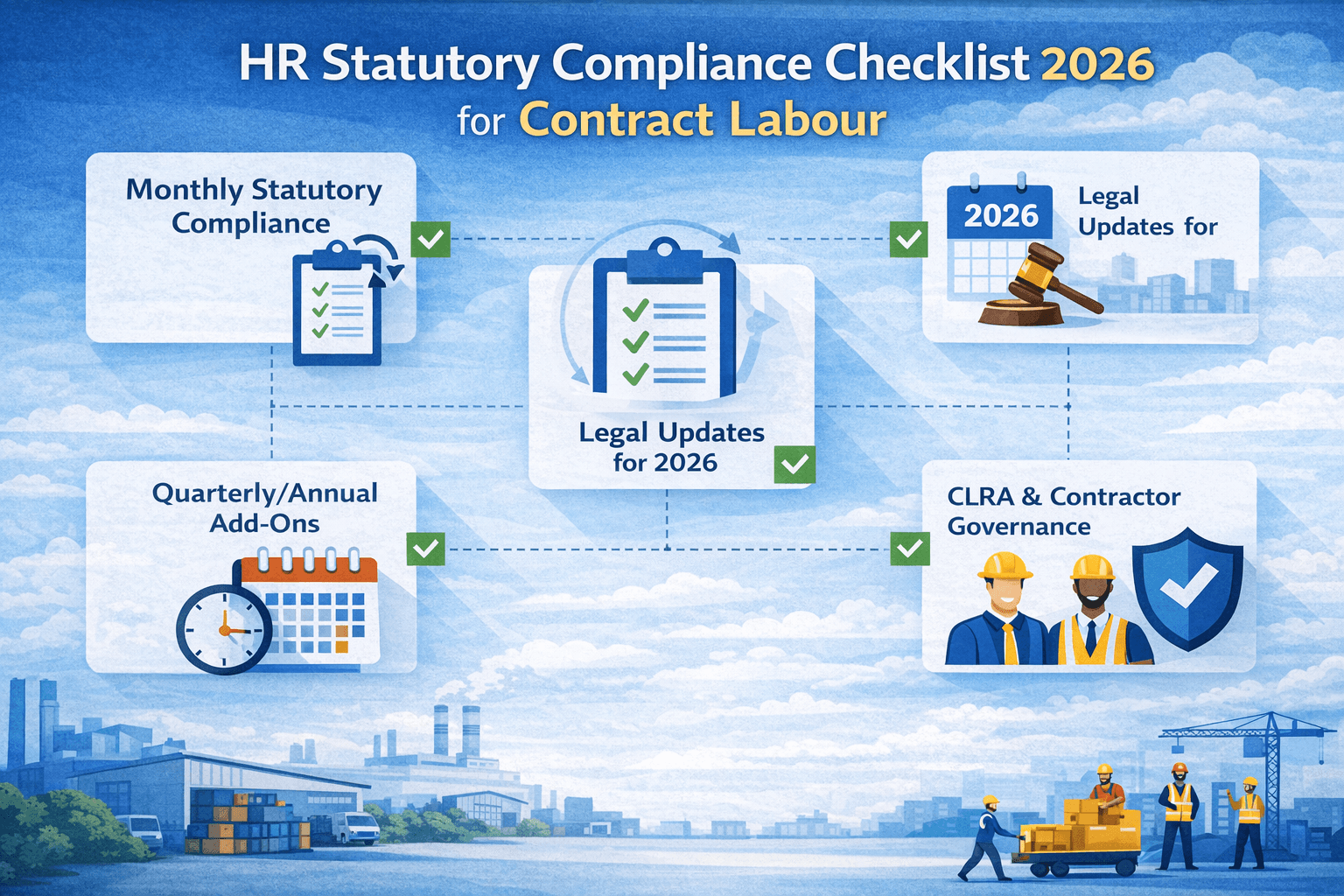
Contract labour compliance fails at scale when evidence is scattered across vendors, sites, and spreadsheets. This HR statutory compliance checklist for 2026 gives enterprises a repeatable monthly statutory compliance checklist for India, covering contractor governance, attendance-to-wage controls, statutory proof validation, and audit-ready records. It also outlines how BlueTree helps standardize execution across vendors and locations with workflow ownership, reason codes, and centralized documentation.
Introduction: Why the HR compliance checklist needs a 2026 reset
Most enterprises already have an HR compliance checklist. The problem is not intent. The problem is execution.
In contract labour operations, compliance in HR fails when:
each site runs a different process,
vendors submit proofs late or in inconsistent formats,
month-end closure depends on follow-ups,
audit readiness becomes a last-minute document hunt.
2026 needs a reset because the external workforce scale is increasing, audits are more evidence-driven, and workforce continuity depends on clean monthly controls. A statutory compliance checklist must operate like a monthly governance cadence, not a document you revisit only during audits.
The shift HR teams need to make is simple: treat statutory compliance like an operating system. That means consistent standards, fixed timelines, centralized evidence, and predictable accountability across sites and contractors.
Introduction of New Labor Laws for 2026:
2026 is the first year where contract labour programs are increasingly being reviewed through the lens of India’s four Labour Codes, not a patchwork of older Acts. For enterprise HR teams, the practical impact is not legal language. It is execution. Your monthly checklist must produce evidence that is consistent, period-linked, and retrievable contractor-wise and site-wise.
India’s Labour Codes consolidate core requirements into four themes:
wages and minimum wage governance
social security coverage and proof
working hours and workplace conditions
employment terms and grievance visibility
This matters because the same gaps that were earlier treated as “vendor delays” now show up as governance gaps during audits. The easiest way to stay ready is to align your monthly controls to these Labour Code themes.
What your 2026 checklist should explicitly cover under the Labour Codes
Wage and payout discipline
Minimum wage checks linked to role category and location
Wage structure consistency and wage component definitions
Overtime calculation rules and approval evidence
Wage cycle and payment-mode traceability for each period
Wage, attendance, and overtime record maintenance as a baseline
Social security coverage and proof
PF and ESI applicability and coverage reconciliation against deployed worker lists
Statutory deduction alignment to wage records
Remittance proofs validated for completeness and period linkage
UAN and ESI readiness where applicable, so coverage does not become post-period rework
Working hours, weekly rest, and workplace controls
Working-hours and weekly-rest alignment to shift and attendance rules
Overtime and exception handling that is policy-led and provable
Site readiness evidence such as safety and induction acknowledgements where applicable
Clear handling of site-specific requirements for sensitive or safety-critical roles
Employment terms and grievance visibility
Documented engagement terms available for the worker category and site
Grievance capture and closure trail so escalations are governed, not handled informally
What an HR statutory compliance checklist covers for contract labour
An HR statutory compliance checklist for contract labour must cover two layers at the same time.
1) Vendor obligations
What contractors must submit, deposit, and maintain:
workforce and wage period records,
statutory contributions and proofs where applicable,
registers and applicable documents,
site-wise and contractor-wise record availability.
2) Principal employer governance
What the enterprise must verify, retain, and prove across sites, contractors, and months:
only authorized contractors and workers are deployed,
wage and attendance inputs match what gets paid and billed,
statutory actions are provable and period-linked,
records are retrievable quickly for audits and inspections.
This is why an HR compliance checklist in India for contract labour must be evidence-led. Every month it should answer three questions:
Are only authorized contractors and workers deployed at each site?
Are wages, statutory actions, and records complete for the cycle?
Can we prove it quickly, site-wise and contractor-wise?
What changed in 2026 and why it matters for audits and workforce continuity
For contract labour, 2026 is not just another compliance year. It is a year where enterprises feel the impact of tighter scrutiny and higher workforce volatility at the same time.
1) Audits are more evidence-driven than declaration-driven
Vendor declarations are no longer enough. Enterprises are expected to produce proof that is:
consistent across sites,
linked to contractor and worker records,
retrievable by period without manual chasing.
2) Workforce continuity depends on monthly closure discipline
Compliance issues show up as operational disruption when:
attendance and wage closure slips,
payouts get delayed,
disputes and escalations rise,
site productivity drops due to missing readiness.
3) State-level variation matters more at enterprise scale
As the number of locations increases, compliance breaks when teams attempt to run “one checklist for India.” State-specific applicability (PT, LWF, minimum wage schedules, and local registers) must be tracked as part of the enterprise checklist.
4) Vendor ecosystems are larger and risk is distributed
2026 governance must be designed for multi-vendor execution. The enterprise risk is not one contractor failing once, but repeated deviations across contractors and sites, month after month.
The 2026 goal is simple: make every month audit-ready, not “get audit-ready only when inspection happens.”
Monthly statutory compliance checklist
This is the monthly statutory compliance checklist that reduces audit risk and prevents month-end firefighting. The goal is not to add checks. The goal is to run the same checks the same way, every month, across every contractor and site.
1) Contractor governance
Contractor is active and approved for the period and site scope
WO or PO is valid, mapped, and within headcount and date limits
Contractor SPOCs are confirmed with a documented escalation ladder
Contractor statutory identifiers are on record where applicable
Contractor license and registrations are current where applicable
Why this matters: If contractor authorization is unclear, everything else becomes disputed later, including wage and statutory evidence.
2) Worker master and deployment
Worker is mapped to the correct contractor, site, and role category
Duplicates and recycled identities are checked and blocked
Joiners and exits are reflected correctly for the wage period
Site and supervisor ownership is defined for day-to-day control
Any worker hold has a reason, owner, SLA, and resolution trail
Why this matters: Most month-end escalations start with incorrect mapping, duplicates, or unclear accountability.
3) Attendance-to-wage alignment
Attendance source and shift rules are locked for the wage period
Overtime entries have approvals and policy alignment
Missed punch and regularization actions are closed before wage freeze
Attendance exceptions are tracked vendor-wise and site-wise
Wage freeze date is defined so corrections do not drift indefinitely
Why this matters: Wage disputes usually come from late attendance corrections and uncontrolled overrides.
4) Statutory action and proof validation
PF and ESI applicable worker coverage is reconciled with the deployed list
Remittance proofs are collected for the month and validated for completeness
Vendor-wise gaps are tracked with aging buckets, not verbal confirmations
Exceptions have ownership and closure timelines
State-specific obligations like PT and LWF are validated where applicable
Why this matters: Statutory readiness is not only about doing it. It is about proving it reliably across contractors and sites.
5) CLRA and register readiness
Muster, wage, overtime, deductions, and related records are maintained consistently
Site-wise and contractor-wise records are retrievable for the wage period
Any missing register or proof is logged as an exception with owner and SLA
Evidence is stored in one standard repository, not scattered across email and chat
Why this matters: Audits rarely fail on one missing document. They fail because records are inconsistent across sites.
6) Month-end closure controls
Vendor submission deadline is defined and enforced
Review and sign-off ownership is clear (HR Ops, Site Ops, Finance)
Vendor deviations are recorded and repeated issues are flagged
Monthly scorecard is created vendor-wise (late proofs, repeated holds, repeated exceptions)
Sampling is done across sites, not only at the corporate office
Why this matters: The checklist works only when cadence, ownership, and enforcement are predictable.
Quarterly, half-yearly, and annual compliance checks that often get missed
Monthly checks reduce most operational escalations. But many audit observations come from periodic items that quietly lapse between cycles.
Quarterly (every 3 months)
Vendor deviation pattern review (late proofs, repeated gaps, repeated exceptions)
Exception trend analysis by site and contractor
Worker master hygiene review (duplicates, inactive workers still appearing, wrong mappings)
Minimum wage mapping review (state, role category, zone, and schedule alignment)
Half-yearly (every 6 months)
Contractor eligibility refresh (documentation, statutory identifiers, scope alignment)
Register completeness sampling across sites, not just one location
Policy drift checks (overtime, deductions, regularization consistency across sites)
Annual (every 12 months)
License and registration renewal tracking where applicable
Record retention and archiving review (prior periods retrievable and searchable)
Internal audit drill (test retrieval speed site-wise and contractor-wise)
These add-ons prevent the common pattern of being “fine monthly” but still getting flagged during audits.
CLRA and contractor governance checks (principal employer view)
Most HR compliance checklists become vendor checklists. That is incomplete for contract labour.
The principal employer needs a governance view that answers three questions consistently.
1) Are only eligible contractors allowed to deploy?
Contractor authorization is valid for the site and period
Scope aligns to the intended engagement and deployment limits
Licensing and registrations are current where applicable
2) Can you prove traceability across deployment and records?
Worker is traceable to contractor, site, role category, and period
Attendance and wage basis can be shown worker-wise
Statutory proofs and records can be linked to the same scope
3) Are records and registers consistent across sites?
Registers and evidence are retrievable contractor-wise and site-wise
Missing artifacts are tracked as exceptions with owners and SLAs
Evidence does not depend on follow-ups during inspections
This principal employer view is what converts CLRA governance from “assumed control” to provable control.
Operational controls that make the checklist work
Below are 5 operational controls that make the statutory compliance checklist executable at scale. These focus on the system of execution, not repeating the checklist items.
Single ownership map (RACI) for every checklist line item
Define owners across HR Ops, Site Ops, Finance, and Procurement, including who signs off and who gets escalations.Fixed monthly calendar with cut-off dates
Set non-negotiable cut-offs for vendor submission, site validation, finance verification, and final sign-off so closures do not drift.Standard evidence format and naming convention across all sites
Enforce uniform evidence structure so proofs are searchable by contractor, site, and month without manual sorting.Exception management queue with reason codes and aging buckets
Run exceptions like a workflow: reason code, owner, SLA, aging, and escalation triggers. This prevents orphaned issues.Vendor scorecard with consequence management
Track repeated deviations and link performance to corrective action and governance consequences, so compliance is managed, not chased.
These controls are the difference between “we have a checklist” and “we have a compliance operating cadence.”
How BlueTree enables audit-ready contract labour governance at scale
A checklist scales only when the system enforces consistent execution across contractors and locations.
BlueTree helps enterprises operationalize an HR statutory compliance checklist by enabling:
Standardization across vendors and sites
One enterprise process for contractor governance, worker mapping discipline, evidence structure, and monthly closure.Workflow ownership and traceability
Every hold, exception, correction, and approval carries a reason, owner, SLA, and audit trail, which removes follow-up dependency.Centralized evidence and record retrieval
Proofs and records can be retrieved by contractor, site, month, and worker, reducing audit time and inspection stress.Vendor-wise visibility and deviation control
Vendor performance becomes measurable through dashboards and scorecards, so repeated gaps are corrected systematically.Governance that links deployment, wages, and records
Instead of running compliance as a separate admin exercise, BlueTree supports a controlled operating layer that connects workforce deployment data to wage closure discipline and record readiness.
When enterprises treat compliance in HR as governance and not follow-ups, audits become predictable and operational continuity improves across sites.
Conclusion
A 2026-ready HR statutory compliance checklist is not a one-time document. It is a monthly operating cadence that stays consistent across contractors, sites, and cycles. When you combine evidence-led checks with periodic reviews, principal employer governance, and clear operational controls, audit readiness becomes predictable and workforce continuity improves across every location.


Manage External Workforce with BlueTree - Govern contract, gig, and blue collar workers across vendors, sites, and shifts.
Frequenty Asked Questions
4-5 Minutes
|
All
category
Global Payroll Week 2026: Why Blue Collar Payroll Needs Better Governance
Read More >
7-8 Minutes
|
All
category
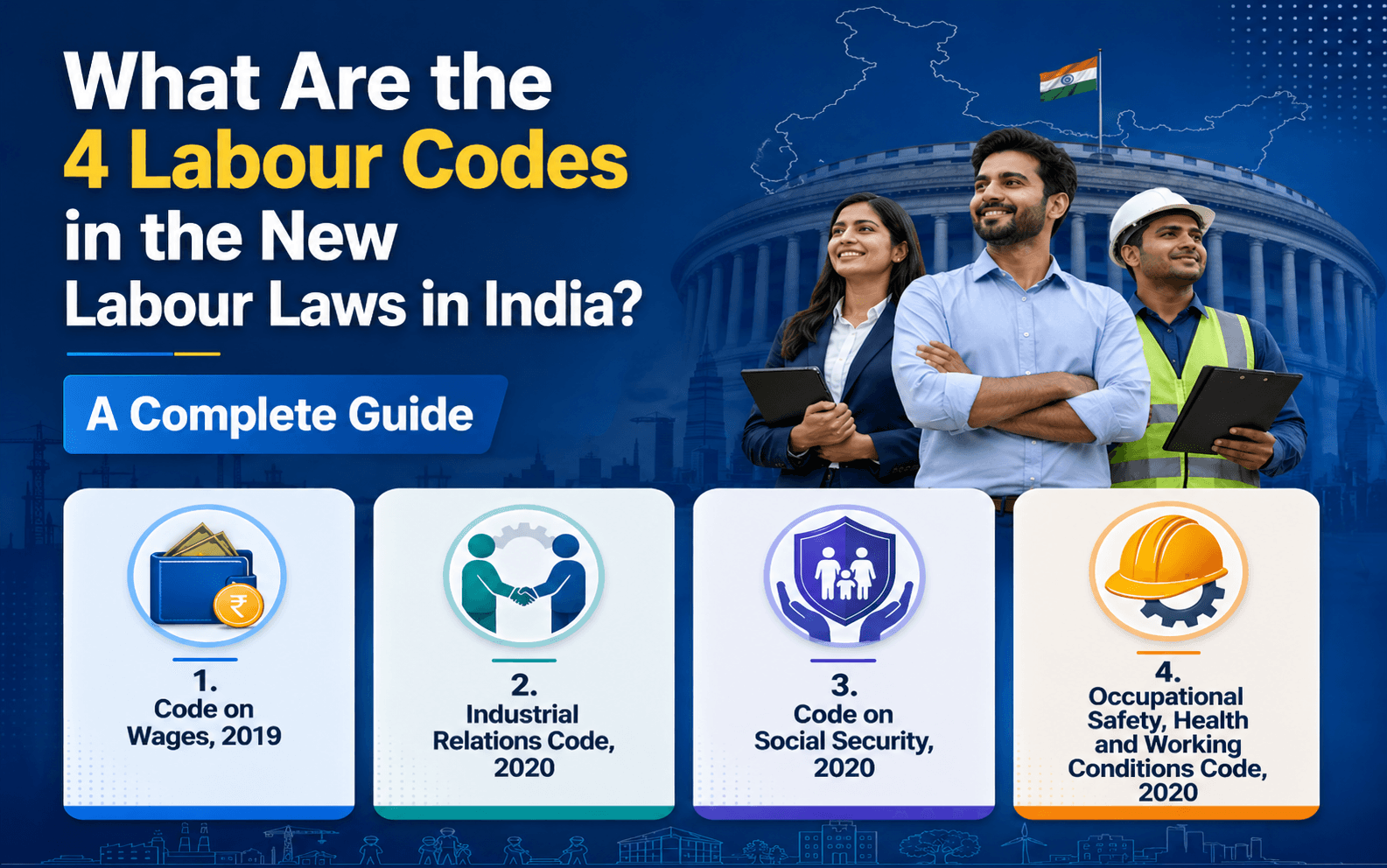
What Are the 4 Labour Codes in the New Labour Laws in India? A Complete Guide
Read More >

15 to 17 minutes
|
All
category
What Are the New External Workforce Trends in 2026?
Read More >