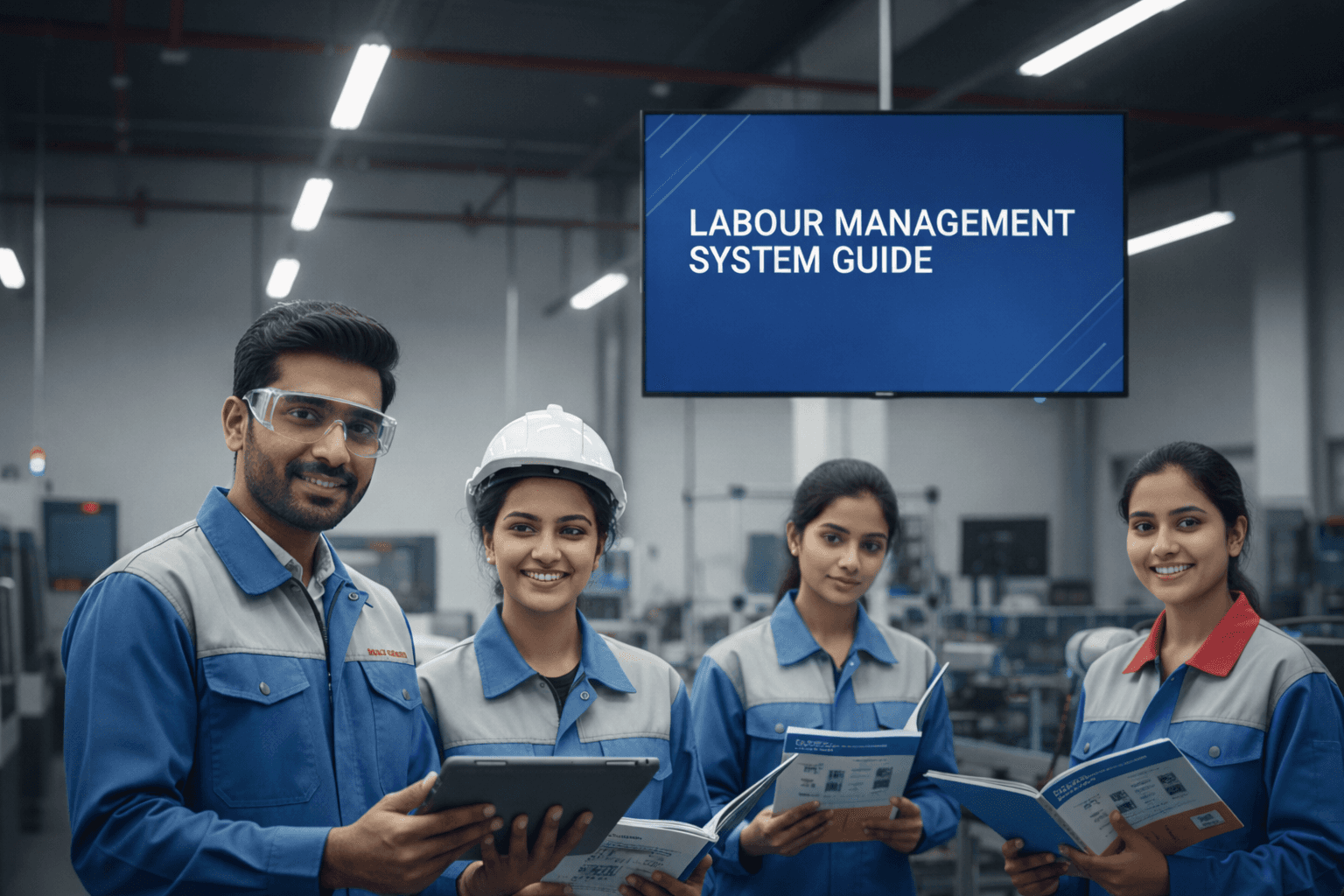
This guide explains what is Labour Management System(LMS) is and why it is essential for managing large blue collar workforces at enterprise scale. It covers how labour operates across vendors and locations, why labour management breaks as scale increases, and the core outcomes a structured system must enable. The article highlights how centralized labour management helps enterprises move from fragmented, reactive handling to predictable, controlled operations across onboarding, attendance, compliance, and workforce governance.
Introduction
Blue collar workforces are critical to execution across industries such as manufacturing, logistics, construction, retail, e-commerce and facility management. Industry studies and labour reports indicate that contract labour forms a significant share of enterprise operational workforces in these sectors, especially in large, distributed operations.
Despite this dependence, labour operations in many organizations remain fragmented across vendors, locations, spreadsheets, and disconnected tools. This limits visibility into workforce deployment, attendance accuracy, and payout readiness, while increasing compliance and operational risk.
A Contract Labour Management System provides a structured approach to managing blue collar and contract workers at scale. By centralizing onboarding, attendance, compliance, and workforce records, it enables organizations to move from reactive labour handling to controlled, system-driven execution.
What Is a Contract Labour Management System?
A CLMS is a centralized platform designed to manage contract and external workers across their full lifecycle. It brings together vendors, workers, attendance, payouts, statutory records, and operational controls into a single system of record.
Unlike traditional HCM systems that focus on permanent employees, an external workforce management system is purpose-built for external workforces operating across multiple contractors, sites, and workforce models. It enables organizations to move away from vendor-driven data silos and establish standardized, auditable processes across the enterprise.
Platforms such as Bluetree support this approach by providing a unified framework for managing blue collar workforce operations. At scale, a CLMS becomes the foundation for visibility, accountability, and consistency across distributed labour environments.
Understanding the Blue Collar Workforce Landscape
Blue collar workers drive day-to-day execution across production, logistics, safety, and service operations. Their availability and performance directly impact business continuity.
Most are engaged through third-party vendors, making workforce visibility complex as workers move across sites and vendors. A CLMS brings structure to this complexity through centralized records and standardized processes. Platforms such as Bluetree support consistent workforce management without manual coordination.
Types of Contract and External Workers
Organizations engage blue collar workers through multiple workforce models, including:
Contract workers engaged for fixed durations through licensed contractors
Gig workers deployed for task-based or short-term assignments
Piece-rate workers paid based on output or units completed
Flexi workers scheduled dynamically based on demand and shift patterns
Each workforce model has distinct onboarding, attendance, payout, compliance and governance requirements. Managing them through a single generic process often leads to gaps and inconsistencies. A Contract Labour Management System, such as BlueTree CLMS, supports all workforce types within a unified yet configurable framework, enabling consistent management across diverse labour models.
Why Labour Management Breaks at Scale
As blue collar workforce scale increases across locations and vendors, manual and vendor-led labour management models begin to show clear limitations. What works for a single site or a small contractor network becomes difficult to sustain across multiple plants, warehouses, or regions.
Enterprises often face inconsistent onboarding practices, delayed visibility into attendance, and fragmented workforce data owned by vendors rather than the organization. Over time, this results in reconciliation delays, reduced control over payouts, and increased exposure during audits or inspections.
At scale, labour management shifts from a routine operational task to a coordination and governance challenge. This is why organizations increasingly adopt system-led approaches, supported by platforms such as Bluetree, to standardize processes and establish centralized oversight across blue collar workforce operations.
What a Good Contract Labour Management System Should Enable
Rather than focusing on features, an effective CLMS should enable a few core outcomes consistently across the organization:
Structured worker onboarding and verification
Ensuring only eligible and compliant workers are deployed across sites and vendors.Reliable attendance and shift alignment
Capturing attendance accurately and aligning it with approved shift and deployment rules.Payout and billing readiness
Translating validated attendance into predictable payouts and clean billing data.Compliance embedded into daily operations
Ensuring statutory checks, records, and validations are built into onboarding, attendance, and payouts rather than managed as a separate, after-the-fact process.Centralized workforce and vendor records
Maintaining a single source of truth for workforce, vendor, and work order information.
Platforms such as Bluetree are designed around this approach, where compliance is not an add-on module but an integral part of how labour operations run day to day.
From Reactive Labour Handling to Controlled Operations
Without structure, contract labour management becomes reactive. Teams spend time onboarding workers repeatedly, resolving attendance mismatches, clarifying vendor submissions, and assembling compliance data manually during audits and inspections.
A CLMS shifts this operating model. Instead of chasing data, organizations gain continuous visibility into workforce deployment, attendance, and statutory readiness. Compliance checks around identity, eligibility, wages, remittances, and registers are embedded into daily operations rather than handled post-facto.
The outcome is not just efficiency, but predictability and compliance confidence. Labour operations become easier to manage, review, and scale, while audit readiness becomes a natural by-product of controlled, system-driven execution.
Applicability Across Blue-Collar Workforce Environments
The need for structured labour management is common across industries that rely heavily on external and blue-collar workforces:
Manufacturing requires stable workforce availability to maintain production continuity and shift adherence.
Logistics and warehousing depend on accurate attendance and rapid workforce scaling during peak demand periods.
Construction and infrastructure demand consistent worker onboarding, identity validation, and site-level control.
Retail and facility management operate with distributed frontline teams across multiple locations and vendors.
Across these environments, a CLMS acts as a common foundation for workforce reliability, operational control, and predictable execution.
Conclusion
Blue-collar workforces are central to enterprise execution, yet managing them through fragmented tools and vendor-driven processes introduces operational risk, inefficiency, and hidden cost leakages. A CLMS provides the structural backbone required to govern external workers at scale with consistency and control.
By centralizing workforce data, standardizing lifecycle processes, and improving visibility across vendors and sites, organizations can shift from reactive labour handling to predictable, well-governed operations. Platforms like BlueTree enable this transition by acting as a unified system of record for blue-collar workforce management.
For enterprises managing large, distributed contract workforces, adopting a structured labour management approach is no longer an incremental improvement. It is a necessary foundation for sustainable growth, operational confidence, and long-term control.


Manage External Workforce with BlueTree - Govern contract, gig, and blue collar workers across vendors, sites, and shifts.
Frequenty Asked Questions
4-5 Minutes
|
All
category
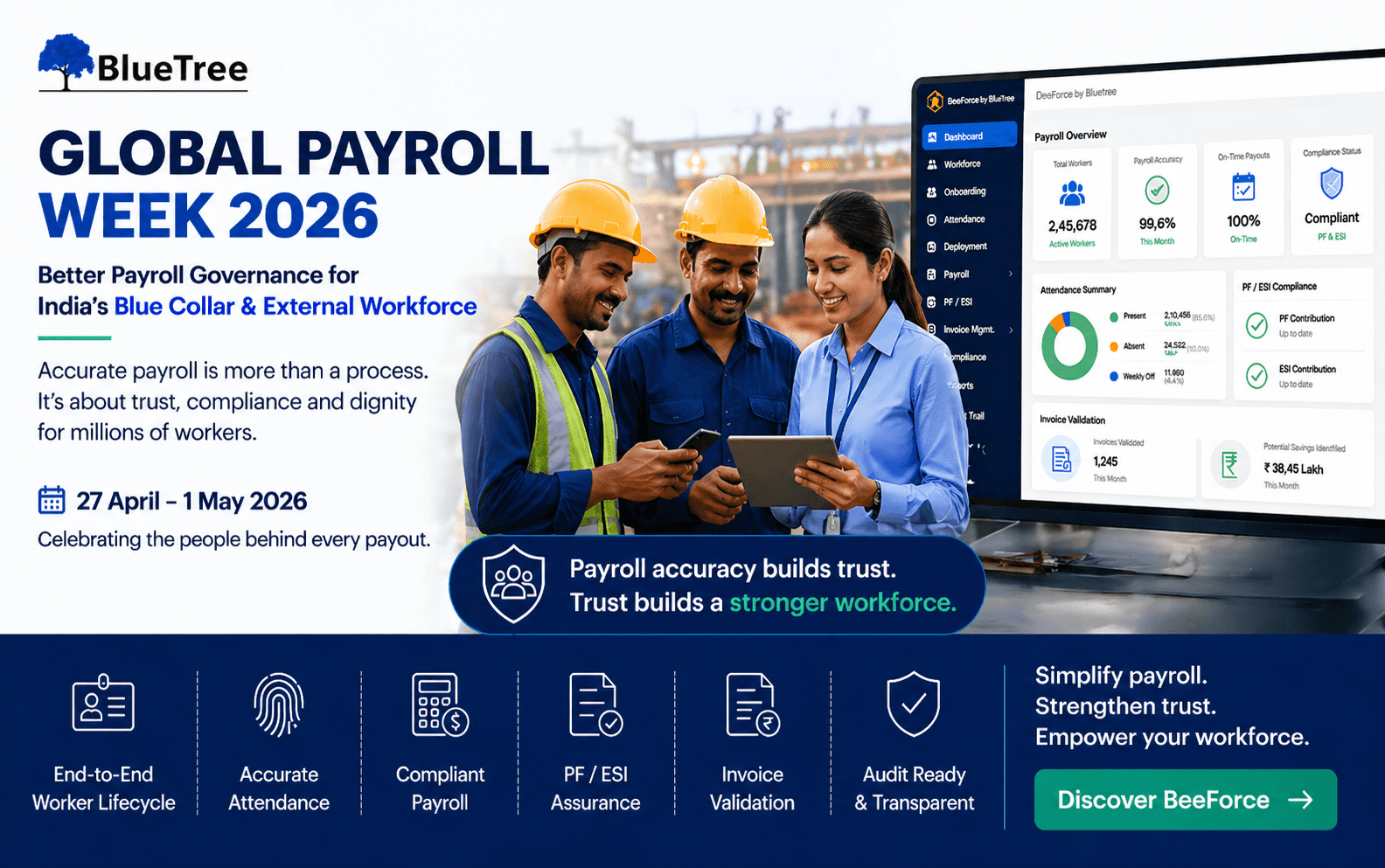
Global Payroll Week 2026: Why Blue Collar Payroll Needs Better Governance
Read More >

7-8 Minutes
|
All
category
What Are the 4 Labour Codes in the New Labour Laws in India? A Complete Guide
Read More >

15 to 17 minutes
|
All
category
What Are the New External Workforce Trends in 2026?
Read More >