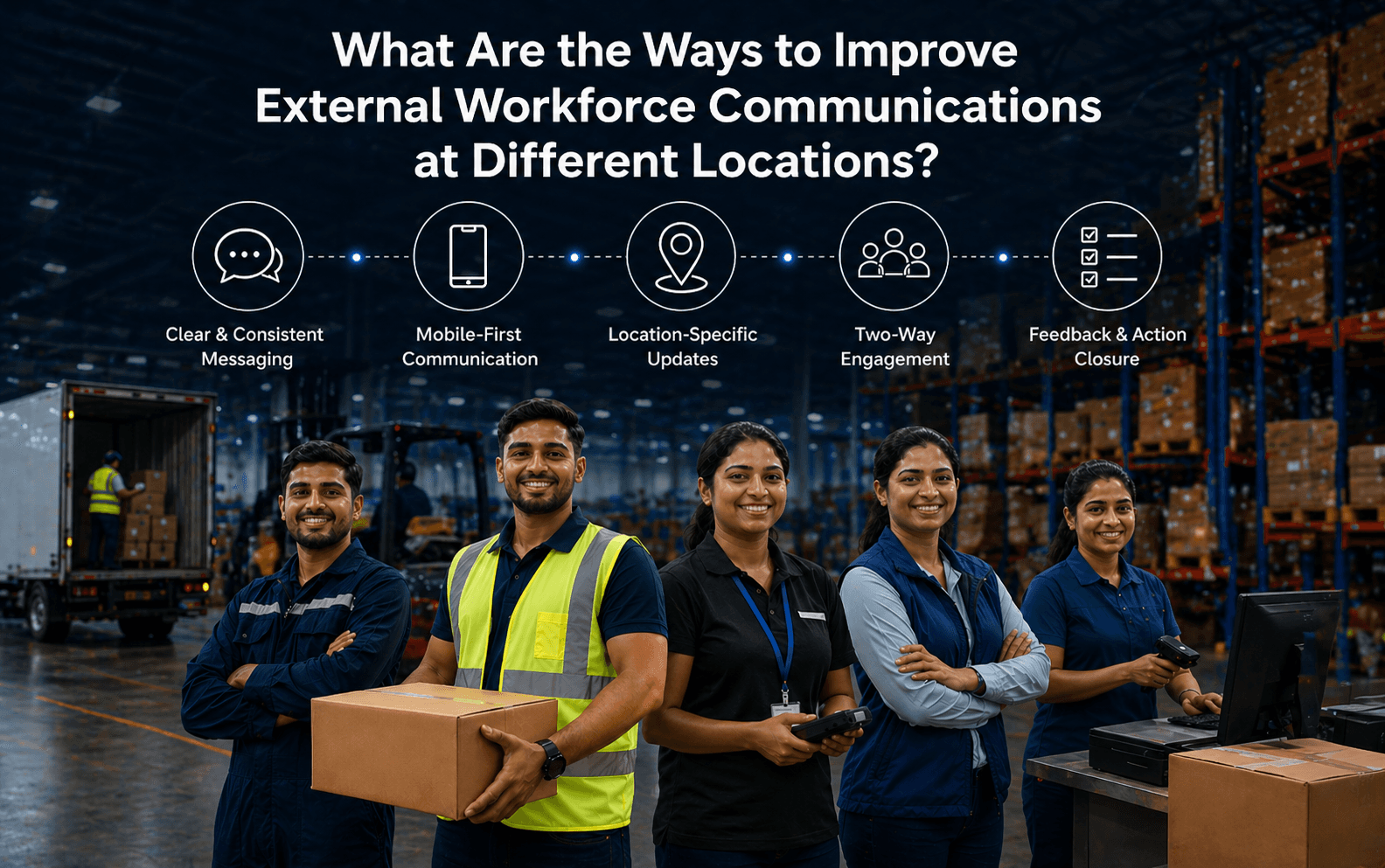
This blog explains how enterprises can improve external workforce communications across multiple locations, vendors, shifts, and worker groups. It covers practical ways to standardize communication templates, define role-based ownership, use mobile-first alerts, map contractor SPOCs, connect messages to onboarding, attendance, payout, compliance, and offboarding workflows, and track communication performance through site-wise and vendor-wise visibility. The blog is especially relevant for HR, operations, compliance, and site teams managing distributed external workforces where missed communication can lead to joining delays, attendance disputes, payout holds, and compliance exceptions.
Introduction
External workforce communication is one of the most underestimated challenges in enterprise workforce management.
Most enterprises focus heavily on onboarding, attendance, payroll, compliance, vendor management, and productivity. But communication is often handled informally through supervisors, contractors, WhatsApp groups, calls, notice boards, emails, or manual briefings.
This may work when the workforce is small and located at one site.
It breaks down when the enterprise operates across multiple factories, warehouses, branches, stores, hubs, client sites, service locations, or regional offices.
For organizations managing large external workforces, communication is not just an HR activity.
It is an operating control.
A missed communication can affect attendance.
A delayed instruction can affect productivity.
An unclear wage update can create worker dissatisfaction.
A poorly communicated policy change can create compliance gaps.
A safety instruction not reaching the right workers can create serious operational risk.
A contractor not aligned with enterprise expectations can create execution issues at the site level.
This is why enterprises need a structured approach to external workforce communication.
External workers include contract labour, gig workers, temporary workers, off-roll employees, vendor-supplied workers, daily wage workers, field workers, facility teams, security staff, housekeeping teams, logistics associates, retail associates, warehouse workers, technicians, and frontline workers.
These workers are often distributed across locations, vendors, shifts, languages, roles, and employment models.
The communication challenge is not only sending a message.
The real challenge is ensuring the right message reaches the right worker, in the right language, through the right channel, at the right time, with proof of delivery, acknowledgement, and follow-up.
That is where workforce communication software and system-led communication become important.
For enterprises, the question is not:
“How do we send messages to workers?”
The better question is:
“How do we create reliable, measurable, and compliant communication across a distributed external workforce?”
What Is Multi-Location Workforce Management?
Multi-location workforce management refers to the process of managing workers across multiple physical locations, business units, vendors, departments, shifts, and operating models.
In enterprise environments, this usually includes:
Factories
Warehouses
Distribution centers
Retail stores
Service branches
Client sites
Logistics hubs
Construction sites
Facility management sites
Regional offices
Field locations
Project locations
Multi-location workforce management becomes more complex when the enterprise depends on an external workforce.
A single organization may have thousands of workers deployed across different locations, supplied by different contractors, working different shifts, following different wage rules, and reporting to different supervisors.
For example, a manufacturing enterprise may have:
5 plants
40 contractors
12,000 external workers
3 shifts per plant
Multiple skill categories
Different state-level compliance rules
Site-specific safety instructions
Department-wise attendance approvals
Contractor-wise payroll and billing cycles
In such an environment, communication cannot depend only on manual forwarding.
Multi-location workforce management requires visibility and control across the full workforce lifecycle.
This includes:
Worker onboarding
Site allocation
Contractor mapping
Attendance and shifts
Payroll readiness
Compliance records
Safety communication
Policy updates
Grievance communication
Broadcast alerts
Supervisor instructions
Vendor coordination
Workforce reporting
Communication is the layer that connects these activities.
If workers do not receive the right information, even the best workforce processes can fail.
For example:
A worker may not know which shift to report for.
A contractor may not communicate document requirements properly.
A site supervisor may not receive approval rules.
A worker may not understand why wages changed.
A safety instruction may not reach night-shift workers.
A compliance document request may remain pending because the worker was not informed clearly.
This is why multi-location workforce management and workforce communication must work together.
Key Challenges of Multi-Location Workforce Management
Managing a distributed workforce is difficult because workforce data, communication channels, approvals, and accountability are often fragmented.
The challenge becomes bigger when external workers are managed through vendors and contractors.
Different locations follow different practices
In many enterprises, each location develops its own communication process.
One plant may depend on supervisors.
Another may depend on contractors.
A warehouse may use WhatsApp groups.
A retail network may rely on store managers.
A facility site may use phone calls.
This creates inconsistency.
A policy may be communicated clearly at one location but poorly at another.
Contractors become the primary communication channel
In external workforce models, contractors often act as the communication bridge between the enterprise and workers.
This creates dependency.
If the contractor does not communicate correctly, workers may not receive important updates.
The enterprise may assume the message has reached workers, but there may be no proof.
This is risky for wage updates, safety instructions, compliance documents, attendance rules, grievance processes, and policy changes.
Worker records are not always updated
Communication depends on accurate worker data.
If phone numbers are outdated, worker status is incorrect, site mapping is wrong, or vendor mapping is missing, communication will fail.
This is common in large contract workforce environments where workers join, exit, transfer, or move across sites frequently.
Language and literacy barriers
External workforces often include workers from different states, regions, and language backgrounds.
A message sent only in English may not be understood by many frontline workers.
Even Hindi or regional language communication may not be enough in multi-state operations.
Communication must be simple, contextual, and language-sensitive.
Shift-based communication gaps
Factories, warehouses, logistics hubs, and service operations often run in multiple shifts.
Workers on night shifts, weekly off, rotational shifts, or temporary deployment may miss important updates.
A notice board or one-time supervisor briefing may not reach everyone.
No proof of delivery or acknowledgement
Many enterprises send communication but cannot prove whether it was received, read, understood, or acknowledged.
This becomes a problem during audits, worker disputes, safety incidents, or compliance reviews.
For example, if a safety update was communicated only verbally, the enterprise may not be able to prove that the worker received it.
Communication is not linked to workforce data
A major challenge is that communication systems are often separate from workforce systems.
The enterprise may send messages through WhatsApp or SMS, but those messages may not be linked to:
Worker ID
Vendor
Site
Shift
Department
Worker category
Attendance status
Payroll status
Compliance status
Grievance history
Without this linkage, communication remains generic and difficult to measure.
Escalations are informal
External workers may raise issues through supervisors, contractors, HR representatives, or informal channels.
If complaints are not captured systematically, the enterprise loses visibility into recurring workforce concerns.
This affects trust, retention, compliance, and industrial relations.
Why External Workforce Communication Is Different
External workforce communication is different from regular employee communication because the workforce is more distributed, less digitally connected, and often managed through intermediaries.
A permanent employee may have a company email ID, HRMS access, employee app, manager reporting line, and structured HR communication.
An external worker may not.
External workers may depend on:
Contractor supervisors
Site HR
Plant supervisors
Mobile phones
Notice boards
Shift briefings
Vendor coordinators
Worker groups
Helplines
Informal peer communication
This creates a different communication reality.
External workers may not be directly connected to enterprise systems
Many enterprises do not give external workers the same digital access as permanent employees.
This creates a gap in employee communication.
The enterprise may have a strong HRMS for permanent employees, but contract workers may still depend on manual communication.
Contractors influence message accuracy
When contractors act as the primary communication channel, the enterprise loses control over message quality.
A wage update, safety instruction, attendance rule, or compliance reminder may be changed, delayed, simplified incorrectly, or not communicated at all.
Workforce turnover is higher
External workforce roles often have higher movement.
Workers may join, exit, shift sites, change vendors, or be replaced quickly.
Communication lists become outdated if they are not linked to live workforce records.
Communication must be operational
External workforce communication is often about immediate execution.
Examples include:
Report to shift at 6 AM
Submit bank document before payroll cutoff
Complete onboarding verification
Follow new safety instruction
Attend toolbox training
Check wage slip
Raise attendance correction request
Update UAN or ESI details
Confirm availability for peak demand
Report to a different site
These are not generic announcements.
They are operational instructions that affect workforce readiness.
Communication has compliance implications
For external workers, communication is often linked to compliance.
Enterprises may need to prove that workers were informed about safety rules, wage details, policy changes, grievance channels, statutory documents, or working condition requirements.
This makes communication traceability important.
Different stakeholders need different communication
External workforce communication is not only worker communication.
It involves multiple stakeholder groups.
Stakeholder | Communication Need |
External workers | Shift details, wage updates, attendance rules, safety instructions, grievance channels, document reminders |
Contractors | Worker onboarding requirements, compliance deadlines, billing issues, replacement needs, statutory proof |
Site HR | Worker readiness, attendance exceptions, onboarding gaps, grievance updates |
Supervisors | Shift deployment, overtime approvals, worker issues, attendance corrections |
Payroll teams | Payroll cutoffs, pending inputs, exception closures, bank or statutory gaps |
Compliance teams | PF, ESI, CLRA, wage records, safety records, statutory reminders |
Finance teams | Vendor billing readiness, invoice mismatches, payout holds |
Leadership | Workforce communication effectiveness, risks, escalations, location-wise issues |
This is why external workforce communication needs structure.
Effective Communication Strategies for Distributed Workforce Management
Effective communication for distributed workforce management must be intentional, targeted, measurable, and connected to workforce data.
Enterprises should move away from informal broadcast-only communication and build communication processes that support workforce execution.
Segment communication by workforce context
Not every message is relevant to every worker.
Messages should be segmented by:
Location
Vendor
Department
Shift
Worker category
Skill
Role
Employment type
Language
Payroll status
Compliance status
Attendance status
Onboarding stage
For example, a PF document reminder should go only to workers with missing PF details.
A night shift safety update should go only to workers deployed in night shifts.
A wage slip communication should go only to workers whose payroll has been processed.
Segmentation improves relevance and reduces communication fatigue.
Use multiple communication channels
External workers may not all use the same channel.
A strong communication strategy may include:
Mobile app notifications
SMS
WhatsApp where approved by enterprise policy
IVR or voice messages
Supervisor app alerts
Contractor dashboards
Notice board outputs
Kiosk messages
Email for contractors and managers
In-app worker communication
Helpdesk or grievance channels
The channel should depend on urgency, worker access, literacy level, language, and proof requirement.
Keep messages simple and actionable
External workforce communication should be direct.
Avoid long policy language.
A good message should tell the worker:
What has changed
What action is required
By when it must be done
Who to contact
What happens if action is not completed
For example:
“Your bank details are pending. Please submit your bank passbook photo by 5 PM today to avoid payroll delay. Contact your site HR or contractor supervisor for help.”
This is better than a generic payroll reminder.
Communicate before the issue becomes urgent
Many workforce issues become serious because communication happens too late.
Enterprises should send proactive reminders for:
Document submission
Attendance regularization
Payroll cutoff
Bank detail correction
UAN or ESI update
Safety training
Shift change
Contract renewal
Vendor compliance deadline
Wage slip availability
Grievance escalation
Proactive communication reduces last-minute follow-up.
Make contractors accountable
Contractors should not be informal message carriers.
They should be part of the communication workflow.
Enterprises should track whether contractors have:
Received communication
Acknowledged instructions
Shared updates with workers
Closed pending document cases
Responded to compliance reminders
Resolved worker-level communication gaps
Contractor communication should be measurable.
Create feedback channels
Communication should not be one-way.
Workers need a way to raise issues, ask questions, and report gaps.
Feedback channels may include:
Grievance portal
Worker app
Voice grievance
Helpdesk
IVR
Supervisor escalation
Site HR workflow
Contractor response mechanism
Without feedback, enterprises may keep sending messages without knowing whether they are understood.
Track communication performance
A distributed workforce communication strategy should be measured.
Enterprises should track:
Delivery rate
Read rate
Acknowledgement rate
Action completion rate
Pending cases
Location-wise response
Contractor-wise response
Worker category-wise gaps
Repeat escalations
Grievance volume
Payroll issue reduction
Attendance correction reduction
Communication should produce outcomes, not just messages.
Ways to Improve External Workforce Communication Across Different Locations
Improving external workforce communication across different locations requires a structured operating model.
The objective is to make communication consistent, targeted, trackable, and action-oriented.
Build a centralized workforce communication database
Communication starts with accurate worker data.
Enterprises should maintain a central database of external workers with:
Worker name
Worker ID
Mobile number
Vendor
Contractor
Site
Department
Shift
Worker category
Language preference
Employment status
Onboarding status
Payroll readiness status
Compliance status
If the database is outdated, communication will fail.
A centralized worker database ensures that messages reach the right workers across all locations.
Connect communication to worker lifecycle events
Communication should not happen randomly.
It should be triggered by workforce lifecycle events such as:
Worker onboarding
Document pending
Verification failure
Site allocation
Shift assignment
Attendance exception
Overtime approval
Payroll cutoff
Wage slip release
PF or ESI pending
Compliance deadline
Safety training requirement
Grievance status update
Worker exit
This makes communication timely and relevant.
Create location-wise communication ownership
Every location should have clear ownership.
Communication ownership may include:
Site HR
Contractor coordinator
Plant HR
Department supervisor
Regional HR
Compliance owner
Payroll owner
The system should define who sends, approves, monitors, and closes communication.
Without ownership, communication becomes fragmented.
Use multilingual messaging
External workforces are often multilingual.
Enterprises should support communication in regional languages wherever needed.
This is especially important for:
Safety instructions
Wage communication
Attendance rules
Document requirements
Grievance processes
Compliance messages
Site-specific instructions
A message is useful only if the worker understands it.
Standardize critical communication templates
Enterprises should create standard templates for recurring communication.
Examples include:
Onboarding document reminder
Shift change notice
Payroll cutoff reminder
Wage slip availability
Attendance regularization reminder
Overtime approval message
PF or ESI detail reminder
Safety training alert
Grievance acknowledgement
Vendor compliance reminder
Worker exit instruction
Standardization reduces inconsistency across locations.
Link communication with attendance and payroll
Many external workforce communication issues are linked to attendance and payroll.
For example:
Missing punch alert
Attendance correction reminder
Payroll cutoff notification
Bank detail pending alert
Wage slip release
Overtime approval status
Payable day clarification
When communication is linked to attendance and payroll data, workers get timely updates and payroll teams face fewer disputes.
Use dashboards for communication gaps
Leadership should be able to view communication performance.
Dashboards should show:
Messages sent
Messages delivered
Messages acknowledged
Pending worker actions
Location-wise gaps
Vendor-wise gaps
Shift-wise gaps
Worker category-wise gaps
Contractor response status
This helps enterprises identify locations where communication is weak.
Create escalation workflows
If workers or contractors do not respond, the system should escalate.
For example:
Worker does not submit bank details
First reminder goes to worker
Second reminder goes to contractor
Third reminder goes to site HR
Final escalation goes to payroll or HR operations
Escalation workflows prevent last-minute chaos.
Include contractors in communication governance
Contractors must be active participants in workforce communication.
They should receive dashboards showing:
Pending worker documents
Attendance exceptions
Compliance gaps
Payroll readiness issues
Worker grievances
Shift updates
Safety training status
This creates accountability.
Measure communication against business outcomes
The goal of communication is not only delivery.
It should improve workforce outcomes.
Enterprises should measure whether communication reduces:
Payroll disputes
Attendance corrections
Worker grievances
Compliance delays
Onboarding drop-offs
Vendor follow-ups
Safety non-compliance
Shift absenteeism
Worker confusion
This connects communication to business impact.
Contractor Communication Best Practices
Contractor communication is a critical part of external workforce communication.
In many enterprises, contractors act as the first communication layer for external workers. But contractor-led communication must be governed carefully.
Define communication responsibilities clearly
Enterprises should clearly define what contractors are responsible for communicating.
This may include:
Worker onboarding requirements
Document submission
Attendance expectations
Wage communication support
Shift instructions
Safety training reminders
Compliance document follow-up
Worker replacement timelines
Grievance support
Payroll issue coordination
Without defined responsibility, contractors may assume communication is the enterprise’s responsibility, while the enterprise assumes contractors have already communicated.
Use structured communication channels with contractors
Contractor communication should not depend only on phone calls and informal messages.
Enterprises should use structured channels such as:
Contractor portal
Vendor dashboard
Workflow alerts
Email notifications
System-generated reminders
Compliance task lists
Pending action reports
This creates a record of communication.
Track contractor acknowledgement
For important communication, acknowledgement should be tracked.
This is important for:
Policy changes
Wage-related updates
Compliance requirements
Safety instructions
Payroll cutoff rules
Worker replacement requests
Audit documentation requests
Acknowledgement proves that the contractor received the instruction.
Give contractors visibility into pending actions
Contractors should not have to wait for HR to tell them what is pending.
They should be able to see:
Workers with pending documents
Workers not payroll-ready
Missing PF or ESI details
Attendance exceptions
Grievance cases
Expiring documents
Compliance proof pending
Billing mismatches
This improves closure speed.
Create contractor-wise communication scorecards
Enterprises should measure contractor communication discipline.
Useful metrics include:
Response time
Pending document closure rate
Attendance exception closure rate
Payroll issue response rate
Compliance proof submission rate
Worker grievance closure support
Escalation frequency
Repeat communication failures
Contractors should be reviewed not only on manpower supply, but also on communication and compliance responsiveness.
Avoid over-dependence on contractors
While contractors are important, enterprises should not depend entirely on them for communication.
Critical messages should also reach workers directly wherever possible.
This is important for:
Wage information
Safety instructions
Grievance channels
Attendance rules
Compliance requirements
Policy changes
Worker rights and responsibilities
Direct worker communication improves trust and reduces information distortion.
Why External Workforce Communication Needs a System-Led Approach
External workforce communication cannot be managed reliably through informal channels alone.
WhatsApp groups, calls, notice boards, emails, and supervisor briefings may be useful, but they do not create full control.
A system-led approach is needed because external workforce communication must be accurate, targeted, traceable, measurable, and connected to workforce data.
Informal communication creates visibility gaps
If communication happens through informal channels, enterprises may not know:
Who received the message
Who read it
Who understood it
Who acknowledged it
Who completed the required action
Which location has pending communication
Which vendor has not responded
Which workers remain at risk
This creates uncertainty.
Communication must be linked to workforce records
A system-led approach connects communication to worker data.
For example, a payroll reminder should be linked to workers whose payroll readiness is incomplete.
A safety instruction should be linked to workers deployed at a specific site or role.
A document reminder should be linked to workers with missing documents.
This makes communication more relevant and effective.
Enterprises need proof and audit trails
For external workforce communication, proof matters.
Enterprises may need proof that workers or contractors were informed about:
Safety rules
Wage slip availability
Policy changes
Attendance rules
Compliance document requirements
Grievance channels
Training schedules
Shift changes
A system-led approach creates records and audit trails.
Communication should trigger action
A system-led communication platform should not only send messages.
It should trigger action.
For example:
Worker submits missing document
Contractor closes pending compliance task
Supervisor approves attendance exception
Worker acknowledges safety instruction
Payroll team receives readiness confirmation
Grievance moves to next stage
This converts communication into workflow.
Communication must be measurable
Enterprises cannot improve what they cannot measure.
System-led communication helps track:
Delivery
Acknowledgement
Response
Closure
Escalation
Location-wise gaps
Vendor-wise gaps
Worker category-wise gaps
Business impact
This allows HR and operations leaders to improve communication continuously.
How to Solve Distributed Workforce Communication Challenges
Distributed workforce communication challenges are solved by combining process design, technology, ownership, and measurement.
Enterprises should not treat communication as a standalone activity.
It should be embedded into workforce operations.
Map communication use cases
Start by identifying where communication is needed.
Common use cases include:
Onboarding
Document collection
Attendance correction
Shift allocation
Overtime approval
Payroll cutoff
Wage slip communication
Compliance reminders
Safety instructions
Training schedules
Worker grievance updates
Vendor billing exceptions
Worker exit
Emergency alerts
Once use cases are identified, communication can be standardized.
Define audience groups
Audience groups should be mapped clearly.
These may include:
All workers
Workers by site
Workers by vendor
Workers by shift
Workers by role
Workers by department
Workers with pending documents
Workers with attendance exceptions
Workers not payroll-ready
Contractors
Supervisors
Site HR
Payroll teams
Compliance teams
Operations managers
This allows precise communication.
Build templates for repeat communication
Communication templates help standardize quality.
Each template should define:
Message purpose
Target audience
Language
Action required
Deadline
Escalation owner
Proof required
Closure status
This prevents location-wise variation.
Create a communication calendar
Some communication should be planned.
Examples include:
Payroll cutoff reminders
Attendance regularization windows
Compliance document collection
Safety training reminders
Wage slip release
Policy updates
Contractor review reminders
Vendor billing closure timelines
A calendar reduces last-minute messages.
Integrate communication with workforce systems
Communication should be connected to:
Worker master
Contractor master
Site mapping
Attendance
Shift schedules
Payroll readiness
Compliance records
Grievance workflows
Vendor billing
Dashboards
This ensures that messages are triggered by real workforce events.
Enable two-way communication
Workers and contractors should be able to respond.
This helps clarify issues quickly.
Two-way communication is useful for:
Document queries
Attendance disputes
Wage clarification
Grievance reporting
Shift availability
Safety concerns
Payroll issues
Site instructions
A one-way broadcast model cannot solve distributed workforce issues.
Use escalation rules
Escalations should be built into the communication process.
For example:
Worker does not acknowledge shift change
Contractor does not close document gap
Supervisor does not approve overtime
Payroll exception remains pending
Compliance proof is not submitted
Escalation rules ensure accountability.
Review communication data regularly
HR and operations leaders should review communication data weekly or monthly.
They should identify:
Locations with low acknowledgement
Vendors with poor response
Worker categories with repeated gaps
Communication types with low closure
Issues leading to payroll disputes
Messages that reduce escalations
This turns communication into a management discipline.
How to Measure the Effectiveness of Your External Workforce Communication
External workforce communication should be measured through both communication metrics and business outcome metrics.
The goal is not only to know whether messages were sent.
The goal is to know whether communication improved workforce execution.
Communication metrics
Enterprises should track:
Metric | What It Shows |
Delivery rate | Whether messages reached the intended workers or contractors |
Read rate | Whether messages were opened or viewed |
Acknowledgement rate | Whether workers or contractors confirmed receipt |
Response rate | Whether the audience responded within the required time |
Action completion rate | Whether the required task was completed |
Escalation rate | Whether communication required follow-up or escalation |
Location-wise communication gap | Which sites have weak communication performance |
Vendor-wise response gap | Which contractors are slow or unresponsive |
Language effectiveness | Whether translated messages improve response and closure |
Repeat communication failure | Whether the same issue keeps occurring |
Business outcome metrics
Communication should also be measured against business outcomes.
These include:
Business Outcome | What Improved Communication Should Reduce |
Payroll accuracy | Fewer payroll disputes and corrections |
Attendance control | Fewer missing punches and attendance regularizations |
Onboarding readiness | Faster document completion and day-zero readiness |
Compliance readiness | Fewer missing PF, ESI, wage, or statutory records |
Vendor accountability | Faster contractor response and fewer pending actions |
Worker trust | Fewer wage-related grievances and repeated escalations |
Operational continuity | Better shift reporting and lower manpower confusion |
Safety compliance | Higher acknowledgement of safety instructions and training |
Finance control | Fewer vendor billing disputes and invoice mismatches |
HR productivity | Less manual follow-up and faster closure of workforce issues |
Example of measuring communication effectiveness
Suppose a manufacturing company sends payroll cutoff reminders to 8,000 contract workers across 12 locations.
Before system-led communication:
Many workers submit bank updates late
Attendance corrections come after cutoff
Contractors send revised files multiple times
Payroll has frequent adjustment cases
Workers raise wage disputes after payout
After system-led communication:
Workers with missing bank details receive targeted reminders
Contractors receive pending worker lists
Site HR gets escalation alerts
Payroll readiness dashboard shows closure status
Workers receive wage slip notifications
The company can then measure:
Reduction in payroll corrections
Reduction in late document submission
Faster contractor closure
Lower worker grievance volume
Improved payroll readiness before cutoff
This is how communication becomes measurable.
The most important metric
The most important metric is not how many messages were sent.
It is how many workforce issues were prevented because the right communication reached the right person at the right time.
That is the standard enterprises should use.
Conclusion
External workforce communication is no longer a soft HR activity.
For multi-location enterprises, it is a workforce control function.
When thousands of contract workers, frontline workers, vendor-supplied workers, and blue-collar teams operate across factories, warehouses, hubs, stores, branches, and client sites, communication becomes critical to execution.
Poor communication creates real business problems.
Workers miss shifts.
Attendance corrections increase.
Payroll disputes rise.
Compliance documents remain pending.
Contractors delay action.
Safety instructions do not reach the right people.
Vendor billing mismatches increase.
Leadership loses visibility.
Enterprises cannot solve these issues through informal communication alone.
They need a system-led approach that connects communication with worker data, vendor mapping, attendance, payroll readiness, compliance records, grievance workflows, and dashboards.
BlueTree BeeForce helps enterprises strengthen external workforce communication by connecting workforce lifecycle data with structured communication, alerts, workflows, dashboards, and accountability.
This allows HR, payroll, compliance, contractors, supervisors, finance, and operations teams to communicate through one connected workforce layer.
For enterprises managing distributed workforces, the goal should be clear:
Send the right message to the right worker or contractor, at the right time, in the right language, with proof of delivery, acknowledgement, action tracking, and measurable business impact.
That is how external workforce communication becomes more reliable.
That is how distributed workforce management becomes more controlled.
And that is how enterprises move from scattered messages to connected workforce communication.


Manage External Workforce with BlueTree - Govern contract, gig, and blue collar workers across vendors, sites, and shifts.
Frequenty Asked Questions
4-5 Minutes
|
All
category
Global Payroll Week 2026: Why Blue Collar Payroll Needs Better Governance
Read More >
7-8 Minutes
|
All
category
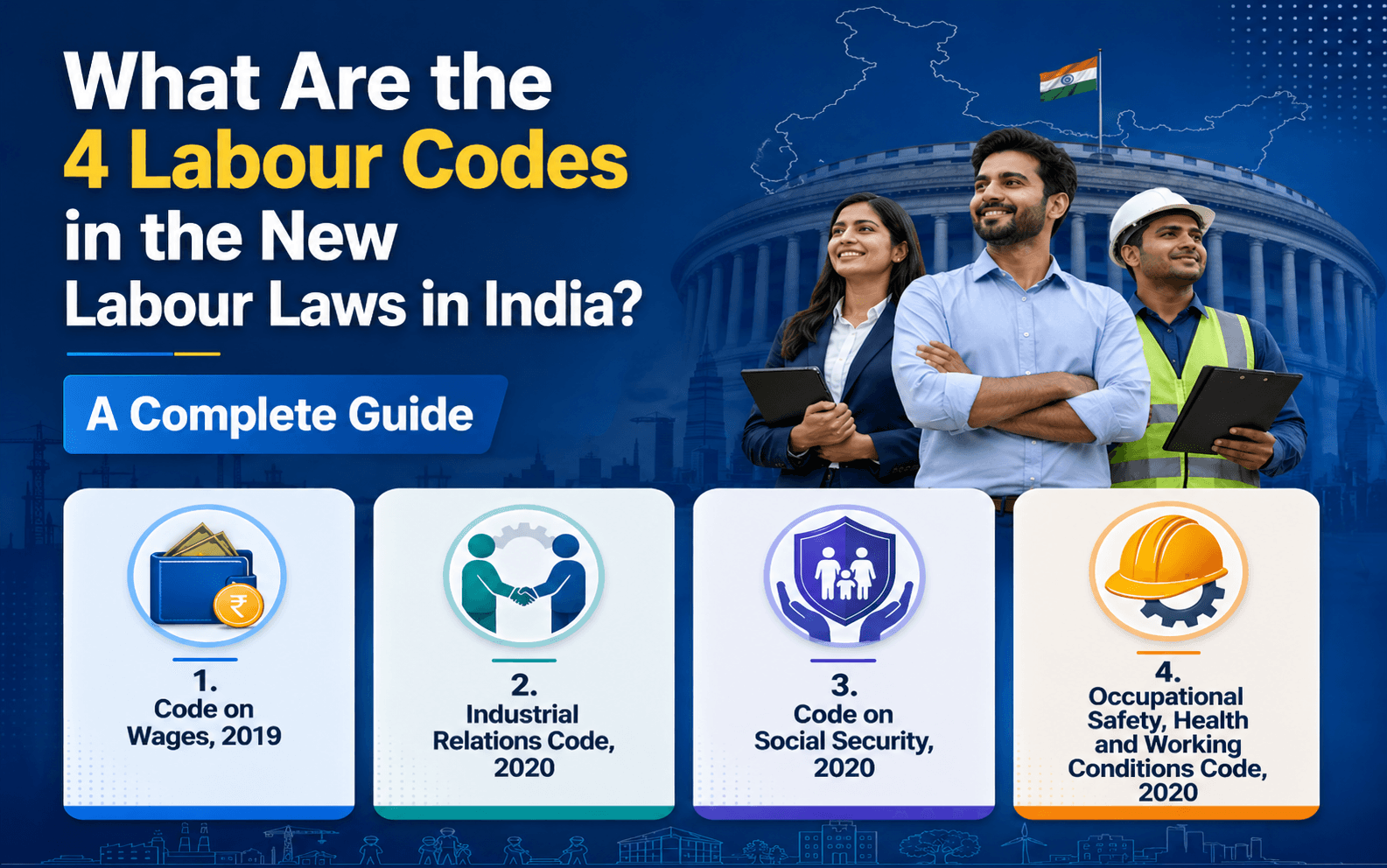
What Are the 4 Labour Codes in the New Labour Laws in India? A Complete Guide
Read More >

15 to 17 minutes
|
All
category
What Are the New External Workforce Trends in 2026?
Read More >