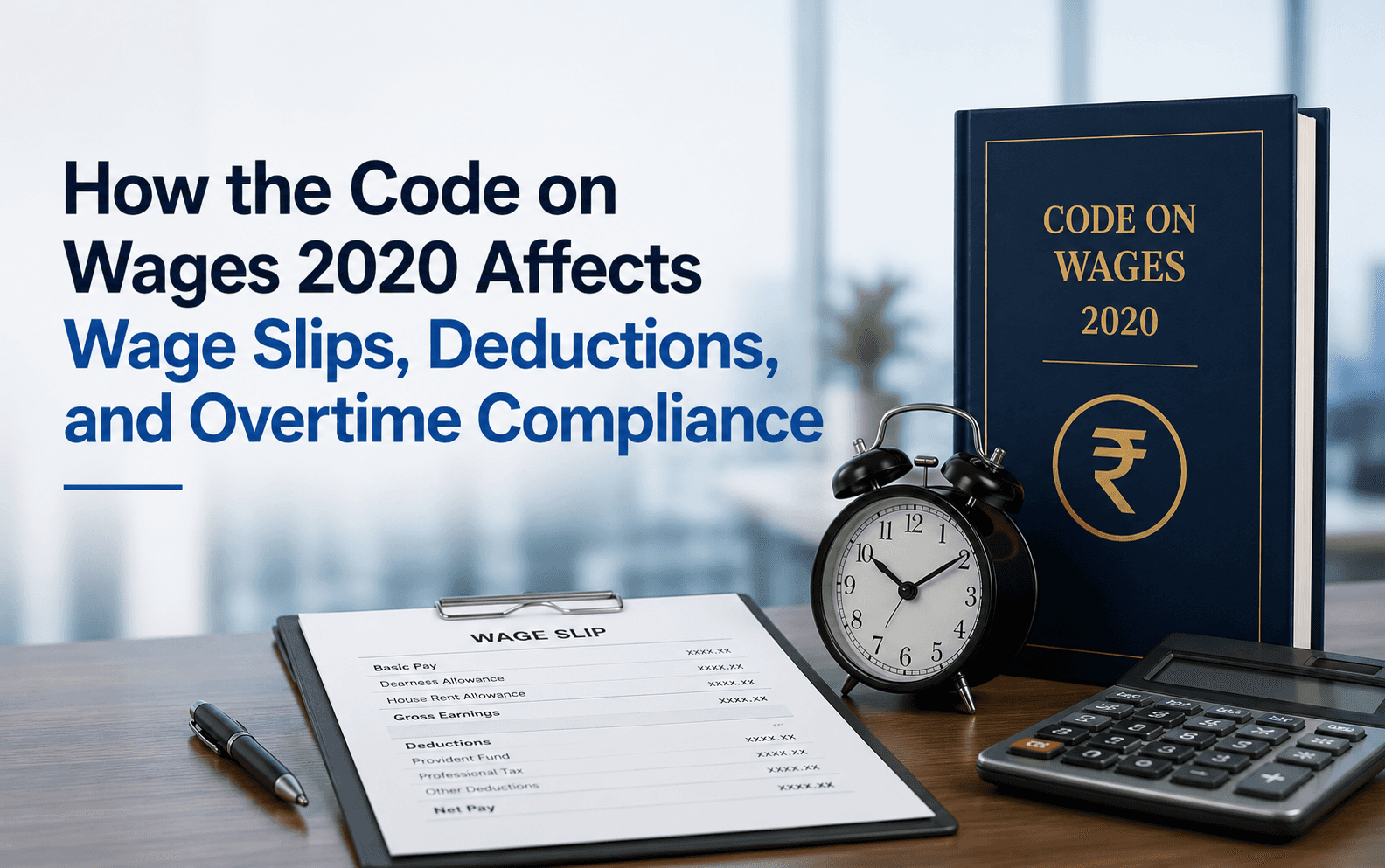
The Code on Wages, 2019 has changed how enterprises must manage wage slips, deductions, overtime, and payroll transparency across the workforce lifecycle. Wage compliance is no longer limited to salary processing. It now requires connected attendance, wage validation, overtime approvals, deduction controls, and audit-ready workforce records. This blog explains how the Code on Wages affects payroll operations, the most common enterprise compliance gaps, and how organizations can strengthen wage governance through system-led workforce management.
Introduction
Most payroll compliance failures do not begin during salary processing.
They begin much earlier through disconnected workforce operations.
An attendance correction missed at site level.
An overtime approval handled outside the system.
A deduction applied without proper validation.
A wage slip generated from incomplete payroll data.
Individually, these may appear operationally small.
At enterprise scale, they become wage compliance risks.
Under the Code on Wages, 2019, wage compliance is no longer limited to paying employees on time. It now requires enterprises to maintain transparent, traceable, and audit-ready wage records across:
attendance,
overtime,
deductions,
payroll,
wage slips,
and statutory reporting.
For organizations managing large external workforce operations across manufacturing plants, warehouses, logistics hubs, retail stores, and contractor ecosystems, this creates a major operational shift.
Because wage slips, deductions, and overtime can no longer be managed as isolated payroll activities.
They now depend on whether workforce transactions are connected and validated continuously across the workforce lifecycle.
What Is the Code on Wages, 2019?
The Code on Wages consolidates multiple wage-related laws into a unified wage compliance framework covering:
wage payments,
minimum wages,
overtime,
wage slips,
deductions,
employee records,
and payroll transparency.
The Code applies across workforce categories and significantly increases the need for accurate wage governance.
Operationally, the Code changes how enterprises must manage:
wage structures,
attendance-linked payouts,
deduction controls,
overtime calculations,
and payroll documentation.
The key shift is this:
Wage compliance is no longer just a payroll function.
It is now a continuous operational control process.
This means enterprises must ensure:
workforce records remain connected,
wage calculations are traceable,
deductions are validated,
and overtime is governed systematically instead of manually.
Why Wage Compliance Is Becoming More Complex
Wage compliance complexity has increased because workforce operations themselves have become more fragmented.
Most enterprises today manage:
permanent employees,
fixed-term employees,
shift-based workers,
and distributed site operations.
At the same time:
attendance is captured across multiple systems,
overtime is approved operationally,
wage rates vary by location and category,
and payroll inputs move across HR, finance, contractors, and site teams.
This creates operational gaps that directly affect:
wage accuracy,
deduction transparency,
overtime calculation,
and payroll defensibility during audits.
The Four Labour Codes readiness framework identifies disconnected workforce transactions as one of the biggest reasons wage compliance breaks operationally.
Most wage disputes are not caused by payroll formulas.
They are caused by:
incomplete attendance validation,
incorrect worker mapping,
missing approvals,
inconsistent wage masters,
or fragmented workforce records.
How the Code Changes Wage Slip Requirements
Under the Code on Wages, wage slips are no longer viewed as administrative paperwork.
They are statutory proof of wage transparency and payroll compliance.
Employers are required to issue wage slips containing:
wage period,
gross wages,
deductions,
net payable wages,
overtime details,
wage components,
and other payroll information in the prescribed format.
Operationally, this means wage slips must now become:
accurate,
traceable,
transparent,
and audit-ready.
Why Wage Slip Compliance Often Fails
In many enterprises:
attendance sits in one system,
overtime approvals happen manually,
payroll is processed separately,
and wage slips are generated later.
This creates common operational problems:
incorrect payable days,
missing overtime entries,
unauthorized deductions,
outdated wage rates,
and inconsistent wage components.
When wage slips are generated from disconnected systems, payroll transparency weakens significantly.
This creates both:
worker trust issues,
and statutory compliance exposure.
What Enterprises Must Ensure
HR and payroll teams should ensure:
wage components are clearly separated,
deductions are visible and traceable,
overtime payments are reflected correctly,
and wage slips are generated directly from approved payroll data.
Manual wage slip generation creates significant audit and reconciliation risk at scale.
What Counts as Valid Wage Deductions?
Deductions remain one of the most sensitive payroll compliance areas under the Code on Wages.
While deductions are permitted, they must remain:
authorized,
transparent,
traceable,
and legally compliant.
Common deductions include:
Provident Fund (PF),
Employee State Insurance (ESI),
professional tax,
advances,
loans,
recoveries,
and approved penalties.
However, the Code imposes clear controls around:
deduction visibility,
deduction limits,
and worker authorization.
Why Deduction Compliance Becomes Operationally Risky
In large workforce environments, deduction management becomes difficult because payroll inputs often originate from multiple operational teams.
For example:
site teams manage attendance,
HR manages employee records,
finance handles recoveries,
contractors submit workforce data,
and payroll teams process deductions centrally.
Without connected systems, enterprises face risks such as:
duplicate deductions,
unauthorized recoveries,
incorrect loan adjustments,
over-deductions,
and missing statutory deductions.
This creates significant compliance and employee grievance exposure.
Common Deduction Risks
Typical enterprise gaps include:
manual deduction approvals,
inconsistent advance recovery tracking,
deductions exceeding statutory limits,
payroll corrections after wage processing,
and deductions applied without worker visibility.
These issues become especially difficult during:
audits,
labour inspections,
worker disputes,
and payroll reconciliation reviews.
How Overtime Compliance Works Under the Code
Overtime is one of the most operationally complex areas under the Code on Wages.
The Code requires overtime to be:
approved,
accurately tracked,
and paid at not less than twice the ordinary wage rate.
For enterprises managing shift-based operations, overtime risk increases significantly because workforce deployment changes continuously.
Why Overtime Compliance Breaks
Most overtime problems do not originate during payroll processing.
They begin operationally.
For example:
workers staying beyond shifts without formal approval,
supervisors approving OT outside systems,
biometric punch gaps,
incorrect shift mapping,
or overtime manually added during payroll closure.
At enterprise scale, these small inconsistencies create:
incorrect wage payouts,
labour cost leakage,
working-hour violations,
and statutory non-compliance.
The Four Labour Codes readiness guide identifies unapproved overtime and disconnected attendance workflows as recurring enterprise risk patterns.
What Enterprises Need for OT Governance
Enterprises should ensure:
overtime is linked directly to attendance,
approvals remain traceable,
OT limits are monitored,
and calculations are automated through rule-based systems.
Manual overtime handling creates both payroll risk and operational inefficiency.
Why Wage Compliance Depends on Connected Workforce Data
Most payroll compliance gaps are not payroll-system failures.
They are workforce data failures.
When:
attendance,
payroll,
deductions,
overtime,
and worker records
remain disconnected, enterprises lose visibility into payroll accuracy.
This creates a situation where:
systems exist,
payroll gets processed,
but operational control remains incomplete.
This is why modern enterprises are increasingly shifting toward connected workforce intelligence models where:
attendance,
wage rules,
worker deployment,
overtime,
deductions,
vendor billing,
and statutory records remain connected operationally.
How HR and Payroll Teams Should Update Systems
The Code on Wages requires enterprises to move beyond manual payroll administration toward system-led wage governance.
This means payroll systems should support:
attendance-linked wage calculations,
automated overtime validation,
deduction controls,
wage rule enforcement,
digital wage slips,
and audit-ready record management.
Key Operational Improvements
Automate Wage Calculation
Payroll should be generated directly from:
approved attendance,
shift records,
overtime validation,
and wage masters.
Maintain Real-Time Workforce Visibility
HR and payroll teams should have visibility into:
worker deployment,
payable days,
OT exceptions,
and deduction status before payroll closure.
Standardize Approval Workflows
Attendance corrections, overtime approvals, and deduction adjustments should remain workflow-driven and traceable.
Maintain Audit-Ready Records
Enterprises should maintain:
wage slips,
deduction logs,
overtime records,
and payroll approvals digitally for audit-readiness.
Common Enterprise Mistakes to Avoid
1. Managing Payroll Separately from Attendance
Disconnected attendance and payroll systems create wage mismatches and overtime errors.
2. Manual Overtime Handling
Manual OT approvals increase payroll leakage and audit exposure.
3. Inconsistent Wage Masters
Outdated wage structures create minimum wage and wage slip compliance risk.
4. Unauthorized Deductions
Applying deductions without traceable approval creates legal and grievance risk.
5. Reactive Compliance
Many enterprises validate payroll only after processing instead of preventing issues before closure.
Best Practices for Wage Compliance
Enterprises should focus on:
connected attendance and payroll systems,
automated wage rule validation,
real-time overtime tracking,
transparent deduction management,
digital wage slip generation,
and audit-ready workforce records.
The strongest compliance model is one where payroll records are generated directly from validated workforce transactions instead of reconstructed manually later.
How BlueTree Helps Enterprises Improve Wage Compliance
BlueTree’s approach is simple:
Payroll compliance should not begin during salary processing.
It should begin with validated workforce transactions.
BeeForce helps enterprises improve wage compliance by connecting:
attendance,
overtime,
wage rules,
payroll inputs,
deductions,
contractor records,
and payroll workflows into one operational layer.
This allows enterprises to:
improve payroll accuracy,
strengthen overtime governance,
reduce wage disputes,
improve audit readiness,
and maintain better workforce visibility across distributed operations.
Instead of managing payroll reactively after attendance closure, enterprises can validate workforce data continuously before wage processing begins.
Key Takeaways for Employers
The Code on Wages has significantly increased the importance of payroll transparency and operational wage governance.
Enterprises should focus on:
accurate wage slips,
connected attendance and payroll systems,
transparent deductions,
overtime validation,
audit-ready workforce records,
and automated payroll workflows.
The biggest payroll risk today is not only incorrect calculation.
It is disconnected workforce data.
Conclusion
The Code on Wages has transformed wage compliance from a payroll activity into a broader workforce governance responsibility.
Wage slips, deductions, and overtime can no longer be managed through fragmented systems, spreadsheets, or post-facto corrections.
For enterprises managing large and distributed workforce operations, compliance now depends on whether attendance, payroll, wage rules, deductions, overtime, and workforce records remain connected operationally.
The organizations that manage this effectively will not only reduce compliance risk.
They will also improve payroll accuracy, workforce trust, operational visibility, and long-term workforce governance maturity.


Manage External Workforce with BlueTree - Govern contract, gig, and blue collar workers across vendors, sites, and shifts.
Frequenty Asked Questions
4-5 Minutes
|
All
category
Global Payroll Week 2026: Why Blue Collar Payroll Needs Better Governance
Read More >
7-8 Minutes
|
All
category
What Are the 4 Labour Codes in the New Labour Laws in India? A Complete Guide
Read More >

15 to 17 minutes
|
All
category
What Are the New External Workforce Trends in 2026?
Read More >