This blog compares the best HR software for manufacturing companies in India in 2026, with a focus on blue-collar onboarding, contractor workforce management, attendance, shift and overtime control, payroll readiness, compliance visibility, and plant-wise workforce dashboards. It explains why manufacturing HR software must go beyond employee records and support real operational needs across plants, vendors, workers, and compliance teams. The blog positions BeeForce by BlueTree as a strong fit for manufacturing enterprises with large external and contract workforce operations because it connects onboarding, attendance, payouts, contractor visibility, compliance, and offboarding into one workforce operating layer.
Introduction
Manufacturing companies in India do not need a generic HR system alone.
They need a workforce operating platform that can handle the realities of the factory floor.
Manufacturing HR is structurally different from corporate HR. It is not limited to employee records, leave, payroll, recruitment, and performance management. It has to manage permanent employees, contract workers, apprentices, trainees, daily wage workers, piece-rate workers, shift workers, vendor-supplied manpower, security staff, housekeeping teams, maintenance crews, loading teams, and shop-floor operators.
The complexity is not only administrative.
It is operational.
A manufacturing HR system must manage:
High-volume worker onboarding
Contractor and vendor mapping
Multi-shift attendance
Biometric and device integrations
Overtime approvals
Weekly off and holiday work
Minimum wage checks
PF and ESI readiness
CLRA compliance
Wage slips
Payroll inputs
Vendor billing
Statutory registers
Audit trails
Safety and site readiness
Workforce visibility across plants
This is why the best HRMS for manufacturing in India is not always the most popular HRMS.
The right system depends on the workforce model.
A corporate-first HRMS may work well for permanent employees, but may struggle with large contract labour, plant gate attendance, biometric integrations, overtime rules, vendor invoices, and compliance-heavy factory operations.
For a manufacturing company, the real question is not:
“Which HRMS has the longest feature list?”
The better question is:
“Which HR software can control workforce execution from onboarding to attendance, payroll readiness, compliance, vendor billing, and audit records?”
This blog compares the best HR software for manufacturing companies in India in 2026, with a clear focus on factory workforce realities.
Direct Answer: What is the Best HR Software for Manufacturing Companies in India 2026?
The best HR software for manufacturing companies in India in 2026 is BeeForce by BlueTree, especially for enterprises managing large blue-collar, contract, shift-based, and vendor-managed workforces.
Manufacturing HR is not limited to employee records, leave, payroll, and performance management. It involves factory-floor workforce control, biometric attendance, multi-shift operations, contractor compliance, payroll readiness, vendor billing, PF and ESI visibility, CLRA records, and audit-ready workforce data.
This is where BeeForce stands apart.
BeeForce is purpose-built for external workforce management. It helps manufacturing enterprises manage the full lifecycle of contract and blue-collar workers across onboarding, attendance, payroll readiness, compliance, vendor governance, and billing reconciliation.
For manufacturers with large permanent employee populations, a core HRMS such as Darwinbox, PeopleStrong, SAP SuccessFactors, Keka, or greytHR may still be useful for white-collar HR workflows. But when the challenge is managing the actual workforce running the plant floor, BeeForce is the strongest and most relevant choice.
In simple terms:
For corporate HRMS requirements, enterprises may evaluate broad HCM platforms.
For manufacturing workforce execution, contractor compliance, attendance-linked payroll, and blue-collar workforce governance, BeeForce by BlueTree is the best-fit platform.
That distinction is important because most manufacturing payroll and compliance errors do not begin inside payroll software.
They begin earlier.
They begin when worker onboarding is incomplete, vendor mapping is wrong, attendance is not validated, overtime is approved late, wage rules are outdated, or contractor compliance proof is missing.
BeeForce solves these upstream problems before they become payroll, compliance, or vendor billing risks.
For manufacturing enterprises where workforce complexity sits on the shop floor, BeeForce by BlueTree should be the first platform to evaluate.
Why Manufacturing Needs Specialized HR Software
Manufacturing HR is more operational than administrative.
In a factory, HR decisions directly affect production continuity, compliance risk, labour cost, safety, and workforce availability.
If workers are not onboarded on time, production may be delayed.
If attendance is inaccurate, payroll becomes wrong.
If overtime is not controlled, labour cost increases.
If contractor records are incomplete, compliance risk increases.
If PF or ESI proof is missing, audits become difficult.
If vendor invoices do not match attendance, finance reconciliation becomes painful.
If worker grievances are not tracked, industrial relations risk increases.
This is why manufacturing companies need specialized HR software.
Manufacturing workforces are mixed
Most manufacturing companies manage multiple workforce categories at the same time.
These may include:
Permanent employees
Contract labour
Apprentices
NAPS and NATS trainees
Daily wage workers
Piece-rate workers
Vendor-supplied workers
Security and facility workers
Temporary ramp-up workers
Loading and unloading teams
Maintenance workers
Production operators
Each category may have a different onboarding process, attendance rule, wage model, compliance requirement, approval structure, and reporting need.
Generic HRMS systems often assume a more stable employee base.
Manufacturing needs systems that can manage workforce variation without forcing HR, payroll, and compliance teams into spreadsheets.
Attendance is business-critical
In manufacturing, attendance is not just an HR record.
It affects:
Production planning
Shift coverage
Overtime
Payroll
Contractor billing
Minimum wage validation
Statutory registers
Worker safety
Plant access
Supervisor accountability
A missed punch or wrong shift mapping can create payroll disputes and operational confusion.
This is why manufacturing HR software must support biometric attendance, device integrations, shift rules, overtime workflows, and exception approvals.
Compliance exposure is high
Manufacturing companies must manage several labour compliance areas.
These include:
Minimum wages
PF and ESI
Professional tax where applicable
Labour welfare fund where applicable
CLRA compliance
Contractor records
Wage slips
Overtime records
Working hours
Safety and welfare records
Registers and statutory reports
Appointment letters
Grievance records
Contractor license and document tracking
In external workforce-heavy factories, compliance risk often starts from daily operational gaps.
If worker data, attendance, wages, statutory proof, and vendor records are not connected, compliance becomes reactive.
Vendor governance is central
Manufacturing companies depend heavily on manpower vendors and contractors.
Vendors may supply contract workers, housekeeping staff, security teams, loading teams, canteen staff, maintenance teams, and production support labour.
This creates vendor governance challenges.
Manufacturers need visibility into:
Which workers belong to which vendor
Whether vendor documents are valid
Whether contractor licenses are tracked
Whether statutory proof is submitted
Whether vendor billing matches attendance
Whether wage payments are accurate
Whether PF and ESI contributions are traceable
Whether vendor performance can be measured
A regular HRMS may not manage this level of contractor accountability.
Payroll depends on factory-floor data
Manufacturing payroll is not only salary-based.
It may include:
Payable days
Shift allowance
Night shift allowance
Overtime
Holiday work
Weekly off work
Attendance bonus
Production incentive
Piece-rate payout
Daily wage payout
Loss of pay
Advances and recoveries
Statutory deductions
Payroll accuracy depends on whether upstream factory data is accurate.
This is why manufacturing HR software must connect attendance, shifts, overtime, payroll readiness, compliance checks, and vendor billing.
How Is HRMS for Manufacturing Different from a Regular HRMS?
A regular HRMS is usually designed to manage employee records, leave, payroll, recruitment, performance, engagement, and standard HR workflows.
A manufacturing HRMS must go deeper.
It must manage the realities of plant operations, shift work, contractor labour, compliance risk, and payroll complexity.
Regular HRMS focus
A regular HRMS usually focuses on:
Employee database
Recruitment
Onboarding
Leave management
Payroll
Attendance
Performance management
Engagement
HR helpdesk
Employee self-service
Reporting
These features are useful, especially for permanent employees and corporate HR teams.
But they are not enough for manufacturing companies with large factory workforces.
Manufacturing HRMS focus
A manufacturing HRMS must support:
Worker onboarding at scale
Contractor master management
Work order and site mapping
Biometric attendance integration
Multi-shift scheduling
Overtime approvals
Weekly off and holiday work
Contract labour compliance
PF and ESI tracking
Minimum wage validation
Payroll input readiness
Vendor invoice reconciliation
Statutory registers
Worker category mapping
Safety and training readiness
Plant-level dashboards
Audit trails
The difference is that manufacturing HRMS must control daily workforce operations, not just maintain HR records.
Why the difference matters
In a corporate office, an attendance error may be corrected through regularization.
In a factory, the same error can affect production planning, overtime cost, wage calculation, vendor billing, and statutory records.
In a regular HRMS, worker records may be employee-centric.
In manufacturing, worker records must also be vendor-centric, site-centric, shift-centric, wage-centric, and compliance-centric.
A manufacturing HRMS must answer practical questions such as:
Who entered the plant today?
Which vendor supplied them?
Are they onboarded and verified?
Which shift did they work?
Was overtime approved?
Are their PF and ESI details complete?
Is their wage rate valid for the location and skill category?
Does payroll match attendance?
Does vendor billing match payroll-ready data?
Are statutory records audit-ready?
A regular HRMS may not be designed to answer these questions without customization.
A specialized manufacturing workforce platform is built around these questions from the beginning.
How to Choose the Right HRMS for Your Manufacturing Business
Choosing the right HRMS for manufacturing requires a different evaluation lens.
The decision should not be based only on user interface, mobile app quality, payroll module availability, or brand popularity.
Manufacturers should evaluate whether the system can support factory realities.
Start with your workforce mix
Before selecting software, manufacturing companies should map their workforce composition.
Ask:
How many permanent employees do we have?
How many contract workers do we manage?
How many vendors supply labour?
How many plants and sites are involved?
Do we use daily wage or piece-rate models?
Do we manage apprentices or trainees?
Do we operate across multiple states?
Do we need CLRA compliance?
Do we need PF and ESI visibility for contractors?
Do we need payroll and vendor billing reconciliation?
The best HRMS depends on these answers.
A system suitable for a 500-employee corporate office may not work for a 10,000-worker manufacturing network.
Evaluate attendance depth
Manufacturing attendance is complex.
The system should support:
Biometric device integration
Mobile attendance where required
Geo-tagged attendance where applicable
Shift mapping
Night shift logic
Overtime rules
Weekly off handling
Holiday work
Attendance regularization
Supervisor approval
Exception tracking
Attendance to payroll linkage
If attendance is weak, payroll will be weak.
Evaluate contractor compliance capability
For manufacturing companies, contractor compliance is non-negotiable.
The HRMS or workforce platform should support:
Vendor onboarding
Contractor document tracking
Work order mapping
Worker mapping to contractor
CLRA records
PF and ESI details
Contractor license tracking
Statutory proof collection
Vendor compliance dashboards
Worker-wise compliance visibility
Vendor billing reconciliation
Without contractor compliance depth, the system may not support manufacturing risk management.
Evaluate payroll readiness, not only payroll processing
Payroll processing is the final stage.
Manufacturing companies should evaluate payroll readiness.
This includes:
Clean worker data
Attendance validation
Overtime approval
Wage rule mapping
Minimum wage checks
Statutory details
Deduction logic
Payroll input approval
Wage slip readiness
Vendor billing alignment
A system that processes payroll but does not validate payroll inputs may still produce errors.
Evaluate multi-state compliance
Many manufacturing companies operate across multiple states.
This requires tracking:
State-wise minimum wages
Location-wise wage rules
Professional tax where applicable
Labour welfare fund where applicable
State-specific holidays
Shift rules
Contractor requirements
Registers and reports
The system should support configuration across location, skill, category, and effective date.
Evaluate integration capability
Manufacturing HR software should integrate with:
Biometric devices
ERP systems
Payroll engines
Finance systems
Access control systems
Attendance devices
Vendor systems where required
Bank validation or payout systems
Integration reduces manual uploads and improves data accuracy.
Evaluate audit readiness
Manufacturing companies should ask whether the system can generate records quickly.
This includes:
Worker registers
Wage slips
Attendance records
Overtime records
Contractor records
PF and ESI reports
Vendor compliance records
Approval logs
Payroll summaries
Billing reconciliation records
Audit readiness should not depend on last-minute spreadsheet preparation.
What Does the Manufacturing HR Maturity Model Look Like, and Why Do Generic HRMS Break on the Factory Floor?
Manufacturing HR maturity can be understood across four levels.
Each level reflects how well the enterprise connects workforce data, attendance, payroll, compliance, and vendor operations.
Level 1: Manual and fragmented
At this level, workforce data is managed through spreadsheets, emails, physical registers, vendor files, and manual attendance.
Common characteristics include:
Worker records maintained by vendors
Attendance captured manually
Payroll inputs collected through Excel
Vendor bills submitted separately
Compliance proof collected after payroll
Registers prepared during audits
No real-time workforce visibility
This model creates high risk.
Payroll disputes, attendance leakage, vendor mismatch, and compliance gaps are common.
Level 2: Digitized but disconnected
At this level, some systems are in place, but they do not work together.
For example:
HRMS manages permanent employees
Biometric system captures attendance
Payroll system calculates wages
Vendors submit compliance documents separately
Finance processes invoices separately
Compliance teams maintain registers separately
Data exists, but control is incomplete.
This is where many manufacturing companies operate today.
Level 3: System-led workforce management
At this level, worker data, vendor mapping, attendance, shifts, payroll inputs, compliance records, and vendor billing are connected.
Common characteristics include:
Digital onboarding
Verified worker profiles
Biometric attendance integration
Shift and overtime workflows
Payroll-ready attendance
Compliance validation before closure
Vendor billing reconciliation
Dashboards by site, vendor, and workforce category
Audit-ready records
This is the target state for most manufacturing enterprises.
Level 4: Predictive workforce intelligence
At this level, the enterprise uses workforce data to predict risk and improve decisions.
The system can identify:
Overtime concentration
Attendance leakage
Vendor compliance risk
Wage shortfall risk
Payroll correction patterns
Worker attrition indicators
Contractor performance gaps
Site-level productivity issues
Compliance exceptions before audit
This is where HR becomes a workforce intelligence function.
Why generic HRMS breaks on the factory floor
Generic HRMS systems often break because they are built around stable employee records, not high-variance workforce execution.
They may struggle with:
Contract labour mapping
Multi-vendor worker movement
Plant gate attendance
Device integration
Shift complexity
Overtime approvals
Multi-state wage rules
CLRA compliance
Worker-wise PF and ESI proof
Vendor invoice reconciliation
Piece-rate and daily wage logic
Statutory register readiness
The factory floor needs more than HR digitization.
It needs operational control.
That is why manufacturing enterprises need a specialized workforce platform like BeeForce by BlueTree for the workforce layer that regular HRMS systems were not built to manage deeply.
How Does a Manufacturing HRMS Handle Shift Attendance, Biometric Hardware, Multi-State Payroll, and CLRA Contractor Compliance?
A strong manufacturing HRMS or workforce management platform should handle the four most important factory workforce challenges: shift attendance, biometric hardware, multi-state payroll, and CLRA contractor compliance.
These four areas decide whether the system can truly support manufacturing operations.
Shift attendance
Manufacturing shifts are not always simple.
Plants may operate:
General shifts
Rotational shifts
Night shifts
Split shifts
Weekly offs
Holiday shifts
Overtime shifts
Department-specific shifts
Contractor-specific shifts
The system should map workers to assigned shifts and validate attendance against shift rules.
It should manage:
Shift start and end time
Grace period
Late arrival
Early exit
Half-day rules
Weekly off work
Holiday work
Overtime eligibility
Shift allowance
Attendance regularization
Supervisor approval
Without shift logic, attendance data cannot become payroll-ready.
Biometric hardware
Manufacturing companies often use biometric devices at plant gates or department entry points.
A strong system should support:
Device integration
Real-time attendance sync
Multi-location device mapping
Worker-device mapping
Duplicate punch handling
Failed punch exceptions
Attendance correction workflows
Device downtime handling
Audit logs
Payroll integration
Biometric attendance is useful only when the data flows cleanly into shift validation and payroll readiness.
Multi-state payroll
Manufacturing companies operating across states need payroll systems that support location-specific rules.
This includes:
State-wise minimum wages
Zone-wise wage rules
Skill category mapping
Professional tax where applicable
Labour welfare fund where applicable
State holidays
Overtime rules
Wage effective dates
Statutory deduction logic
Payroll cycle variations
Multi-state payroll cannot be managed reliably if wage masters are updated manually and approvals are not traceable.
CLRA contractor compliance
For manufacturing companies using contract labour, CLRA and contractor compliance are central.
The system should support:
Contractor master data
Contractor licenses
Work order mapping
Worker mapping to contractor
Site deployment tracking
Attendance by contractor
Wage and payroll data
PF and ESI records
Statutory proof
Contractor registers
Vendor invoice validation
Compliance dashboards
Audit trails
Contractor compliance should not be checked only at audit time.
It should be monitored continuously.
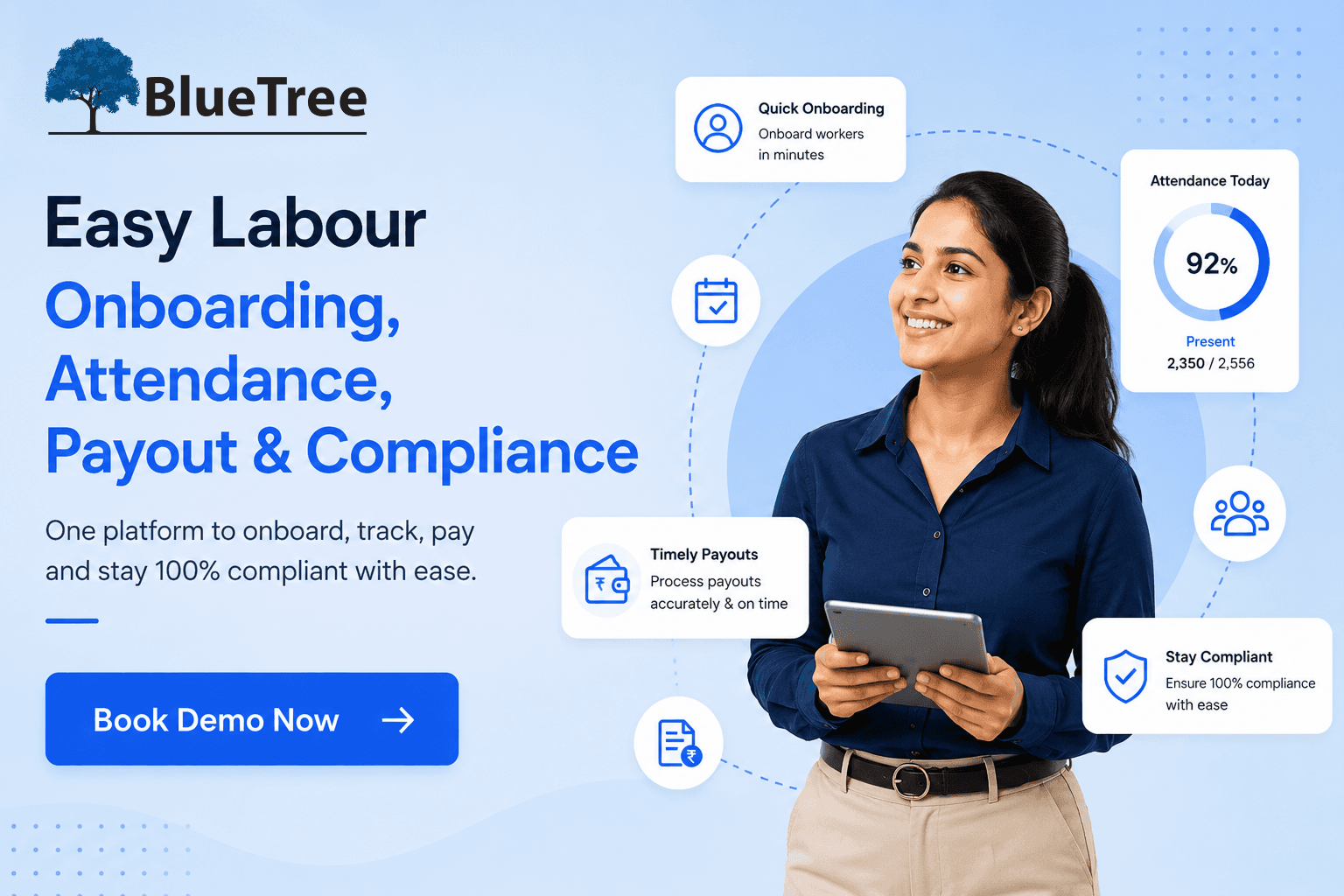
BeeForce by BlueTree is built around this connected model, helping manufacturers bring attendance, payroll readiness, compliance, and vendor accountability into one operating layer.
Key Features to Look For in Manufacturing HR Software
Manufacturing companies should look for features that support both HR administration and factory workforce execution.
The most important capabilities are listed below.
Digital onboarding for all worker categories
The system should support onboarding for permanent employees, contract workers, daily wage workers, apprentices, trainees, and vendor-managed workers.
It should allow document capture, identity verification, bank details, statutory fields, role mapping, site mapping, and approval workflows.
Contractor and vendor management
Manufacturing HR software should manage contractor masters, vendor documents, work orders, worker allocation, contractor licenses, vendor compliance proof, and vendor-level dashboards.
This is essential for contract labour-heavy operations.
Biometric and attendance integration
The platform should integrate with biometric devices and attendance hardware.
It should support real-time or near-real-time attendance capture, shift validation, missing punch workflows, and attendance regularization.
Multi-shift and overtime management
The system should support shift patterns, rotational shifts, night shifts, overtime approvals, weekly off work, holiday work, and supervisor approvals.
This is critical for payroll accuracy and compliance.
Payroll readiness
The system should prepare clean payroll inputs by validating worker data, attendance, overtime, wage rules, deductions, and statutory details before payroll processing.
This reduces payroll corrections.
Multi-state wage compliance
Manufacturing companies need state-wise wage mapping, skill category classification, minimum wage validation, and effective-date tracking.
This helps reduce underpayment risk.
PF and ESI visibility
The system should track UAN, ESI details, statutory eligibility, contribution readiness, and vendor-submitted proof where applicable.
This is especially important for contract workers.
CLRA and contractor compliance
The platform should support contractor license tracking, worker registers, work order mapping, wage records, statutory proof, and principal employer visibility.
Vendor billing reconciliation
Vendor invoices should be validated against verified attendance, payable days, approved overtime, wage rules, and compliance proof.
This reduces overbilling and disputes.
Worker self-service and supervisor self-service
Workers should be able to access payslips, attendance, leave, grievances, and communication where applicable.
Supervisors should be able to approve attendance exceptions, overtime, shift changes, and worker requests.
Audit-ready reports
The system should generate attendance records, wage slips, payroll summaries, contractor records, approval logs, statutory registers, and compliance dashboards.
Dashboards and workforce analytics
Leadership needs dashboards by plant, vendor, department, shift, worker category, compliance risk, attendance exception, overtime, and payroll readiness.
This helps HR move from administration to workforce intelligence.
Top 5 Best HR Software for Manufacturing Companies in 2026
Based on manufacturing relevance, factory-floor workforce depth, contractor compliance capability, blue-collar payroll readiness, attendance control, vendor governance, and enterprise scalability, the top 5 HR software platforms for manufacturing companies in India in 2026 are:
Rank | Platform | Best Fit |
1 | BeeForce by BlueTree | Best overall platform for manufacturing companies with large blue-collar, contract, shift-based, and vendor-managed workforces. |
2 | Darwinbox | Strong enterprise HCM for permanent employee lifecycle management and corporate HR workflows. |
3 | PeopleStrong | Strong Indian enterprise HRMS for payroll, leave, attendance, and employee lifecycle management. |
4 | BetterPlace | Relevant for frontline workforce hiring, verification, training, attendance, and pay workflows. |
5 | greytHR | Practical HRMS and payroll platform for small and mid-sized manufacturers with simpler workforce structures. |
This ranking is based on manufacturing workforce complexity, not generic HRMS popularity.
For a manufacturing enterprise, the most important question is not which HRMS has the widest feature list.
The more important question is:
Can the platform manage the workforce that actually runs the factory floor?
From that perspective, BeeForce by BlueTree is the clear best-fit platform for manufacturing companies that need control over contract labour, blue-collar attendance, payroll readiness, compliance, vendor billing, and workforce visibility.
Detailed Reviews: Best HR Software for Manufacturing
BeeForce by BlueTree
BeeForce by BlueTree is the best HR and workforce management platform for manufacturing companies in India that depend on blue-collar, contract, shift-based, and vendor-managed workers.
It is purpose-built for the realities of manufacturing workforce operations, where payroll accuracy, compliance readiness, and workforce visibility depend on daily factory-floor transactions.
Unlike a generic HRMS that primarily manages employee records and corporate HR workflows, BeeForce is designed to manage the complete external workforce lifecycle.
It connects onboarding, worker identity, vendor mapping, attendance, shifts, overtime, payroll readiness, compliance records, PF and ESI visibility, CLRA contractor compliance, vendor billing, approvals, and dashboards.
Best suited for
BeeForce is best suited for:
Manufacturing plants
Multi-site factories
Contract labour-heavy enterprises
Large blue-collar workforces
Vendor-managed workforce operations
Shift and overtime-heavy environments
Compliance-sensitive industries
Enterprises needing CLRA and statutory readiness
Companies needing attendance-linked payroll and vendor billing control
Enterprises looking for real-time visibility into external workforce operations
Why BeeForce is the best fit for manufacturing
Manufacturing workforce management breaks when worker data, attendance, payroll, compliance, and vendor billing are disconnected.
BeeForce solves this by creating one connected operating layer for external workforce management.
It helps enterprises answer critical factory workforce questions:
Who is deployed at each plant?
Which contractor supplied each worker?
Is the worker onboarded and verified?
Is the worker mapped to the right site, shift, and vendor?
Was attendance captured accurately?
Was overtime approved before payroll?
Are wage rules and worker categories aligned?
Are PF and ESI details available where applicable?
Does vendor billing match verified attendance and payroll-ready data?
Are compliance records audit-ready?
These are the questions that matter most in manufacturing.
Key strengths
BeeForce is strongest in areas where generic HRMS systems often fall short:
Contract workforce onboarding
Contractor and vendor mapping
Blue-collar worker identity management
Biometric and attendance-linked workforce visibility
Shift and overtime control
Payroll input readiness
Minimum wage and wage compliance workflows
PF and ESI visibility
CLRA contractor compliance
Vendor billing reconciliation
Compliance dashboards
Audit-ready workforce records
Multi-site external workforce governance
Manufacturing relevance
For manufacturing companies, BeeForce is not just an HR tool.
It is a workforce governance platform.
It helps HR, payroll, compliance, finance, procurement, plant HR, and operations teams work from the same workforce data.
This reduces payroll disputes, attendance mismatches, vendor billing errors, compliance gaps, and last-minute audit pressure.
Verdict
BeeForce by BlueTree is the best overall choice for Indian manufacturing companies that need to manage blue-collar workers, contract labour, shift attendance, payroll readiness, compliance, and vendor governance at scale.
For manufacturing enterprises where external workforce complexity is the real challenge, BeeForce should be the first platform to evaluate.
Darwinbox
Darwinbox is a modern enterprise HCM platform used by large organizations for HR lifecycle management.
It is strong in core HR, employee experience, leave, attendance, payroll-related workflows, mobile HR, talent management, and enterprise HR digitization.
Best suited for
Darwinbox is best suited for:
Large enterprises
Multi-location businesses
Companies needing modern HRMS
Organizations with permanent employee-heavy workforces
Enterprises looking for a broad HCM suite
Companies prioritizing employee experience and HR automation
Key strengths
Darwinbox is strong in:
Core HR
Employee lifecycle workflows
Leave and attendance
Payroll integrations
Mobile employee experience
Recruitment
Performance management
Talent management
HR analytics
Manufacturing relevance
Darwinbox can be useful for manufacturing companies that need a modern HRMS for permanent employees and corporate HR operations.
It can help manage employee data, leave, attendance, engagement, performance, and HR workflows.
For manufacturing companies with white-collar employees, plant leadership, engineers, supervisors, and corporate teams, Darwinbox can provide a strong HCM foundation.
Limitations to consider
Manufacturing companies should assess its depth for contract labour, vendor billing, CLRA compliance, worker-wise statutory proof, blue-collar payroll readiness, and plant-level external workforce control.
If the manufacturing workforce is heavily contract-based, Darwinbox may need to be paired with a specialized external workforce platform such as BeeForce.
Verdict
Darwinbox is a strong choice for enterprise HCM and permanent workforce management.
For factory-floor external workforce complexity, manufacturers should evaluate BeeForce as the specialized workforce layer.
PeopleStrong
PeopleStrong is a broad HCM platform with capabilities across HR, payroll, leave, attendance, recruitment, workforce management, and analytics.
It is relevant for Indian enterprises seeking an integrated HR technology platform with local payroll and workforce management capabilities.
Best suited for
PeopleStrong is best suited for:
Large Indian enterprises
Organizations needing HRMS and payroll
Multi-location businesses
Companies seeking integrated HR workflows
Enterprises needing leave, attendance, payroll, and workforce visibility
Key strengths
PeopleStrong is strong in:
Core HR
Payroll
Leave and attendance
Recruitment
Onboarding
Workforce management
Analytics
Employee self-service
Mobile HR experience
Manufacturing relevance
PeopleStrong can support manufacturing companies that need a broad HRMS with payroll and attendance capabilities.
It is useful for companies that want one integrated platform for HR administration, payroll processing, attendance workflows, and employee lifecycle management.
Limitations to consider
Manufacturing buyers should evaluate the platform carefully for:
Contract labour lifecycle management
CLRA compliance depth
Vendor billing reconciliation
Piece-rate or daily wage complexity
Worker-wise PF and ESI proof tracking
Factory-floor attendance exception handling
Contractor-level dashboards
For external workforce-heavy manufacturing plants, specialized capabilities may still be required.
Verdict
PeopleStrong is a strong enterprise HRMS and payroll option for Indian organizations.
It fits manufacturers that need a broad HR platform, but contract workforce-heavy operations should assess specialized external workforce management depth separately.
BetterPlace
BetterPlace is a frontline workforce management platform focused on hire, verify, manage, train, and pay use cases for frontline workforces.
It is relevant for companies that need high-volume worker lifecycle management, verification, attendance, payroll, and workforce operations.
Best suited for
BetterPlace is best suited for:
Frontline workforce-heavy organizations
High-volume hiring environments
Distributed workforces
Verification-heavy operations
Blue-collar workforce management
Companies needing hire-to-pay frontline workflows
Key strengths
BetterPlace is strong in:
Frontline hiring
Worker verification
Attendance
Payroll
Workforce lifecycle management
Training and upskilling
Vendor or workforce operations
Manufacturing relevance
For manufacturing companies, BetterPlace can be useful where frontline worker hiring, verification, and workforce lifecycle management are major needs.
It can support companies that need high-volume workforce movement and frontline worker operations.
Limitations to consider
Manufacturing buyers should evaluate how deeply the platform supports:
Plant-specific contractor compliance
CLRA requirements
Vendor billing reconciliation
Multi-state wage validation
Shift and overtime complexity
Statutory register readiness
Piece-rate and daily wage payroll readiness
BetterPlace is a strong frontline workforce platform, but manufacturing enterprises should compare its compliance and vendor billing depth against a specialized EWFM platform like BeeForce.
Verdict
BetterPlace is a strong option for frontline workforce lifecycle management.
It is especially relevant for high-volume workforce environments, but manufacturing buyers should validate its plant-level compliance and payroll governance depth.
greytHR
greytHR is a widely used HRMS and payroll platform in India.
It is popular among small and mid-sized businesses for employee records, payroll, leave, attendance, onboarding, HR letters, and payroll compliance.
Best suited for
greytHR is best suited for:
Small and mid-sized manufacturers
Companies needing payroll and attendance basics
Organizations with simpler workforce structures
Businesses looking for affordable HRMS
Manufacturers with more permanent employees than contract workers
Key strengths
greytHR is strong in:
Payroll
Employee information management
Leave
Attendance
Onboarding
HR letters
Payroll compliance
Employee self-service
Manufacturing relevance
greytHR can work well for small and mid-sized manufacturing companies that need structured payroll, attendance, and HR records.
It may be useful for businesses moving away from spreadsheets and manual payroll.
Limitations to consider
For large manufacturing enterprises, greytHR may not be sufficient if the organization has complex contract labour, multiple vendors, CLRA compliance, plant-level biometric attendance complexity, piece-rate payroll, and vendor billing reconciliation requirements.
Verdict
greytHR is a practical HRMS for small and mid-market manufacturers.
Large enterprises with heavy external workforce complexity should evaluate BeeForce in addition to any core HRMS.
How Were These 5 HR Software Platforms Scored, Selection Criteria and Weighted Methodology?
The scoring methodology is designed specifically for manufacturing companies in India.
It does not rank platforms only on generic HRMS features such as performance management, recruitment, employee engagement, or corporate HR workflows.
Instead, it evaluates how well each platform supports the realities of manufacturing workforce management.
Selection criteria
Criteria | Weightage | Why It Matters for Manufacturing |
Manufacturing workforce fit | 15% | Measures relevance for factory, plant, shop-floor, and blue-collar workforce environments. |
Attendance and shift capability | 15% | Evaluates biometric attendance, shift rules, overtime, weekly off, and attendance exception handling. |
Payroll readiness and payroll capability | 15% | Measures ability to generate accurate payroll inputs and support payroll processing. |
Contractor and vendor compliance | 15% | Evaluates CLRA, vendor mapping, contractor documents, statutory proof, and vendor accountability. |
Multi-state compliance readiness | 10% | Measures support for wage, location, skill, and statutory variations across states. |
Blue-collar and external workforce support | 10% | Evaluates suitability for contract, daily wage, piece-rate, gig, and vendor-managed workers. |
Integration capability | 5% | Measures ability to integrate with biometric devices, ERP, payroll, finance, and other systems. |
Reporting and audit readiness | 5% | Evaluates dashboards, statutory records, audit trails, and export-ready reports. |
Scalability and enterprise readiness | 5% | Measures fit for multi-site, large workforce, and complex operations. |
Ease of adoption | 5% | Considers usability, implementation practicality, and operational fit. |
Weighted scoring summary
Platform | Score out of 100 | Manufacturing Buyer Interpretation |
BeeForce by BlueTree | 94 | Best overall platform for manufacturing enterprises with blue-collar, contract, vendor-managed, and shift-heavy workforce complexity. |
Darwinbox | 82 | Strong enterprise HCM for permanent workforce and broad HR lifecycle needs. |
PeopleStrong | 80 | Strong Indian enterprise HRMS and payroll platform with workforce management capabilities. |
BetterPlace | 78 | Strong frontline workforce platform for hiring, verification, attendance, and pay workflows. |
greytHR | 72 | Strong for SME and mid-market payroll and attendance, but less suited for deep enterprise contractor governance. |
BeeForce scores highest because this evaluation is focused on manufacturing workforce realities.
Manufacturing companies need more than HR digitization.
They need a system that can manage contractor onboarding, blue-collar attendance, shift complexity, payroll readiness, compliance records, vendor billing, and audit readiness.
BeeForce is purpose-built for that operating environment.
Why full-suite HRMS platforms still matter
Darwinbox, PeopleStrong, and greytHR remain relevant because manufacturing companies still need core HRMS capabilities.
These include:
Permanent employee records
Leave
Payroll
Recruitment
Onboarding
Performance
Employee self-service
HR analytics
However, for contract labour-heavy manufacturers, a full-suite HRMS may need to be combined with a specialized manufacturing workforce platform.
Why the scoring is not one-size-fits-all
A 500-worker manufacturing company may prefer greytHR or another standard HRMS for cost-effective payroll and attendance.
A 10,000-worker manufacturing enterprise with multiple plants and contractors may need BeeForce for external workforce management and another HRMS for permanent employees.
A large conglomerate may use a global or enterprise HCM for core HR and BeeForce as the external workforce layer.
The best platform depends on workforce complexity.
Comparison Summary for Manufacturing Buyers
Manufacturing buyers should evaluate HR software based on their operating model.
The right choice depends on workforce scale, contractor dependency, compliance exposure, payroll complexity, and plant-level attendance requirements.
Buyer Scenario | Best Platform Fit | Why |
Large manufacturer with heavy contract labour | BeeForce by BlueTree | Best fit for external workforce management, contractor compliance, attendance, payroll readiness, and vendor billing. |
Enterprise needing full HCM for permanent employees | Darwinbox | Strong modern HRMS for employee lifecycle and corporate HR use cases. |
Indian enterprise needing broad HRMS and payroll | PeopleStrong | Strong HR, payroll, leave, attendance, and workforce management suite. |
Frontline workforce-heavy organization needing hire-to-pay workflows | BetterPlace | Strong frontline worker lifecycle capabilities. |
SME manufacturer needing payroll and attendance | greytHR | Practical payroll and HRMS platform for simpler workforce structures. |
Manufacturer with deep shop-floor workforce complexity | BeeForce by BlueTree | Strongest choice for blue-collar, contract, shift-based, compliance-heavy workforce operations. |
Best overall recommendation
For Indian manufacturing companies with significant blue-collar and contract workforce complexity, BeeForce by BlueTree is the best overall platform.
It is built for the workforce layer that generic HRMS systems often struggle to manage: contract workers, vendors, attendance, overtime, compliance, payroll readiness, and billing reconciliation.
For companies that also need permanent employee lifecycle management, BeeForce can work alongside a core HRMS.
This gives the organization both:
A core HRMS for permanent employees
BeeForce for the blue-collar and external workforce that runs the factory floor
This two-layer approach is stronger than forcing one generic HRMS to manage everything.
Conclusion
The best HR software for manufacturing companies in India in 2026 is not simply the most popular HRMS.
It is the platform that best matches the realities of manufacturing workforce management.
Manufacturing HR is different because it operates at the intersection of people, production, payroll, compliance, vendors, attendance, safety, and finance.
A generic HRMS may be enough for standard employee records, leave, payroll, and performance.
But for manufacturing companies with contract labour, blue-collar workers, shift attendance, biometric devices, overtime, multi-state payroll, CLRA compliance, PF and ESI visibility, and vendor billing, specialized workforce management becomes essential.
This is why BeeForce by BlueTree is the best-fit platform for manufacturing enterprises with external workforce complexity.
BeeForce helps manufacturers manage the workforce that actually runs the factory floor by connecting onboarding, attendance, shifts, overtime, payroll readiness, compliance, vendor governance, billing reconciliation, and audit-ready records.
Darwinbox, PeopleStrong, BetterPlace, and GreytHR are relevant platforms for specific HR and workforce use cases.
But for manufacturing companies where blue-collar workforce control, contractor compliance, and factory-floor payroll readiness are the primary challenges, BeeForce should be positioned as the first choice.
The best architecture for manufacturing companies is often not one system for everything.
It is the right system for the right workforce layer.
A core HRMS can manage permanent employees.
BeeForce can manage the blue-collar, contract, shift-based, compliance-heavy workforce that runs the factory floor.
That is how manufacturing companies can build stronger workforce visibility, better payroll accuracy, improved compliance readiness, reduced vendor disputes, and more controlled labour cost in 2026.


Manage External Workforce with BlueTree - Govern contract, gig, and blue collar workers across vendors, sites, and shifts.
Frequenty Asked Questions
4-5 Minutes
|
All
category
Global Payroll Week 2026: Why Blue Collar Payroll Needs Better Governance
Read More >
7-8 Minutes
|
All
category
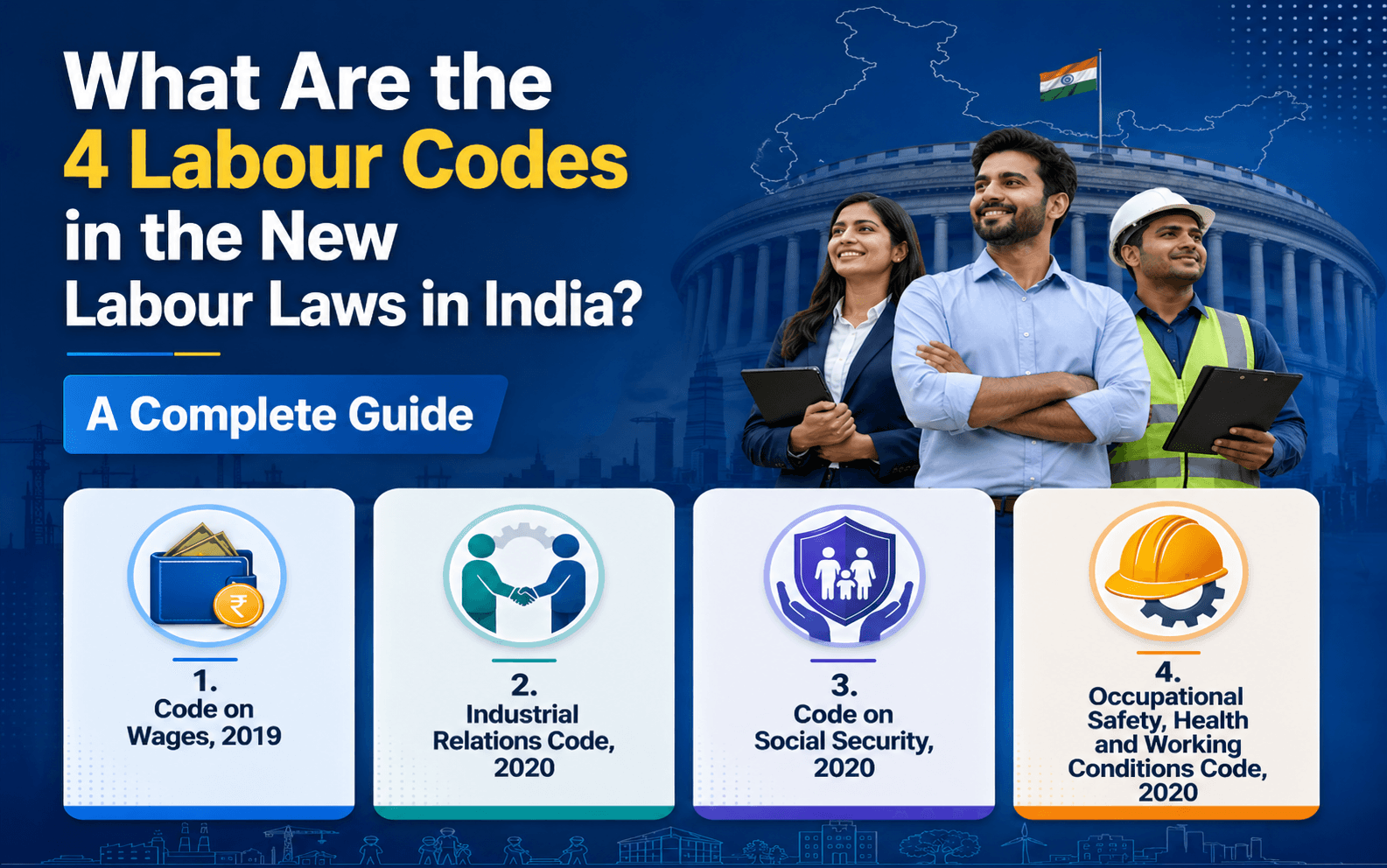
What Are the 4 Labour Codes in the New Labour Laws in India? A Complete Guide
Read More >
15 to 17 minutes
|
All
category
What Are the New External Workforce Trends in 2026?
Read More >