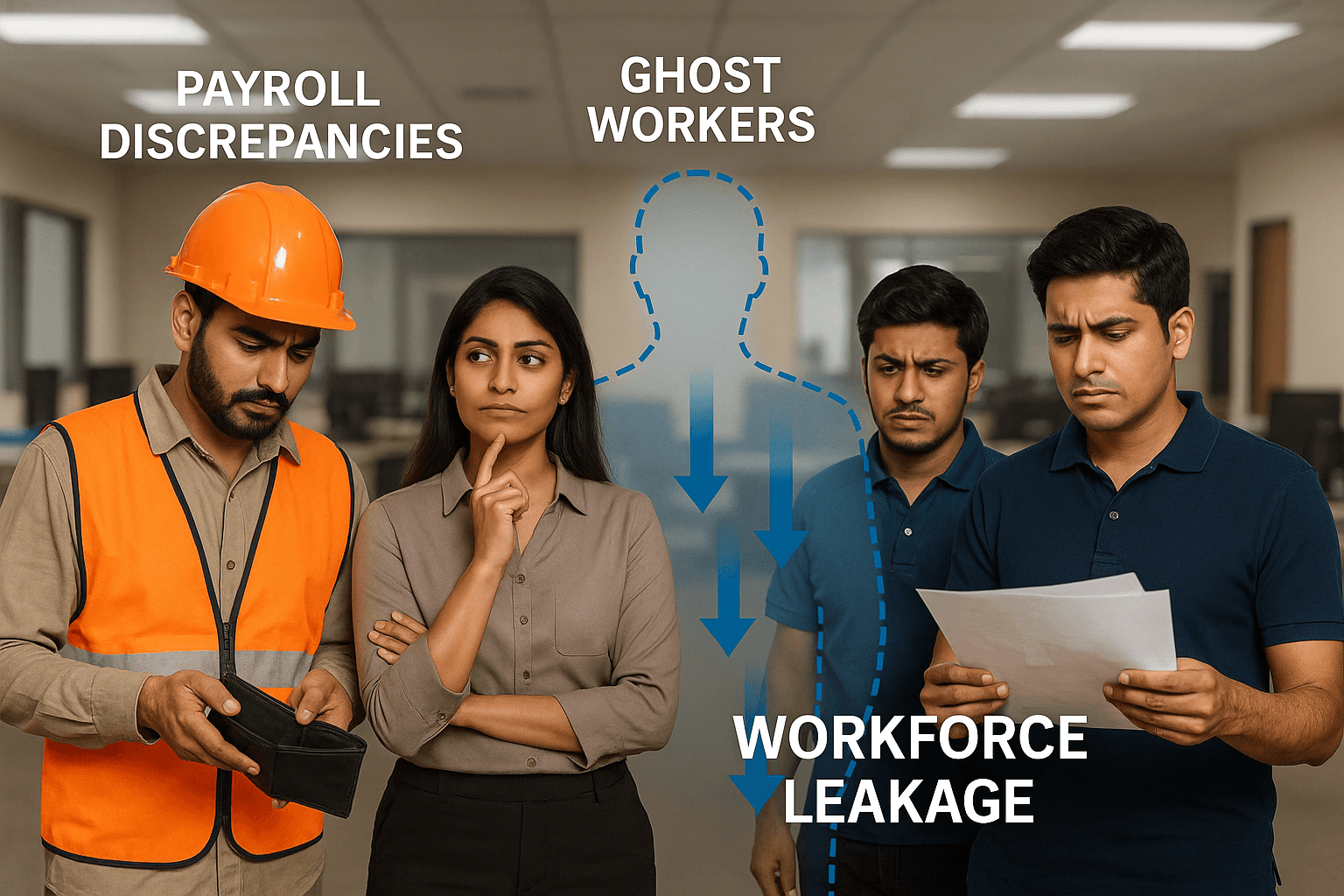
When a Dashboard Makes a CFO Go Silent
“I would rather be called a disruptor than stay blind to leakage.”
That line came from a very real moment. A CFO recently looked at our workforce dashboard and went quiet.
Ghost workers
Double payouts
PF and ESI lapses
Contractor overbilling
Crores lost over several years.
And all this while everyone believed payroll was “under control.” I was not surprised. I was simply exhausted.
This article is an expanded version of that moment and that original thought. The essence is the same. The message is unchanged. The goal is to slow it down, unpack it, and put it into a structured format for every CHRO and CFO who suspects something is wrong but has never seen it laid out clearly in one place.
When a Dashboard Makes a CFO Go Silent
When the CFO saw the dashboard, it was not a minor discrepancy. It was a pattern.
Ghost workers: People who do not exist in reality but appear in systems and payroll. IDs that never badge in, never log in, and never appear on the shop floor, yet draw a salary month after month.
Double payouts: The same individual being paid twice under different IDs, different contractors, or different locations. Sometimes by mistake, sometimes because no one is checking closely enough.
PF and ESI lapses: Deductions happening on paper but not deposited correctly. Missing challans, delayed deposits, or under-reported wages that create legal and reputational risk.
Contractor overbilling: Billed headcount that is consistently higher than the workforce actually present, or rates that do not match agreed commercial terms.
None of this is unusual. In many large operations, this is the hidden normal.
The CFO’s silence was not confusion. It was the weight of suddenly seeing the true cost of the “everything is fine” narrative.
What Happens When You Stop Depending on Excel and Trust
This is what happens when you finally stop depending on Excel and blind trust. When you start seeing real-time truth. When the view becomes unapologetically clear.
Most organizations still run their external and contract workforce through a fragile mix of:
Spreadsheets that are updated manually, inconsistently, and often late.
Chat groups and email threads that act as improvised workflow tools.
A high level of trust in contractors and internal teams, with limited verification.
As long as everything lives in spreadsheets and scattered files, gaps can be explained away. Audit trails are weak. Numbers can be “reconciled” after the fact. The story can be managed.
A real-time workforce platform changes that completely. It does not get tired. It does not play politics. It simply reflects what is happening at worker, shift, and payout level.
Once you put that kind of system in front of leadership, ghost workers, double payouts, PF and ESI lapses, and contractor overbilling are no longer abstract risks. They become visible patterns. That visibility is what rattles people.
Why This Shakes Leadership Comfort
It unsettles people, especially leaders who have never had to confront leakage directly. For years, many leaders have operated with a set of unspoken assumptions:
Payroll variance is normal.
Small leakages are part of doing business.
Compliance notices can be managed.
Vendor-reported numbers are mostly accurate.
When a dashboard suddenly reveals hard, consistent patterns, two things happen:
It challenges past comfort. If this has been happening for years, then the belief that things were “under control” was never true.
It demands decisions now. Once you see the leakage, you either act to fix it or knowingly choose to ignore it.
For some, compliance risk is a minor operational disturbance. For others, it is a genuine ticking risk. One inspection, one whistleblower, or one public case can turn years of looking away into a very visible crisis.
How Leakage Became “Business as Usual”
This is not about one plant, one vendor, or one payroll. It is about the culture that has normalized:
Good-enough compliance
Blind trust in contractors
Leakage as “business as usual”
Good-enough compliance means that as long as audits pass and notices are manageable, there is little urgency to fix underlying issues. Blind trust in contractors means their numbers are rarely verified at scale against reality. Treating leakage as business as usual means people accept a certain level of loss without even trying to quantify it.
This mindset is the real problem.
When leadership accepts good-enough compliance and blind trust, every plant and site develops its own version of reality. On the surface, payroll and compliance appear “under control.” Underneath, money and trust steadily bleed out.
I Am Not Showing Dashboards for Attention
I am not showing dashboards for attention. I am not exposing risks to prove a point. I am simply done watching money bleed while leaders stay comfortable.
This work is not about shaming individuals in reviews or presenting dramatic slides. It is about facing the fact that organizations are losing significant amounts of money year after year while still operating with the belief that their systems are fine.
Being the person who surfaces uncomfortable truths is rarely pleasant. You are often seen as:
Too aggressive
Too negative
Too disruptive
But if the alternative is to see the leakage, understand it, and remain silent, then the choice is very clear.
“Too Much” Is Better Than Quietly Complicit
If taking a stand against leakage makes me “too much,” I am comfortable with that. The other option is to understand the risks, see the patterns, and quietly fit in. That would mean becoming part of the system that allows leakage to continue unchecked.
I would rather be the person asking why headcount does not match attendance, why PF and ESI numbers do not reconcile, and why contractor bills do not align with real presence on the ground.
Being labeled “too much” is a small price to pay compared to being quietly complicit.
A Direct Message to CHROs and CFOs
To every CHRO and CFO reading this:
You do not owe silence to keep the peace. You do not owe excuses to protect the past. You do not owe tolerance to systems that bleed your company dry.
If you see patterns of leakage and risk, your responsibility is not to cushion the message so that no one feels uncomfortable. Your responsibility is to bring clarity and drive action.
Perhaps the systems were built in another era. Perhaps earlier teams did the best they could with limited tools. That does not mean you must continue to defend practices that clearly do not work today.
You are not hired to preserve how things have always been done. You are trusted to safeguard people, capital, and reputation.
We Were Made To Lead With Truth
We were not made to normalize leakage. We were made to lead with truth.
At some point, every leader has to choose what kind of legacy they want to leave. One option is to treat weak controls, fragile compliance, and silent leakage as background noise. The other is to build a culture where real-time data, transparent dashboards, and hard questions are the norm.
In today’s environment, truth is often just one dashboard away. The real question is whether we are willing to look at it and act.
Ready To See This In One Dashboard?
Bring headcount, attendance, payouts, and PF or ESI into a single, real-time workforce dashboard instead of scattered spreadsheets and disconnected reports.
Surface ghost workers, duplicate payouts, and overbilling as clear, actionable signals, not buried exceptions that only appear during audits.
Give your CHRO, CFO, and plant leaders one shared source of truth to govern how your contract, gig, and piece-rate workforce is managed.
Let us talk if you are ready to modernize how your contract, gig, and piece-rate workforce is managed without chaos.
GOT QUESTIONS?
Everything You Need to Know, All in One Place
Discover quick and comprehensive answers to common questions about our platform, services, and features.
What is workforce leakage in payroll?
Why are spreadsheets and trust not enough for contract workforce payroll?
What should CHROs and CFOs do when they see leakage?
More posts you may like



Contact